How to buy used power tools: stolen-tool checks, battery health and fair prices
Quick answer
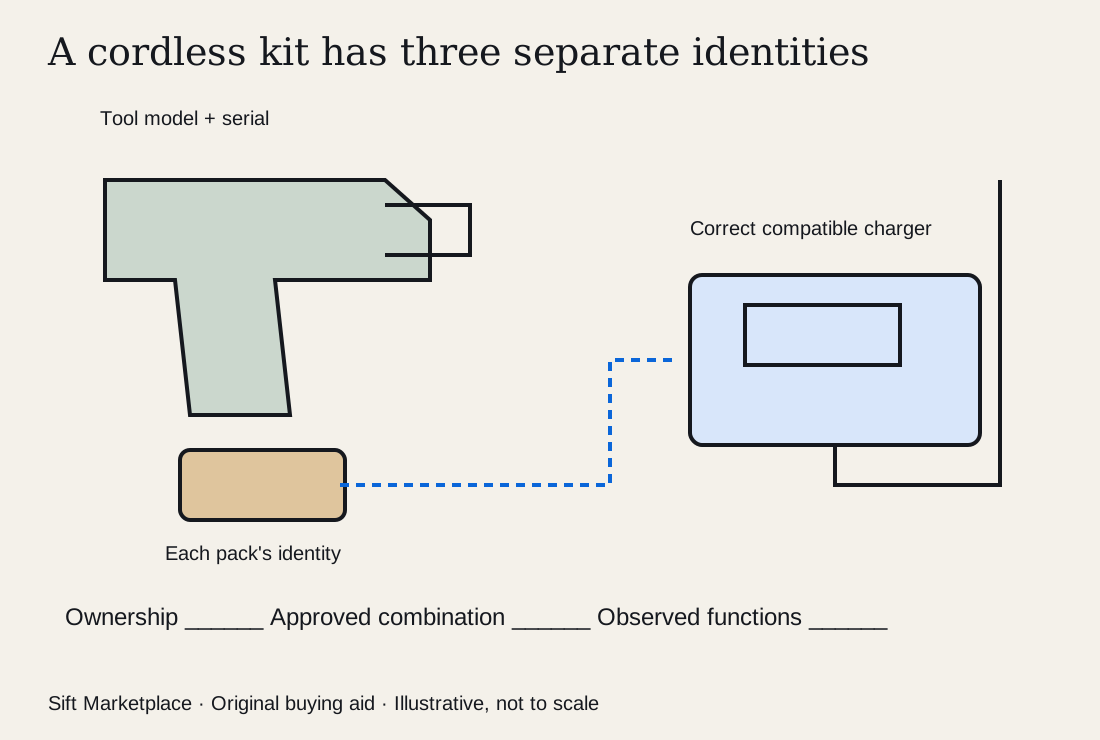
Ask for ownership and service history, identify the exact tool, each battery and charger, and confirm approved compatibility. Arrange ordinary operation using the manual and resolve connected-tool handover where applicable. A gauge, brief run or clean casing does not establish remaining battery life or internal condition.
Could the tools be stolen?
Ask where the tools came from and request credible ownership evidence. Compare model/serial markings with receipts or service records where available. Altered identifiers, unexplained company marks or inconsistent history warrant clarification before payment; one listing characteristic alone does not prove theft.
Do not remove another owner’s markings or treat a low price as compensation for unresolved ownership. Use the appropriate manufacturer or local authority route if a tool is reported stolen or its identity is suspicious. A clear explanation and intact serial are useful evidence, not a universal guarantee.
 Enlarge diagram
Locked tools: Milwaukee ONE-KEY and DeWalt Tool Connect
Check the actual model’s connected features and official transfer/inventory process. Milwaukee’s ONE-KEY lockout guidance explains that supported tools can be locked. Its received-stolen-tool guidance supplies the appropriate support route.
Ask the seller to resolve ownership and any required account/inventory steps through the maker before completing the sale. A tool running briefly is not a guarantee that all connected-management questions have been settled. Do not try to bypass a lock or accept credentials belonging to an employer or previous owner.
How to test a used cordless battery
Record each pack’s exact identity, platform and label, then confirm that it and the charger are approved for the intended tool through their actual documentation. A similar slot or voltage number is not sufficient. Inspect accessible casing and contacts without opening the pack; do not use damaged, swollen, leaking or modified packs.
Have the seller demonstrate ordinary permitted operation and charging with the correct equipment. Record unexpected shutdowns, fault indications or damage for manufacturer-guided assessment. A fuel gauge and a brief run do not measure remaining capacity or future life. Do not deliberately overheat, deeply discharge or work a pack hard as a buying test.
Fake batteries
Compare labels and provenance with the maker’s current guidance and authorized supply information. A good-looking label cannot authenticate a pack by itself. If identity or condition cannot be established, choose another purchase route rather than relying on a list of cosmetic tells. Unidentified third-party or rebuilt packs should not silently receive the value of a verified approved battery.
How to test the tool itself
Identify the exact model and manual, required accessories, guards, controls and approved supply. With power disconnected appropriately, inspect accessible casing, cord/plug where fitted, attachment points and visible safety features. Leave missing guards, damaged wiring and uncertain modifications unresolved until assessed and repaired appropriately.
Ask the seller to demonstrate normal operation suitable for the tool and setting. Record erratic speed, unexpected movement, noise, smoke or shutdowns without diagnosing the internal repair. Stop for concerning behavior. Do not improvise a heavy-load test, defeat a guard or open energized equipment. Use qualified service assessment when a fault determines the deal.
Warranty on used tools
Check the actual regional product terms with the manufacturer using model, serial and purchase evidence. Do not assume coverage transfers or that an original box establishes eligibility. Assign warranty value only when the applicable terms and evidence support it; otherwise compare the tool as an unsupported private purchase.
What to pay
Make separate rows for bare tool, each verified compatible pack, charger, essential accessories, confirmed service and collection. Compare a supported complete alternative rather than subtracting an arbitrary amount for an unknown fault.
| Part | Record |
|---|---|
| Tool | Identity, ownership, normal functions and unresolved concerns |
| Each battery | Exact identity, approved compatibility and observed condition |
| Charger | Correct model, normal charging evidence and damage |
| Accessories | Essential pieces actually included and approved replacements |
In a hypothetical comparison, a $90 bare tool needs a $75 verified compatible pack, $40 charger and $30 confirmed service: $235. A suitable complete kit at $200 plus $15 collection totals $215. Unknown battery capacity remains unknown; it is not a measured discount. Use actual quotes in the cost calculator.
How to find used tools on Facebook Marketplace
Search exact model numbers as well as ordinary tool names and platform terms. Ask: “Could you send model/serial labels for the tool, each battery and charger, ownership/service history and included accessories? Can we observe ordinary permitted operation and resolve any connected-tool handover?” Keep the record in the listing comparison tool.
Filtering tool listings with Sift
Sift can filter unwanted terms such as “battery only” or “for parts,” focus nearby candidates and show recorded asking-price changes while you browse Facebook Marketplace and Kijiji. Use the focused drill press, planer or welder guides when that product needs its own purchase plan. Search organization does not establish ownership or equipment condition.
Questions people ask
Can a short run prove battery health?
No. It shows only that operation under those conditions was possible. Remaining capacity and life need more evidence; keep uncertain packs separate in the valuation.
What should I do with a locked connected tool?
Use the manufacturer’s official ownership/support process before purchase. Do not bypass a lock or accept another person’s credentials.
Does a low price prove a tool is stolen?
No. Ask for credible ownership and inspect identifiers. Resolve inconsistent or suspicious history through the appropriate maker or authority route.
Sources
- 01Milwaukee ONE-KEY Tool lockout
- 02Milwaukee ONE-KEY Received stolen tools
- 03CPSC Recalls