How do you buy a used drill press for the work you intend to do?
Quick answer
Identify the exact drill press and its documented capacity, speeds and supply. Measure the clearance needed for your workpiece, tooling and holding fixture. Inspect externally and observe an ordinary properly secured task by a competent operator. A spinning chuck does not establish machining accuracy, and unexplained wobble needs assessment rather than a guessed bearing repair.
Fit the workpiece, tool and fixture together
Write down the materials, hole sizes and workpiece shapes you intend to drill. Then compare the exact model’s documented capacity and speed arrangement. A large-looking machine does not automatically provide the low speed, reach or workholding space your task needs.
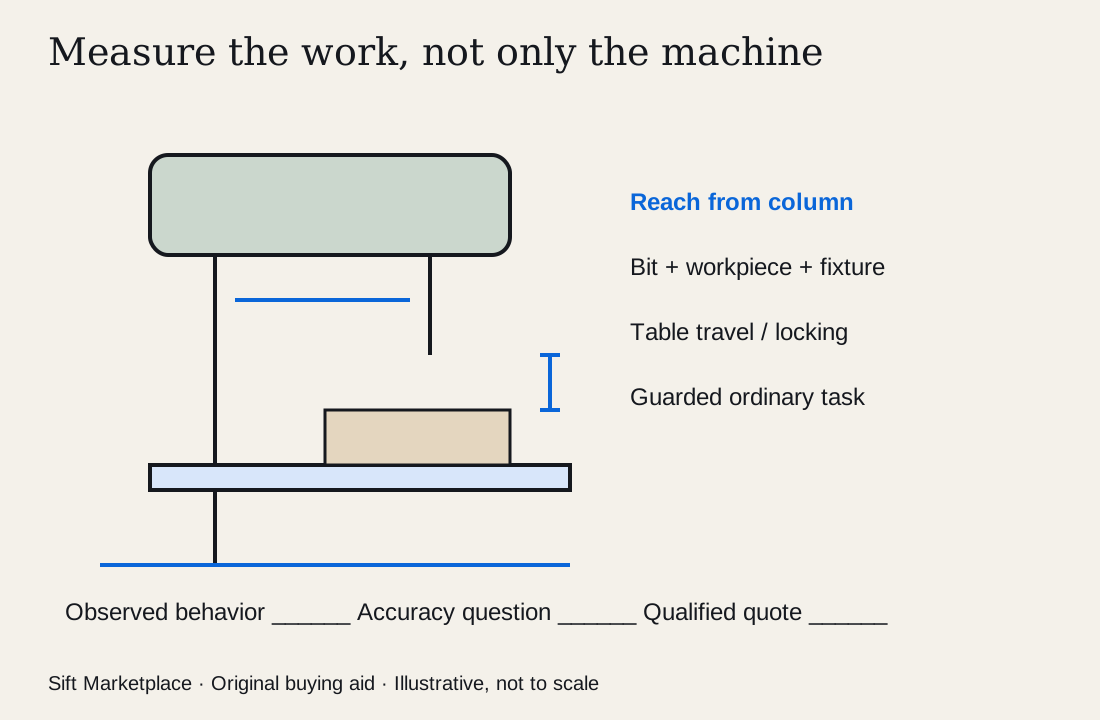
Measure the distance from chuck to table with the relevant tooling and holding fixture allowed for, and the reach from the column to the drilling position. Include the bench or floor footprint and room to support longer work. The Grizzly G7943/G7944 manual is an example of model-specific capacities, controls and workpiece precautions; use the correct document for the actual manufacturing range.
 Enlarge diagram
Identify the machine and complete equipment
Request the model/serial plate, power label, full machine, table, chuck and guarded drive area. Inventory the correct chuck, key if required, handles, depth stop, table locks and covers. Ask about repairs, electrical changes and missing safety parts.
Grizzly’s G7943 parts listing distinguishes documentation and parts by manufacturing period. Do not buy a replacement chuck or cover solely because the broad model name looks right. Confirm exact fit, availability and service labor before offering.
For a machine with altered wiring or a supply different from your workshop, get qualified advice and cost before purchase. Do not assume a different plug resolves the electrical requirement.
Inspect with power isolated
Follow the manual’s safe state for ordinary inspection. Look at the base, column, table, mounting areas and accessible fasteners. Note cracks, damaged slots, heavy corrosion, obvious distortion and repairs. Operate permitted table adjustments and locks normally; do not use excessive force to disguise stiffness.
Check the quill’s ordinary travel and return with the machine isolated as instructed. Look at chuck condition and ask the seller to demonstrate correct tool retention. Do not open a powered belt cover, improvise a runout measurement near rotating tooling or declare a universal acceptable wobble tolerance.
A suspected accuracy issue needs suitable measurement and competent interpretation for your intended work. Visible motion can have several causes; naming a bearing from a video is not a service diagnosis.
Observe a secured ordinary drilling task
Agree on a competent operator, correct tooling, suitable material and proper workholding. A workpiece held casually by hand is not an acceptable demonstration. Keep guards in place and follow the model’s operating instructions.
Record startup, controls, feed, return, table stability and the result of the ordinary task. If only an unloaded spin is available, record that limit. It does not show how the machine behaves while drilling or prove precision over its whole working range.
| Finding | Response |
|---|---|
| Correct capacity and normal secured task observed | Continue to complete-cost comparison |
| Missing approved chuck key or handle | Confirm exact replacement and price |
| Table lock or quill return behaves unexpectedly | Obtain assessment before use |
| Unexplained runout or vibration | Seek competent measurement/repair quote or pass |
| Missing drive cover or altered control | Resolve the safe configuration before demonstration |
Add workholding and moving to the price
In a hypothetical comparison, a $200 drill press needs a $45 correct chuck/key assembly, $60 suitable fixture and $75 transport: $380. A complete alternative at $290 plus the same $60 fixture and $30 collection also totals $380. These invented figures show why accessories and loading matter.
Do not give a random vise value until its condition, mounting and suitability are established. Plan the machine’s weight and high centre of gravity with appropriate handling help and the manufacturer’s transport guidance. A benchtop label does not mean it is a one-person carry.
Ask for the exact identity, repair history, missing parts and a secured demonstration before travelling. Use the cost calculator for confirmed costs, and the used-power-tool guide for broader ownership checks. Buy the capacity and condition you can establish; negotiate specific omissions, not an unknown accuracy problem.
Sources
- 01Grizzly G7943/G7944 owner manual
- 02Grizzly G7943 parts