What makes a used woodworking workbench worth buying?
Quick answer
Choose a bench that supports your intended work at a usable height, with sound joints and a suitable workholding system. Inspect the top and underside, try the vises normally and verify the parts needed for transport and reassembly. Cosmetic tool marks differ from structural movement; an unknown repair is not automatically a cheap restoration.
Start with the work you need to hold
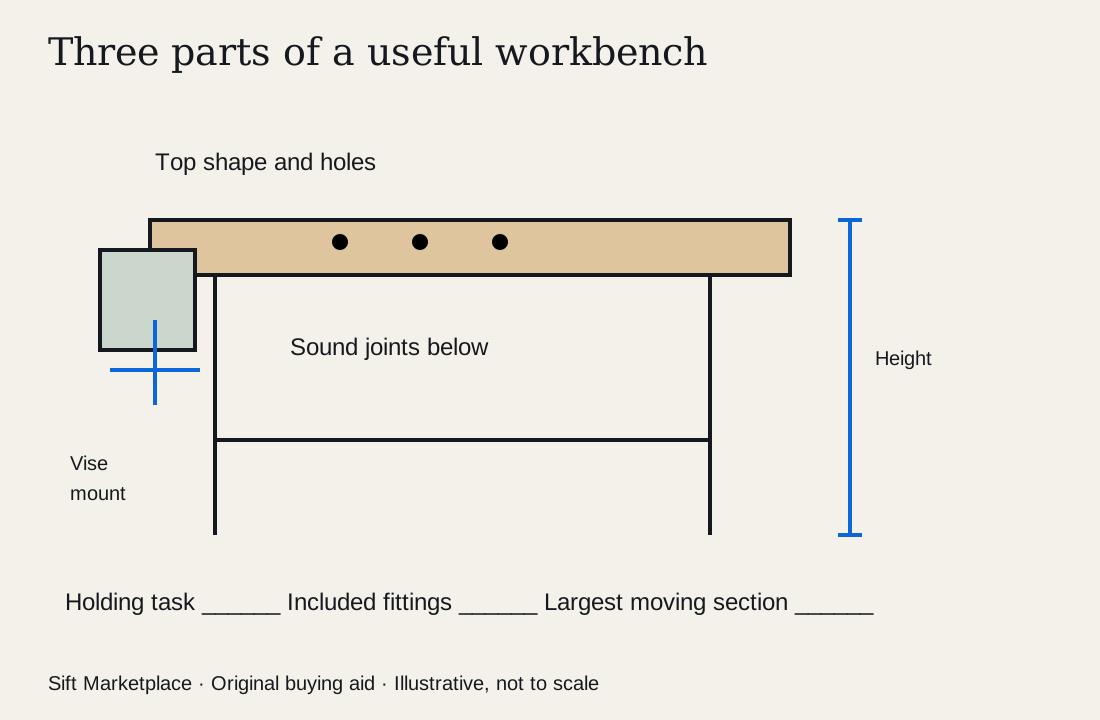
A heavy bench can still be awkward for your work. List two or three real jobs: planing a board edge, holding a small cabinet part, assembling a frame or carving. For each, record the height, clear surface and holding arrangement you need. A seller’s claim that the bench is “professional” does not answer those questions.
Measure overall length including vise handles, depth including any rear trough, and top height. Allow space to stand and move around the work. Check whether a wall, radiator or nearby machine would block a vise handle or long board. If the bench has cupboards, open doors and drawers in the proposed location on your plan.
 Enlarge diagram
Separate a documented bench from a handmade one
For a commercial model, obtain the maker, model and approximate generation. Sjöbergs’ download centre separates assembly instructions and maintenance guidance by bench family. Use the actual drawing to count stretchers, bolts, braces, vises and accessories. The Elite assembly drawing is one example, not a parts list for every wooden bench.
For a handmade bench, ask what timber and joinery were used, whether the top is laminated, how it attaches to the base and whether it has been moved before. Treat undocumented load claims as unknown. You can judge whether its visible construction and ordinary behavior suit your task without inventing a manufacturer rating.
Ask which accessories are actually included. Dogs, holdfasts, removable jaws, cabinet inserts and a vise pictured in an old workshop photo may be excluded. Measure hole diameter and top thickness when accessory compatibility matters; a similar-looking peg is not enough.
Inspect the working surface and the structure separately
Look across the top in good light, then underneath with the seller’s permission. Note stains, gouges, splits, lifted laminations, old holes and repairs. Use a straightedge appropriate to your intended work to understand the surface, without imposing an invented universal flatness tolerance. An assembly bench and a precision reference surface are different purchases.
Find out whether visible twist is in the top, the base or an uneven floor. Do not accept “it only needs flattening” as a diagnosis. Removing material can affect top thickness, vise alignment and accessories; obtain advice or a quote if that work is central to the deal.
Observe ordinary modest hand pressure in a safe, unloaded state. Watch joints and the base rather than merely whether the whole bench slides. Movement at a joint, a split through a leg or an altered fixing needs explanation. Do not climb onto the bench or use a load test to establish capacity.
Operate each vise through its normal travel. Check that it opens, closes and holds a suitable scrap using normal force. Inspect accessible jaws, guide surfaces, handle and mounting. Binding, damaged threads or a jaw that lifts unexpectedly is a service question. A fresh coat of finish does not answer it.
Make the viewing produce a decision
| Finding | Buying consequence |
|---|---|
| Tool marks, sound structure and suitable holding | Cosmetic preference and price discussion |
| Missing compatible dogs or jaw pads | Confirm the exact replacements and delivered cost |
| Top shape unsuitable for your assembly task | Price skilled correction before offering |
| Movement at joints or a damaged vise mounting | Resolve structural condition or pass |
| Excellent bench that cannot reach the workshop | Stop until a viable move is quoted |
For a hypothetical comparison, Bench A is $220 with $70 of confirmed vise parts and $110 delivery: $400. Bench B is $330 with the holding equipment you need and $50 delivery: $380. If A also needs uncertain top work, its lower listing price is not a saving you can establish. These are example figures, not market prices.
Agree on collection before dismantling
Measure the largest piece that will remain after permitted disassembly, the route’s narrowest opening and the stair turns. Ask whether the top lifts off using the documented method or whether joints are glued. Do not assume every wooden bench flat-packs.
Agree who dismantles it, photographs the joints and labels the hardware, and who is responsible for loading. Do not remove structural parts simply to discover whether it fits. Get suitable help for the actual weight and awkward shape. Compare the complete buying cost, including delivery and confirmed parts, before paying.
A useful seller message is: “Could you send the underside and both vise mountings, the overall dimensions including handles, and a list of included dogs and hardware? I need to know the largest transport section and whether I can see ordinary workholding at the viewing.” Buy a bench that holds your work and reaches your space without relying on an unpriced rebuild.
Sources
- 01Sjöbergs Download Center
- 02Sjöbergs Elite 1500/2000 assembly