How do you inspect a used benchtop thickness planer?
Quick answer
Identify the exact model and cutter version, then match its permitted stock and supply requirements to your work. Inventory guards, controls, tables and dust equipment. Observe a competent operator using suitable stock under the manual. One good board is useful evidence, but it does not certify every feed setting, knife condition or future reliability.
Confirm that a thickness planer solves your task
Write down your intended stock width, thickness, material and ordinary board length. Compare the model’s permitted stock and cut requirements, including its minimums. Do not invent a small test-piece size or treat a planer as a universal way to straighten any warped board.
Record the exact model/type and whether the cutter is original or modified. DEWALT’s DW735 page identifies a specific knife system, feed options and included parts; a used machine may no longer have that configuration. A claimed upgraded cutter requires its own identity, documentation and installation history.
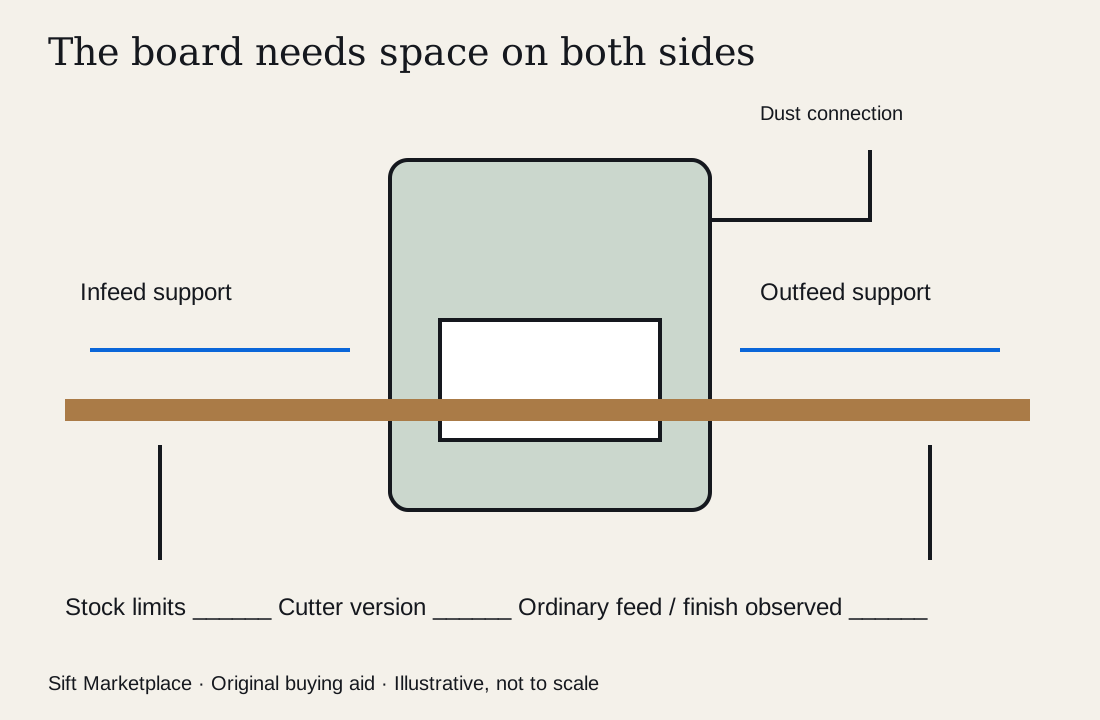
Measure the machine footprint plus the infeed and outfeed space for your intended stock. Plan stable support and a suitable power supply. The machine fitting on a shelf does not mean the workshop can accommodate its normal use.
 Enlarge diagram
Inventory controls, tables and collection parts
Request label and all-side photos, height controls, tables or extensions, covers and the dust outlet. Confirm which stands, adapters and accessories are included. Ask about knife changes, feed problems, repairs and stock that may have contained hidden metal.
Use the DW735 Type 1 manual only for that exact version, or obtain the corresponding manual for another machine. Verify compatible knives or inserts, collection adapters and any missing guards before pricing the offer.
Inspect only permitted accessible areas with power isolated. Look for damaged tables, missing fasteners, cracked housings, obvious corrosion and altered controls. Do not expose the cutter during operation or reach into the feed path. A sharp-looking knife edge in a photograph does not establish alignment or service life.
Agree on a competent ordinary-stock demonstration
Choose suitable clean stock and a normal cut within the exact manual’s requirements. A competent seller should use the required guards, support and chip collection. Do not request reclaimed wood with uncertain nails, an undersized offcut or an aggressive cut to prove motor strength.
Record stock, setting, feed behavior, control response and the visible result. Note persistent lines, uneven output, feeding interruptions or unexpected sound without claiming a diagnosis. Stock condition, support and setup can affect a sample; they do not explain away an unresolved repeated problem.
| Observation | Purchase consequence |
|---|---|
| Suitable stock feeds and finishes normally | Useful bounded evidence for that setup |
| Only unloaded motor run available | Feeding and finish remain unverified |
| Known knife wear with a confirmed service plan | Include exact parts and fitting cost |
| Persistent feed or height-control issue | Seek competent assessment or pass |
| Missing guard or uncertain cutter modification | Resolve documentation and configuration before use |
Do not interpret one smooth board as a machine-wide precision certificate. If your work requires a particular tolerance, arrange suitable professional measurement rather than inventing an acceptance number at the viewing.
Price the complete workshop arrangement
A hypothetical $250 planer with $90 confirmed knife/service work, $45 adapter and hose, and $40 transport totals $425. A complete suitable machine at $360 with $35 collection totals $395. These are illustrative amounts; include any needed stand or collection equipment consistently in both comparisons.
Use the dust-collector guide for the separate collection-system purchase. A seller’s adapter does not prove that your collector meets the planer’s requirements. The cost calculator records known additions but cannot diagnose a feed problem.
Ask for exact cutter identity, repair history and an ordinary approved-stock demonstration. Confirm transport weight, permitted handling points and support arrangements before paying. Buy when task fit, complete equipment and evidence align; negotiate a known obtainable omission, and pass when the saving depends on an unconfirmed internal repair.
Sources
- 01DEWALT DW735 product and included parts
- 02DEWALT DW735 Type 1 instruction manual