How do you buy a used woodworking dust collector for your shop?
Quick answer
List each tool’s collection requirements and connection, then identify the collector’s exact configuration, filter and supply. Inspect contamination history and complete bags, seals and adapters. Evaluate the intended hose route against manufacturer guidance; an advertised airflow figure is not installed performance or proof of safe exposure control.
Start with the tools and intended layout
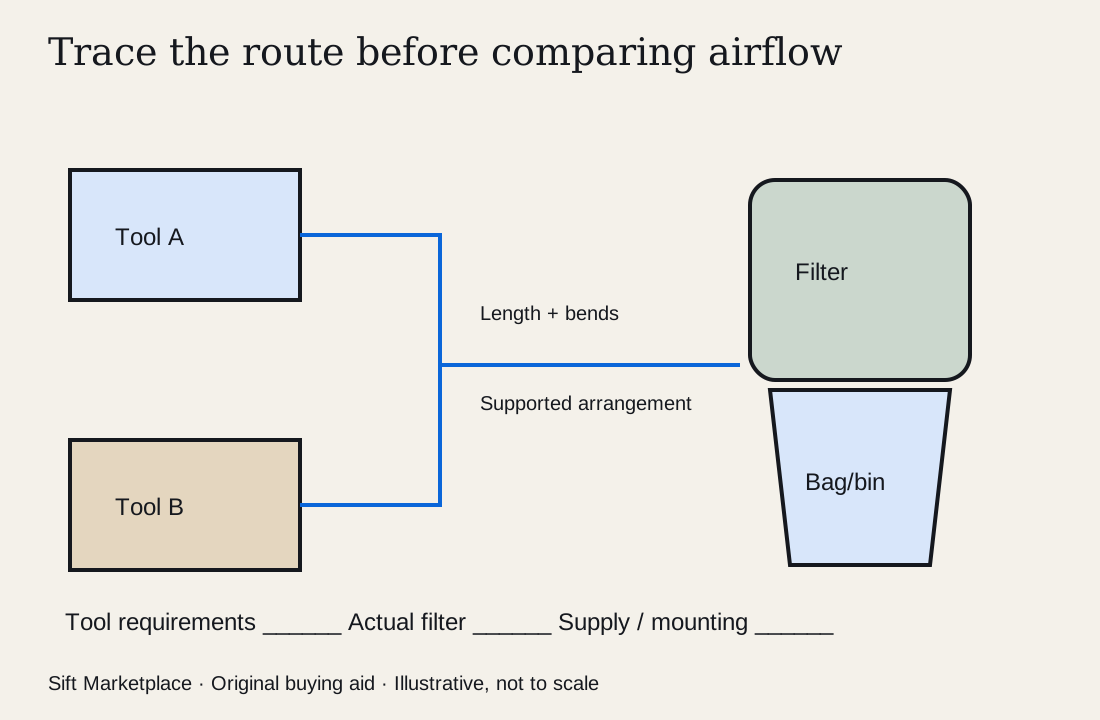
Draw the tools you want to connect, their port sizes and the route to the collector. Record each tool maker’s collection requirements and whether you plan one tool at a time or another supported arrangement. A hose fitting a port does not establish adequate capture.
Compare documented performance under stated conditions. Do not treat a headline airflow figure as the flow delivered through your proposed hose, bends, branches and filter. If the system design is uncertain, get appropriate collection-system advice before buying a machine that only appears large enough.
The Grizzly G0710 manual and product specification describe a particular woodworking collector. This guide does not cover asbestos, lead, metal dust, sparks or other hazardous materials. Do not repurpose an unknown used collector for those tasks.
 Enlarge diagram
Identify the actual collector configuration
Ask for model and power labels, filter labels, bag and clamp photos, inlet adapters and the mounting or base arrangement. Determine whether the filter is original, replaced or modified. A seller may quote specifications for the original machine while selling a different filter and improvised duct setup.
Check exact compatibility for upgrades. Grizzly’s T10877 page lists supported collector models. That kind of explicit match is useful; “one-micron filter” alone does not establish fit, installed sealing or the suitability of the whole system.
Ask what materials were collected, whether the machine had a fire or water incident, and how filters were maintained. Unknown or unsuitable contamination can make a cheap collector a poor purchase. Do not open or shake out an unidentified dust load during inspection.
Inspect the complete air path safely
With the machine isolated according to its manual and suitable precautions for known dust, inspect accessible housing, bags, filter exterior, clamps, seals and hoses. Note tears, damaged retaining surfaces, improvised patches and corrosion. Do not reach into an impeller or operate with a guard or required bag removed.
| Component | Confirm before offering |
|---|---|
| Filter | Exact identity, permitted cleaning, condition and replacement price |
| Collection bag/bin | Correct fit, closures and availability |
| Hoses/adapters | Compatible sizes, condition and intended route |
| Mount/base | Complete supported hardware and suitable installation location |
| Electrical supply | Exact requirement and any qualified preparation cost |
| Controls | Normal operation; no bypassed protection |
Arrange normal operation with the complete intended assembly, following the exact manual. Record unusual vibration, noise, leaks or controls that fail to respond. Seeing chips enter a bag is not a measurement of fine-dust exposure or proof that a proposed multi-tool layout is adequate.
Compare the installed system
A hypothetical $120 collector needs a confirmed $100 correct filter, $65 hoses/adapters and $35 transport: $320. A complete compatible alternative at $250 plus $25 collection totals $275. These invented amounts do not include electrical or mounting work; add those consistently where required.
An expensive included hose has little value if it does not suit your layout. An unsupported filter conversion should not be counted as an upgrade until the maker or a competent specialist confirms it. Use the cost calculator for known costs and keep design uncertainty separate.
Ask: “Please send the collector and filter labels, all bag/clamp/adapter photos, collected-material history and any modifications. I want to verify it against my tools’ collection requirements before arranging normal operation.” The benchtop-planer guide shows one common tool-side decision; each other tool still needs its own requirements checked.
Sources
- 01Grizzly G0710/G0710P manual
- 02Grizzly G0710 specifications
- 03Grizzly T10877 filter compatibility