How do you assess a used welder without guessing about the system?
Quick answer
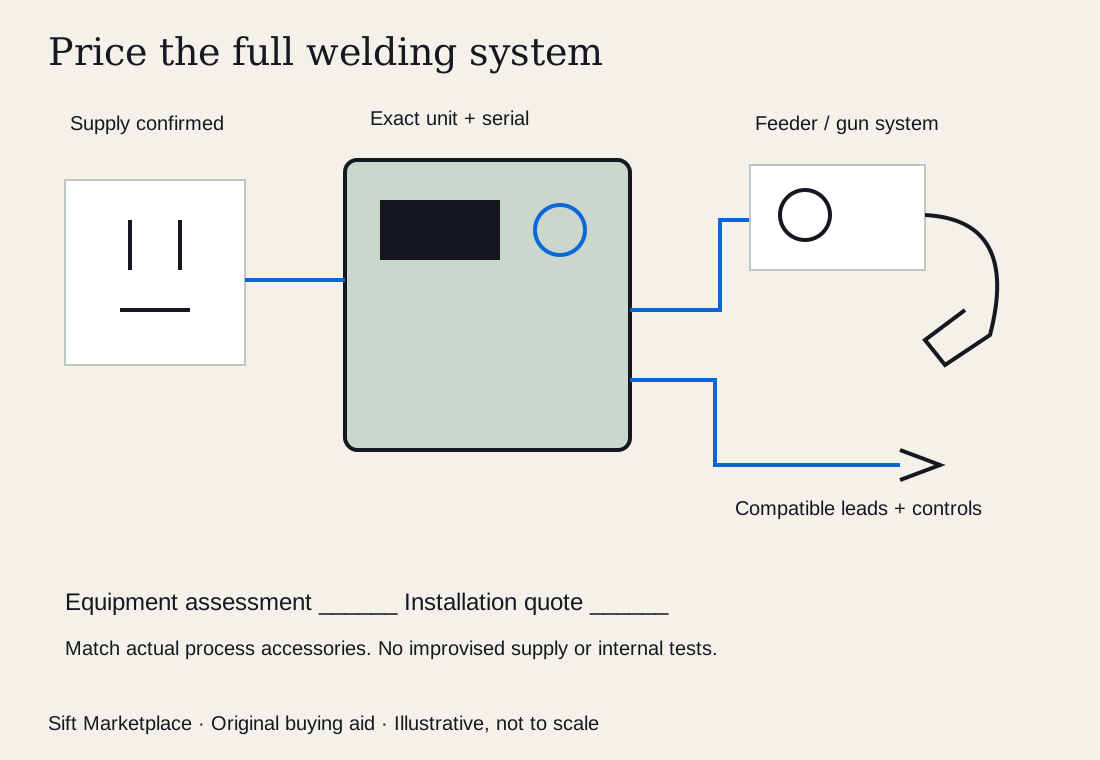
Match the exact machine and serial-specific manual to your intended process and available supply. Inventory the compatible torch, feeder, leads and required accessories, then arrange assessment by a qualified welding-equipment provider. A lit display or an improvised demonstration does not establish output condition, installation suitability or a complete working system.
Define the work before choosing the power unit
Describe the materials, thickness range, work frequency and process you actually need. Ask an experienced instructor or qualified equipment supplier to help match the documented machine capabilities to that work. A machine advertised simply as “MIG/TIG” can leave essential process capability and accessories uncertain.
Record maker, full model, serial number and regional rating plate. Miller’s manuals and parts portal illustrates why the serial matters: documentation and replacement parts can be tied to the exact unit. A manual for a similarly named current machine is not evidence for an older revision.
Separate output rating from input requirements. Miller’s selection guide discusses process, input power and duty ratings. Compare the rating at the relevant output and process, not the largest amperage printed in a listing. This is a specification comparison, not an invitation to test a machine to its limits.
 Enlarge diagram
Get a supply and installation assessment
Show the rating plate and exact manual to a qualified electrical installer when assessing the intended location. Ask it to confirm the required supply and any installation work. Plug appearance alone does not resolve voltage, phase, circuit requirements or whether previous modifications are appropriate.
An old industrial machine may have a supply requirement very different from an ordinary home workshop. Do not price it as ready to use until that question is resolved. Do not propose homemade adapters, changed protection devices, internal reconnection or extensions as a way around an unsuitable supply.
Write the supply result as “confirmed with quote,” “existing arrangement confirmed,” or “unresolved.” If your purchase depends on an installation you cannot reasonably complete, choose another machine before paying for transport.
Inventory the complete process equipment
Ask the seller to lay out everything included. Check each part against the exact manual and primary parts documentation rather than a generic bundle photo. For the selected process, record the torch or gun, feeder where separate, cable/lead lengths, connectors, work return lead and clamp, controls, and the appropriate consumable system.
For gas-shielded work, have a qualified supplier assess the required gas equipment, cylinder arrangement and applicable supply/transport responsibilities. A cylinder photographed beside the machine may be rented, empty, out of scope or not included. Do not assume ownership or condition, and do not treat modified gas components as a repair opportunity.
Check whether a pedal, remote, spool gun or other optional accessory is essential to your intended work. Similar connectors do not prove electronic or process compatibility. Price the exact compatible accessory before giving a bare machine the value of a complete package.
| Item | Evidence needed |
|---|---|
| Power unit | Exact model, serial, rating plate and manual |
| Process capability | Manufacturer documentation for the intended task |
| Supply | Qualified confirmation and installation quote where needed |
| Torch/feeder/leads | Correct compatible identities and full inventory |
| Gas equipment, if applicable | Appropriate supplier assessment and ownership arrangement |
| Condition | Qualified equipment assessment with stated scope |
Use a qualified condition assessment
Ask about use history, storage, faults, service records and all modifications. Observe external damage with the equipment isolated as appropriate: casing, connectors, controls, cable insulation and visible missing parts. Do not remove covers, probe energized circuits or perform a beginner welding demonstration for the sale.
The Miller Auto Arc manual is one example of a manufacturer requiring trained qualified people for installation, operation and service. Use the actual machine’s manual and a suitable service provider for the assessment. The cited manual does not establish that another model is equivalent.
Ask the provider what its inspection includes: the supported processes/accessories, fault observations, service needs and limitations. If a demonstration is appropriate, it should be arranged and performed by competent people in a suitable setting using the manufacturer’s requirements. A seller’s attractive sample weld is history; it is not a measured service report on every machine function.
Agree who pays for assessment and how the sale depends on the findings. Keep unassessed output behavior, intermittent faults and unavailable parts as unresolved risks rather than assigning a small arbitrary repair allowance.
Compare a complete, supported purchase
In an invented example, Machine A costs $550, needs a $180 compatible gun, $120 confirmed service and $250 quoted supply work: $1,100. Machine B costs $900 with the correct accessories and $120 assessment/service: $1,020, assuming its intended supply has been confirmed. Gas, consumables and transport still need the same treatment for both.
Use actual quotes in the cost calculator. Record service support and parts availability beside the total. A low purchase price cannot compensate for an unavailable essential feeder or a location where the machine cannot be installed appropriately.
Does power-on prove it works? No. It provides only that limited observation. Required process and condition evidence needs a qualified assessment.
Is a higher maximum output always better? It does not answer process fit, useful duty rating, supply cost or portability. Compare the documented requirements of your intended work.
Ask: “Please send the full rating plate, serial, manual reference, all included accessories and service/modification history. I need my installer and equipment service provider to confirm the supply and assessment plan before committing.” Search exact models whose supported complete system suits that plan.
Sources
- 01Miller Manuals and parts
- 02Miller Buying your first welder
- 03Miller Auto Arc Model 255 owner manual