What should you check before buying a used pressure washer?
Quick answer
Match the exact machine to your water and power supply, then inventory its compatible hose, gun, lance and nozzles. Ask about storage and observe normal use with adequate water in a suitable area. Do not run it dry or treat an unexplained pressure fault as a cheap seal replacement. Compare the complete working setup.
Start with the cleaning task and available supply
List the surfaces you intend to clean and confirm that pressure washing is appropriate for them. Then identify the available water source and electrical or fuel arrangement. A machine suited to a driveway may be unsuitable for delicate cladding, and the biggest advertised pressure number is not a buying plan.
Record exact model, regional electrical specification, stated flow and pressure with their test conditions. The Sun Joe SPX3000 manual, for example, labels maximum pressure and maximum flow under different conditions. Do not multiply unrelated headline maxima and present the result as demonstrated cleaning performance. Compare like specifications and the instructions for the actual model.
Confirm supply requirements before arranging a viewing. A gas-powered unit needs an appropriate outdoor operating setting; an electric one needs the supply and protective arrangements in its manual. Do not assume an improvised extension lead, indoor engine demonstration or inadequate water source is acceptable.
 Enlarge diagram
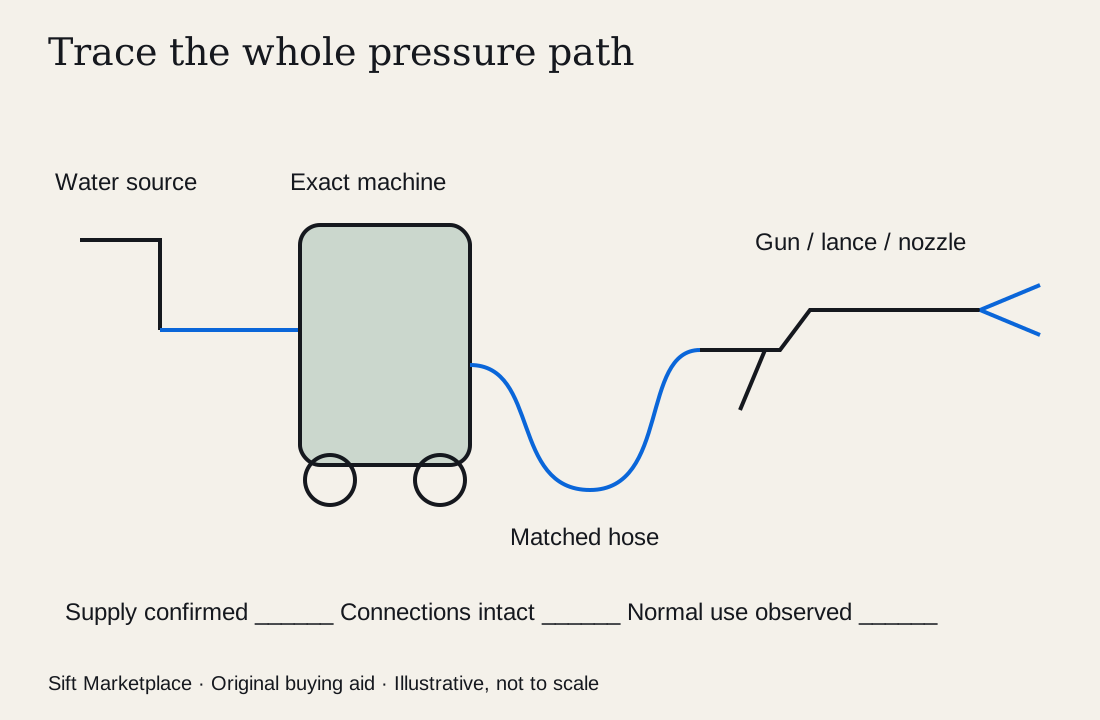
Inventory the entire pressure path
Ask for the machine label and all accessories laid out. Record the water inlet fitting/filter, high-pressure hose, gun, lance, nozzles and any detergent container or pickup system. Identify replacement or aftermarket parts and verify their approved compatibility and ratings; similar-looking threads are not enough.
Inspect the disconnected, depressurized equipment as the manual permits. Look for split hoses, damaged couplings, cracked housings, cord or plug damage and improvised repairs. Do not put hands near a pressurized leak or attempt high-pressure repairs during the viewing. A missing nozzle can be a known cost; a damaged pressure hose is a stop-before-use issue.
Ask how the machine was drained and stored, whether it was exposed to freezing conditions, and about leaks or interrupted operation. The story is relevant but cannot diagnose hidden pump damage. “Only needs an O-ring” needs an identified fault and the correct repair route, not optimism.
Arrange ordinary use, not a stress test
Agree on adequate water supply, a permitted test surface, suitable protective equipment and a safe clear area. Have a competent seller set up and demonstrate normal use according to the exact manual. Never run the pump dry, aim at a person or animal, or use the jet to prove a material’s strength.
Observe normal controls and the intended nozzle. Note whether the unit runs consistently, the trigger operates normally and water escapes anywhere unintended. Ask for the detergent function only if it matters and the exact setup permits it. A short ordinary demonstration does not measure rated pressure or prove every accessory works.
| Evidence | Consequence |
|---|---|
| Complete system operates normally on a suitable task | Continue to full-cost comparison |
| Motor runs with no correct water demonstration | Pump performance remains unverified |
| Persistent surging, shutdown or leakage | Seek competent diagnosis or pass |
| Known missing approved nozzle/tool | Confirm availability and price |
| Damaged hose, electrical part or improvised connection | Resolve before operation; do not bargain around use risk |
An inadequate supply can affect the result, but do not assume it explains every fault. If a correct ordinary setup cannot be provided, arrange another demonstration or decline. Keep “not tested” separate from “failed” and from “passed.”
Price the machine you can actually use
In a hypothetical example, a $80 unit needs a confirmed $55 hose/gun set, $20 nozzle set and $15 collection: $170. A complete candidate at $145 plus $15 collection totals $160. These are invented figures. The incomplete option still needs its operation verified; part prices do not establish pump condition.
Use the cost calculator for confirmed parts, service and transport. Compare a suitable new alternative at the same usable scope. If a surface-cleaning accessory is included, verify its compatibility and condition before giving it value.
A useful seller message asks for the exact model, all hose-end and accessory photos, storage history and a normal water-fed demonstration. Confirm the agreed parts before collection, then follow the model’s pressure-release, draining, transport and first-use instructions. For cordless supply questions, the used-power-tool guide provides a separate battery-and-charger buying framework.
Sources
- 01Sun Joe SPX3000 operator manual MR14