How do you assess used alpine ski equipment before buying?
Quick answer
Identify the skis, boots and bindings separately and have a competent ski shop confirm fit, compatibility and willingness to assess the actual combination before committing. Inspect visible condition without adjusting bindings or performing release tests. A boot clicking into a binding, a recent wax or the seller’s old settings do not establish suitability for you.
Start with the skier and boot fit
Define your skiing experience, intended terrain and the advice you need from a qualified shop. An unfamiliar ski length or advanced model is not automatically a bargain because its original price was high. Treat the equipment as a system that must suit the skier, not three independently attractive objects.
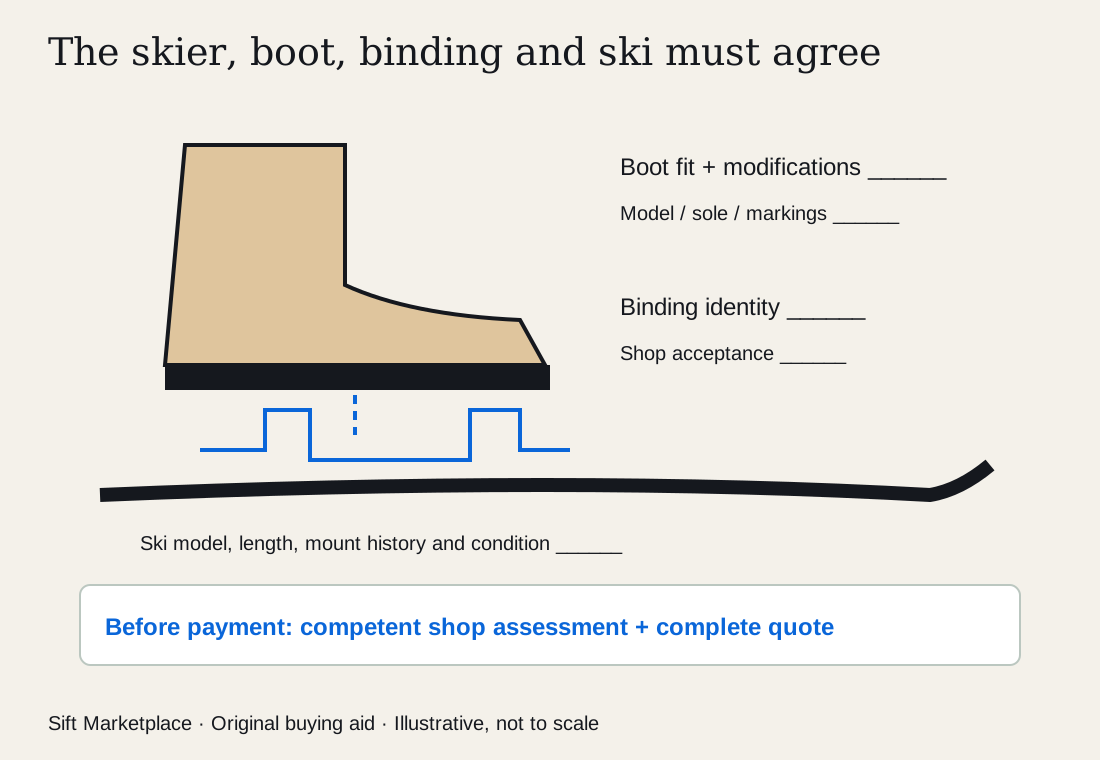
Arrange an appropriate boot fitting. Record the boot’s maker, model, shell markings, sole length and actual installed sole type, together with any liner, footbed or shell modifications. A street-shoe size or a seller’s description of “comfortable” does not establish your fit. Boots that require uncertain major changes may erase the saving in a used package.
Ask about punches, grinding, replaced soles, aftermarket liners and previous repair. Do not assume a modification made for another foot can be reversed. Keep a professional fitter’s assessment separate from a seller’s sizing label and from the compatibility assessment below.
 Enlarge diagram
Collect exact identities before asking a shop
Request clear photos of each ski’s model/length and both bindings’ identifying marks. Record binding generation, brake identity if known, mounting system and any previous remounts the seller knows about. Photograph the boot soles and their markings, not only the shell logo.
Salomon’s current compatibility page directs buyers to matching boot/binding compatibility markings and professional help when they do not match or are absent. Those markings address a particular compatibility question; they do not by themselves establish fit, condition or correct setup for a skier.
The GripWalk FAQ also distinguishes compatibility from release adjustment by an authorized dealer. Do not use a logo, marketing phrase such as automatic adjustment, or the fact that a boot clicks in as permission to ski an unassessed setup. Touring and alpine equipment must not be mixed by appearance.
Send the full identity record to the shop you intend to use. Ask whether it can currently accept those exact bindings and boots for inspection and any required service, and what it needs to make that determination. This guide does not supply a universal age cutoff or service-acceptance list. Policies, documentation, parts and the item’s condition can all affect the answer.
Make the professional gate part of the purchase
Agree an inspection arrangement with the seller before money changes hands. If the deal depends on the result, document that condition using an appropriate purchase arrangement. A verbal “any shop can adjust these” is not the same as the intended shop accepting the actual equipment.
REI’s shop page describes inspection/estimates and binding services while noting that availability varies by location. It illustrates the type of service to seek; it is not acceptance of a particular used model, a quote, or an endorsement of this package. Use a competent local provider and obtain its item-specific scope and cost.
Ask the shop to distinguish what can be assessed now from what depends on seeing the equipment. A photo-based indication may help avoid an unnecessary drive, but it is not a completed condition inspection. If the binding is declined, determine whether an approved replacement/mounting plan is feasible and economical before buying the skis alone.
Record visible condition without conducting setup tests
Look at ski tops, edges, bases and sidewalls for cracks, delamination, deep damage, corrosion, repairs and unusual distortion. Ask about impacts, storage and previous base or mounting work. Note visible loose or missing components around bindings without tightening, adjusting or dismantling them yourself.
Inspect boots for cracked shells, damaged buckles, worn or altered soles, liner wear and missing components. A polished shell and clean liner do not establish structural condition or release compatibility. Photograph concerns for the shop; do not flex damaged equipment aggressively to see whether it breaks.
| Evidence | Decision |
|---|---|
| Fitter accepts boot fit; shop accepts exact system for assessment | Proceed to inspection and complete quote |
| Boots click in but identities are unclear | Compatibility remains unresolved |
| Bindings declined by intended shop | Price an accepted alternative or pass |
| Essential boot modification unassessed | Keep fit and total cost open |
| Visible crack, separation or uncertain repair | Obtain professional assessment before commitment |
| Wax/tune receipt only | Useful history, not a current system assessment |
Compare a ski-ready plan with a rental alternative
In a hypothetical example, a $220 package needs $90 confirmed service and $120 accepted boot work: $430. A $300 package needing $90 service totals $390 if it already fits. If the first package also needs unquoted replacement bindings, its total is incomplete. These figures are invented, not shop prices.
Keep skis, boots, binding work, parts, collection and any needed lessons or rental plan in separate rows. A shop-approved seasonal rental may be a useful alternative when fit is changing or you are still learning what equipment suits you. Use the cost calculator for confirmed costs rather than treating unknown repairs as zero.
Are old seller settings usable? They do not establish correct setup for you. Use the professional service route; this guide provides no release numbers or adjustment procedure.
Should I buy the skis while deciding on boots later? Only with a credible supported plan for the complete system. Changing boots can alter the compatibility and service questions.
Ask the seller: “May I send the ski, binding and boot identities to my shop and arrange its assessment before I commit? Please include sole markings, prior modifications and remount history.” Search for equipment that can meet that plan, rather than selecting by graphics or discount alone.
Sources
- 01Salomon Ski boot and binding compatibility
- 02GripWalk FAQ
- 03REI Ski and snowboard shop services