How do you inspect used binoculars without mistaking setup for damage?
Quick answer
Identify the model and specification, adjust them correctly for your eyes, and view ordinary distant detail in safe daylight. Inspect lenses and mechanisms externally without dismantling. Persistent double images, internal haze or unexplained focusing problems need qualified optical assessment. A short viewing cannot verify waterproof seals or restore a claimed factory specification.
Choose a viewing task before a specification
Decide whether you want a pair for walking, birdwatching, a fixed viewpoint or casual travel. Compare weight, grip, field of view, close-focus needs and how steadily you can hold them. More magnification is not automatically more useful for your task.
Record the exact model and the marked magnification/objective specification. Nikon’s binocular handbook explains the vocabulary used in these comparisons. Check the actual generation: a familiar model name may cover different coatings, eyecups or construction over time.
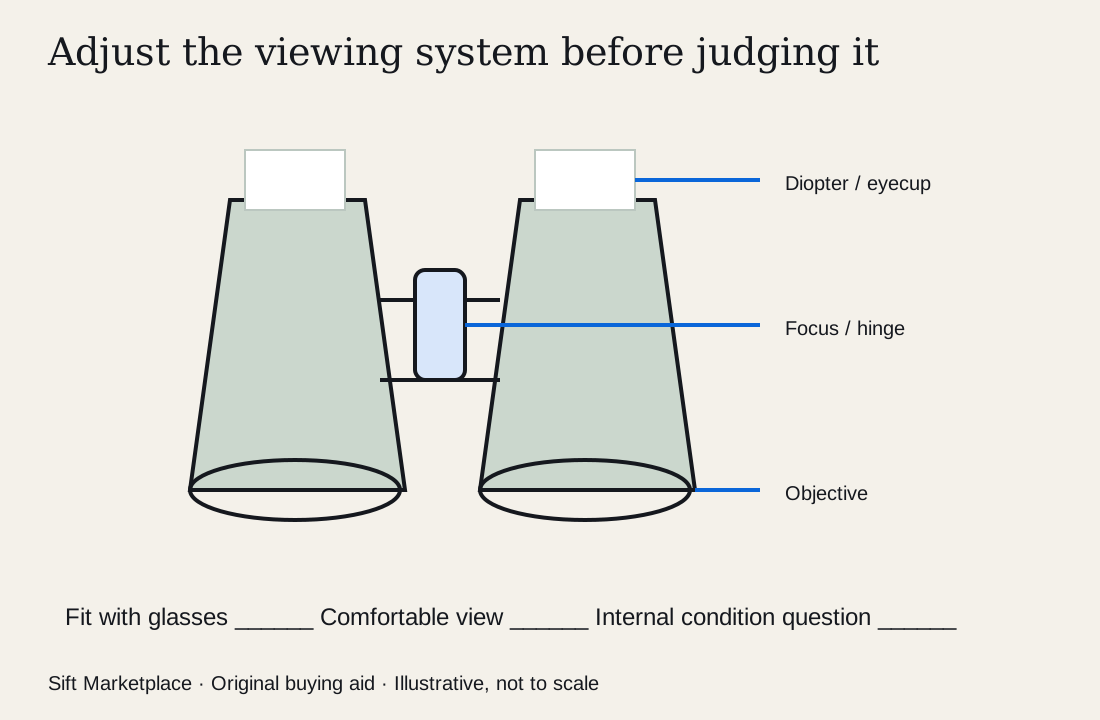
If you wear glasses, bring them. Adjust the eyecups as intended and check whether you can see a comfortable full field. Assess hinge range for your eye spacing. A pair that produces a good image for the seller can still be awkward for you.
 Enlarge diagram
Inspect the body and the accessible glass
Ask about drops, water exposure, repairs and storage. Examine the hinge, focus wheel, diopter control, eyecups, strap mounts and armour. Look for damage or movement that changes the alignment of the barrels. Peeling armour can be cosmetic, but do not assume the condition beneath it is known.
Inspect the accessible lens surfaces in ordinary good light, noting scratches, coating damage, chips and dirt. Look for visible internal haze, debris or fungus-like patterns without opening the instrument. A seller’s “just dust” or “easy to clean” is not a service diagnosis. Internal cleaning or alignment may need specialist work and may not be economic.
Do not use household cleaners or rub dry grit off a lens during the viewing. Consult the exact care instructions. Bushnell’s manual index is one route to model-specific guidance; use the equivalent maker resource for another brand.
Adjust first, then compare what you see
Follow the appropriate focus and diopter sequence for the actual design. Nikon’s general instructions distinguish adjustment arrangements. Do not assume every pair has the diopter on the same side or a central focus wheel.
View ordinary stationary detail at a comfortable distance. Never look at the sun through binoculars. Check focus movement, whether settings stay where placed, both barrels’ useful views and whether the combined image is comfortable. Use several ordinary subjects rather than a single bright sign.
If you see persistent double images after appropriate adjustment, stop treating the problem as a small price deduction. Seek a qualified optical assessment or pass. Do not turn hidden alignment screws or attempt to correct collimation at the meetup. Eye strain and unusual image behavior deserve attention, but an informal observation does not identify the internal cause.
| What you can observe | What it does not prove |
|---|---|
| Focus works on ordinary subjects | Factory resolution across the entire field |
| Comfortable combined view for you | A professional alignment certificate |
| Clean accessible lens surfaces | No internal moisture or past water exposure |
| Intact seals externally | Current waterproof performance |
| Seller’s service receipt | That every later impact caused no damage |
Do not immerse or spray the binoculars to test a waterproof label. For image-stabilized models, add the correct battery, controls and stabilization demonstration under their instructions. Keep battery leakage or an unexplained stabilizer fault separate from the passive optics assessment.
Decide whether service uncertainty defeats the saving
In a hypothetical comparison, a $120 pair needs $35 confirmed eyecups and $20 collection: $175. A suitable intact pair at $165 with $10 collection costs the same. If the first also has unexplained internal haze, that cost is not included merely because you hope cleaning is simple.
Obtain an exact-model service quote and confirm whether parts are available before valuing a repair project. Include case, strap and lens caps only at the replacement cost relevant to you. A branded case does not establish authenticity or optical condition.
Ask: “What is the exact model, have they been dropped or wet, and has any optical work been done? Could I see the lenses, focus and diopter controls and try them with my glasses?” Use the cost calculator for known additions. Buy a comfortable, identifiable pair with the condition you can establish; pass when the attraction depends on an unconfirmed internal repair.
Sources
- 01Nikon Binocular handbook
- 02Nikon General binocular instructions
- 03Bushnell Binocular manuals