How do you check a used bread maker without guessing from a power light?
Quick answer
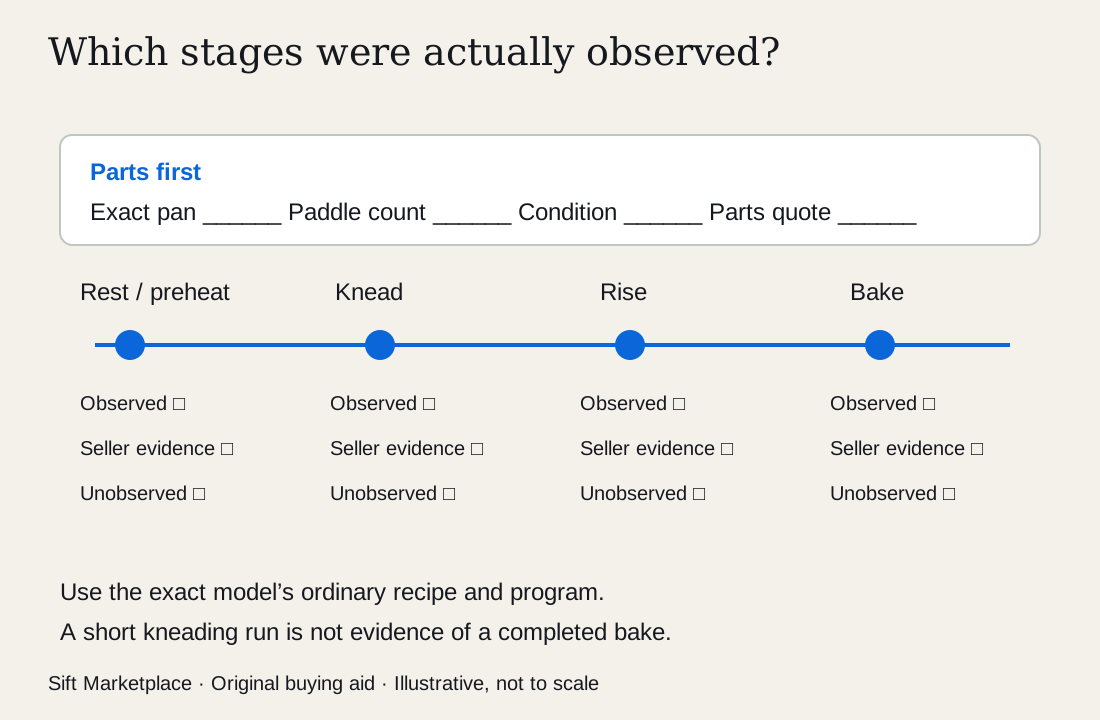
The correct pan and paddle set matters as much as the motor base. Identify all parts, inspect their condition and match the programs to the bread you intend to make. Record whether kneading and baking were actually observed. A powered display or a short kneading run cannot establish a successful full bake.
Buy for the loaf and routine you want
Decide whether you want a complete baked loaf, dough for a separate oven, a particular loaf size or a documented specialist program. Check the exact model’s instructions and recipes. A list of program names in a marketplace description can come from another generation.
For example, Zojirushi’s basic white bread guidance provides model-specific recipe and course information. Use that principle when comparing candidates: the settings and quantities should belong to the machine you would own. Do not assume a program label guarantees suitability for every dietary requirement or recipe adaptation.
Measure counter space, overhead lid clearance and storage access. A heavy machine that must be carried out of a low cupboard every time may not suit your routine. Check regional electrical requirements and use the supplied approved arrangement rather than planning an adaptor workaround.
Identify the pan and every kneading blade
Request the base label, pan interior, pan underside, paddle or paddles, and the machine’s empty baking chamber while cool and unplugged. Some designs use more than one paddle. Count the actual pieces rather than treating “paddle included” as a complete inventory.
Zojirushi’s BB-PDC20 replacement-blade page explicitly warns that blades from different models are not interchangeable. Its BB-SSC10 manual shows a particular pan locking arrangement and matching shaft/blade shape. These examples make model identification essential; they do not establish compatibility between the two machines.
Ask whether the pan or paddles were replaced, and with which parts. An accessory that can be pushed onto a shaft may still be wrong. Confirm replacement compatibility with the maker before buying a base without its original food-contact assembly.
Inspect the pan before focusing on cosmetics
With the pan cool and removed as the manual permits, inspect the interior coating, corners, seams, handle mounts and paddle hubs. Note peeling, deep scratches, corrosion, cracks, persistent residue and obvious damage. A scuffed outer case may be acceptable; a food-contact component you need to replace changes the cost immediately.
Ask about leakage under the pan, unusual noises during kneading, burned smells and interrupted cycles. Do not force a stiff drive mechanism or dismantle seals to identify a fault at the viewing. A leak or binding concern belongs with manufacturer support or a competent service assessment.
Check the cord, plug, lid, display and ordinary buttons. Look at the accessible baking chamber without touching or bending heating parts. Evidence of a liquid spill into the base, damaged wiring or a modified power connection should stop an operating demonstration until properly assessed.
Make a cycle evidence record
 Enlarge diagram
A full ordinary bake takes planning. If the seller is willing, agree on a manual-approved recipe and timing before the meeting. Record which stages you actually see. A dated seller video or photo of a loaf may provide context, but it is not equivalent to your observation of the same machine completing a cycle.
Zojirushi’s breadmaker FAQ explains that many courses begin with a rest or preheat stage. Immediate paddle movement is therefore not a universal start test. Follow the exact program rather than interrupting it repeatedly or diagnosing a stationary paddle from the first minute.
| Evidence available | What it supports | Still unresolved |
|---|---|---|
| Display and program buttons respond | Basic controls operated | Kneading, heating and full cycle |
| Ordinary kneading stage observed | Pan/drive task worked during that stage | Baking and completed loaf |
| Complete normal cycle observed | That recipe and cycle completed | Every other program and future reliability |
| Seller’s recent loaf/video | Seller-reported use context | Your direct observation and exact test conditions |
| No practical demonstration | Identity and visible condition only | Functional condition |
Do not run an empty heating cycle unless the exact manufacturer instructions expressly permit that use. Do not defeat a lid switch or reach into moving parts. If a meaningful demonstration cannot be arranged, decide whether an unverified appliance is worth the uncertainty; do not quietly mark it as working because the display lights up.
Compare pan replacement with a complete machine
Suppose a used machine costs $35. A correct replacement pan is quoted at $65, its needed paddles at $20 total, and collection at $10. The hypothetical total is $130. A complete alternative at $90 plus $10 collection totals $100. These figures illustrate the calculation, not current manufacturer prices.
The incomplete machine costs $30 more before any functional uncertainty. If the pan is no longer available, an advertised “universal pan” does not solve compatibility. Confirm the part and regional stock first. Use the cost calculator for known costs, and compare a new alternative with its actual included parts and return terms.
A known missing measuring spoon may be a minor omission. A missing pan is central. A worn pan with an exact supported replacement may justify an offer; an unexplained drive failure needs a diagnosis, not just a guessed paddle purchase.
Ask a message that makes the visit worthwhile
Try: “Could you send the full model label and photos of the pan inside and underneath, plus all kneading blades? Have there been leaks, stalled kneading or failed bakes? Which normal cycle can be demonstrated, and are there any replaced parts?”
Before collecting, agree on the pan, paddle count and extras in writing. Let hot parts cool, secure removable pieces and follow the maker’s cleaning guidance before first use. For the broader household comparison, see used appliances. A useful bread maker is the complete machine that supports your actual baking routine.
Sources
- 01Zojirushi BB-SSC10 instruction manual
- 02Zojirushi Breadmaker FAQs
- 03Zojirushi BB-PDC20 kneading blade BX167083G-00
- 04Zojirushi Basic white bread model-specific recipes