How do you check a used carpet cleaner or spot extractor?
Quick answer
Identify whether you need an upright carpet cleaner or a portable spot extractor. Inventory the correct clean and dirty tanks, lids, seals, hose and tools, then observe a small normal-use demonstration on a permitted surface. A motor sound or spray alone does not show that the machine recovers water properly.
Match the machine to the surface and the size of the job
A portable spot extractor may suit stairs or a small upholstery task; an upright cleaner may suit a larger carpeted area. Neither purchase is automatically suitable for a delicate rug, an unknown upholstery fabric or a floor finish that should not be wetted. Start with the surface manufacturer’s cleaning instructions and the machine’s supported uses.
BISSELL’s Little Green getting-started guide makes the upholstery care label part of the decision. For an unknown or missing label, establish appropriate cleaning with the furniture maker or a qualified cleaner before planning a demonstration on it. The machine spraying successfully is not permission to clean that material.
Record the areas you need to reach, the useful hose length, stairs and storage space. If a tool for your main task is absent, price it before travelling. A low-cost machine with an awkward hose or the wrong tool may be less useful than a complete alternative.
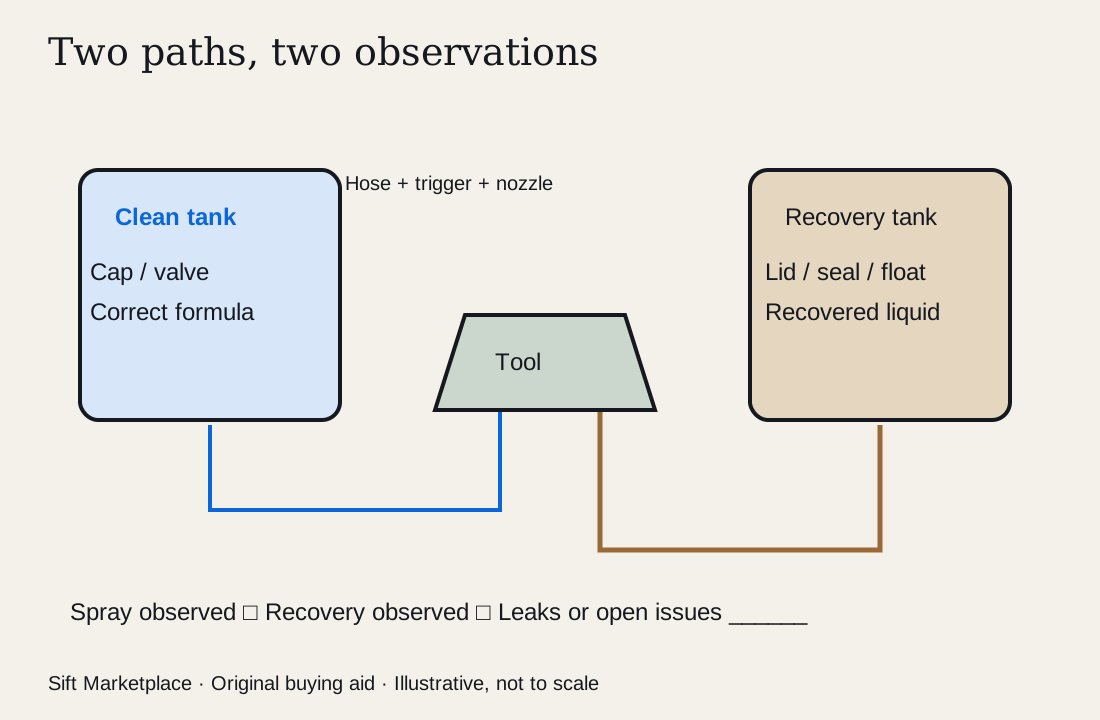
Draw the two water paths
 Enlarge diagram
Request the model-label photograph and pictures of the clean tank, dirty tank, their lids, seals, hose ends and all tools. Identify any separate brush assembly, nozzle cover or filter the model requires. Do not rely on a seller’s photograph of a current retail bundle.
| Part or path | Evidence to collect | Purchase consequence |
|---|---|---|
| Clean-water tank and cap | Correct model, intact fit and closure | Missing valve/cap can prevent normal dispensing |
| Hose and trigger | No obvious splits, crushed sections or broken fittings | A matched hose may cost more than a small generic tool |
| Cleaning tool/nozzle | Correct coupling and intact recovery opening | A visibly attached tool is not necessarily the right one |
| Dirty tank, lid and seals | All required parts seat normally | Missing closure can affect recovery or leak control |
| User-cleanable filters/float parts | Present and intact per manual | Do not bypass a shutoff component to demonstrate suction |
| Cord or approved battery/charger | Exact identity and external condition | Electrical damage needs assessment before operation |
Use the maker’s parts diagram to distinguish an optional extra from a required component. BISSELL’s 1400B support page provides a model-specific route to its manual, parts and troubleshooting. Other brands need the same exact-model check; product names can span several different machines.
Ask what has been through the machine
Cleaning equipment can carry contamination from earlier work. Ask about pet waste, floodwater, strong chemicals, long periods stored wet and any leak or motor problem. A seller’s claim that a machine is sanitized is not something a visual inspection can certify.
With power disconnected and removable parts handled according to the manual, inspect tank corners, caps, seals, hose ends and accessible tool channels. Note persistent odour, visible residue, cracks and missing components. Do not promise that a rinse will make inaccessible contamination acceptable. If you would not want the machine or its hoses near your furniture in their current condition, make that a deliberate purchase decision.
Distinguish stains on clear plastic from damage that affects fit or cleaning. Ask the manufacturer about an uncertain component instead of scraping, soaking or applying a solvent during the viewing. The 1400B manual is a model example of why assembly, cleaning formula and after-use care should follow the specific instructions.
Observe a small ordinary cleaning task
Agree on a permitted surface, approved solution and normal setup before visiting. Let the seller prepare and operate their machine according to its manual. Do not use an unfamiliar rug as a test patch simply because it is nearby, and do not add an improvised cleaning chemical to make the demonstration look more dramatic.
Watch the supply path: does the intended tool dispense normally, and is there leakage around tanks or connections? Then watch the recovery path: with ordinary technique, does recovered liquid reach the dirty-water tank? The result should be recorded as an observation under those conditions, not a claim of measured extraction efficiency.
Listen for changes and note any error, unexpected shutdown or water escaping from the machine. A weak result may involve setup, a seal, a blockage or a more substantial fault; the symptom alone does not identify the cause. The seller can correct normal setup issues described in the manual, but persistent behavior remains unresolved.
Do not equate a successful spot-clean with removal of every stain, disinfection or a guarantee that your carpet will dry within a particular time. Those depend on more than the used machine. Also keep battery runtime unverified if you only observed a short cordless demonstration.
Use the result to decide what is negotiable
A missing known tool with an available correct replacement is a priced omission. A cracked proprietary tank with no supported replacement may make the machine unusable. A seller who says “only needs a pump” is offering a diagnosis you have not established; obtain competent assessment or choose another listing.
In a hypothetical comparison, a $55 extractor needs a $35 confirmed tank lid, $25 tool and $15 collection: $130. A complete candidate at $100 plus $10 collection totals $110. The cheap listing costs more before allowing for cleaning effort. These figures illustrate a method, not current prices.
Enter the confirmed components under missing parts in the cost calculator. Keep ordinary consumables and any professional assessment separately identified. If the machine’s operating condition is unknown, do not make a small parts allowance stand in for the entire repair risk.
Confirm the package and first use
A useful message is: “Please send the exact model label and photos of both tanks, lids, hose and all tools. What was it used to clean, was it stored wet, and are there any leaks or loss of spray or recovery? Could we observe a small manufacturer-permitted cleaning task?”
Agree which tools and removable parts come home with you. Follow the model’s emptying, transport and drying instructions, then its cleaning guidance before use on your own surfaces. If the rug itself is the purchase, see the used-area-rug guide; its material and condition remain a separate decision from the extractor.
Sources
- 01BISSELL Little Green 1400B user manual
- 02BISSELL Little Green getting started
- 03BISSELL Little Green 1400B product support