How do you inspect a used compost tumbler?
Quick answer
Inspect the empty tumbler, identify its exact assembly and check the drum, doors, axle and frame together. Confirm that it turns and opens normally and fits your collection routine. A seller’s successful compost batch does not establish the condition of hidden panels, and a broken drum is different from a dirty intact one.
Buy a container that suits your routine
Decide where the tumbler will stand, how you will carry material to it and where finished material will go. Measure the base footprint and the space needed to rotate the drum, open its doors and place a collection container below. A large capacity is of little use if the only suitable corner prevents you from emptying it.
Choose deliberately between one chamber and a divided drum. A divider changes the way you manage batches; it is not merely an extra panel. FCMP explains the separate filling and finishing role of its double chamber in its tumbler guidance. Do not turn an example processing time into a guarantee for your ingredients, climate or routine.
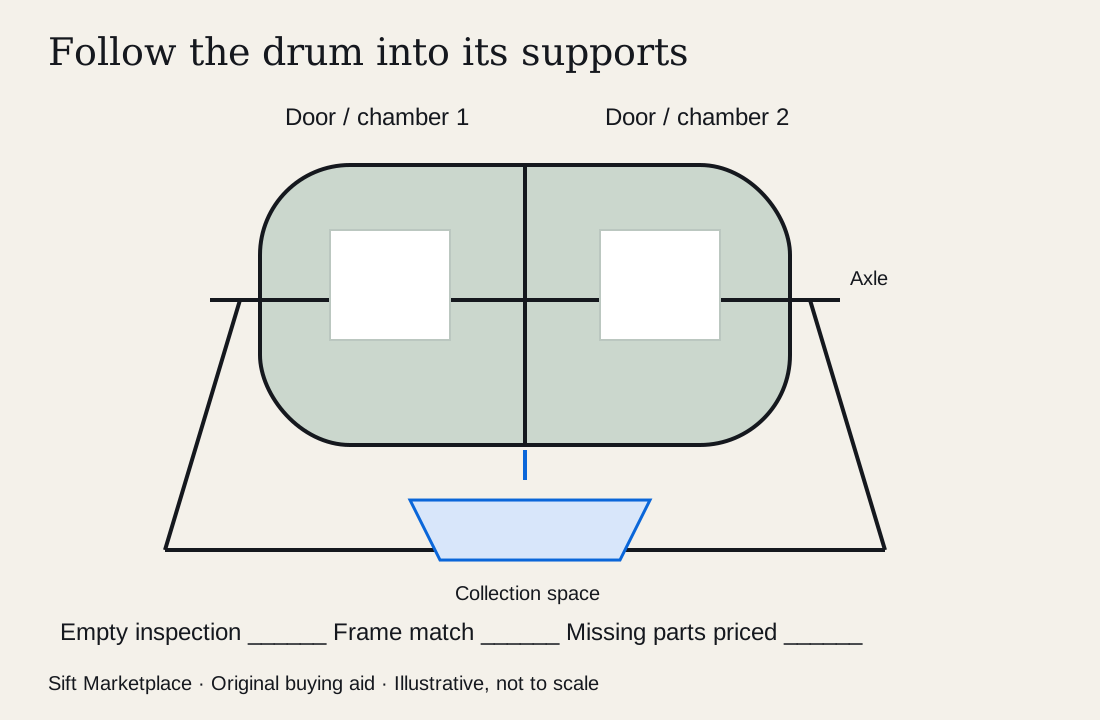 Enlarge diagram
Request an empty, identifiable assembly
Ask for model information, all sides, both doors and the frame connections. Find out whether the drum can be emptied before the viewing and whether removal of existing contents is included. Do not accept unknown material as a free bonus. Ask what has been put into the unit and whether it has held chemicals or other substances outside its intended use.
Use the exact manual to identify panels, end caps, doors, vents, axle supports and any divider. The FCMP IM4000 pictorial illustrates why similar-looking plastic pieces should not be counted as interchangeable. For a dismantled unit, lay out the parts against the drawing before discussing completeness.
A claimed missing part may already be nested inside another component; a claimed complete kit may lack a critical support. Confirm identity and availability with the manufacturer rather than assuming a hardware-store substitute will preserve the design.
Look at stress points, then ordinary movement
Inspect around fastener holes, door tracks, end caps and axle supports in daylight. Note splits, stretched holes, missing hardware, distortion and repairs. Surface fading alone is not a measurement of remaining plastic strength. Conversely, a neat painted repair does not prove a cracked support is sound.
Check the frame for bending, heavy corrosion and missing connections. Ask about instability and whether the unit has been moved while full. Place it on an appropriate level surface for the viewing and have the seller operate the empty drum normally. Keep fingers clear of moving gaps. Do not hang on the frame, overload it or force a seized drum to prove it works.
Open each door and check ordinary closure. Make sure the doors supplied actually fit their openings and remain in the intended position during rotation. A divider should be the correct part and seated as designed. For any unexplained rubbing or poor alignment, compare the actual assembly with the model instructions before deciding whether it is a correctable assembly issue or damage.
| Observation | Next decision |
|---|---|
| Intact dirty drum with known ordinary use | Budget cleaning and handling you are willing to do |
| One missing documented door or vent | Confirm exact replacement, availability and shipping |
| Frame assembled differently from the drawing | Have the seller resolve it before a meaningful viewing |
| Cracks at axle supports or heavily distorted panels | Pass unless a documented viable replacement makes sense |
| Contents hide the bottom or divider | Keep those areas unverified until emptied |
Price the ready-to-use tumbler
Imagine a $35 listing needing a confirmed $25 door plus $18 shipping and $20 collection. Its total is $98, before your cleaning time. An intact empty alternative at $70 with $15 collection totals $85. These hypothetical figures show how a cheap incomplete drum can lose its advantage.
Enter purchase, transport and missing-part costs in the buying-cost calculator. Record cleaning time separately if you want to compare effort. Do not enter a guessed amount for a replacement drum that is unavailable or not yet identified.
Ask the seller: “Can it be empty for the viewing? Are both doors, the divider and all frame parts included? Has it held anything besides normal composting materials? Could I see it turn and close on level ground?” Agree who handles the contents and whether it travels assembled. Photograph the complete unit and bag any permitted removable hardware. Buy the working container, rather than a promise that every composting problem will disappear.
Sources
- 01FCMP Outdoor Tumbling composter troubleshooting
- 02FCMP Outdoor IM4000 assembly pictorial