How do you choose a used garden cart that works on your property?
Quick answer
Measure your route before comparing capacity. Identify the cart and whether it is intended for hand pulling or towing, inspect its complete running gear and try ordinary empty operation. Price confirmed wheels or hardware separately from damage to the tub, frame or steering. A published maximum load does not prove the condition of a used cart.
Measure the route the cart must travel
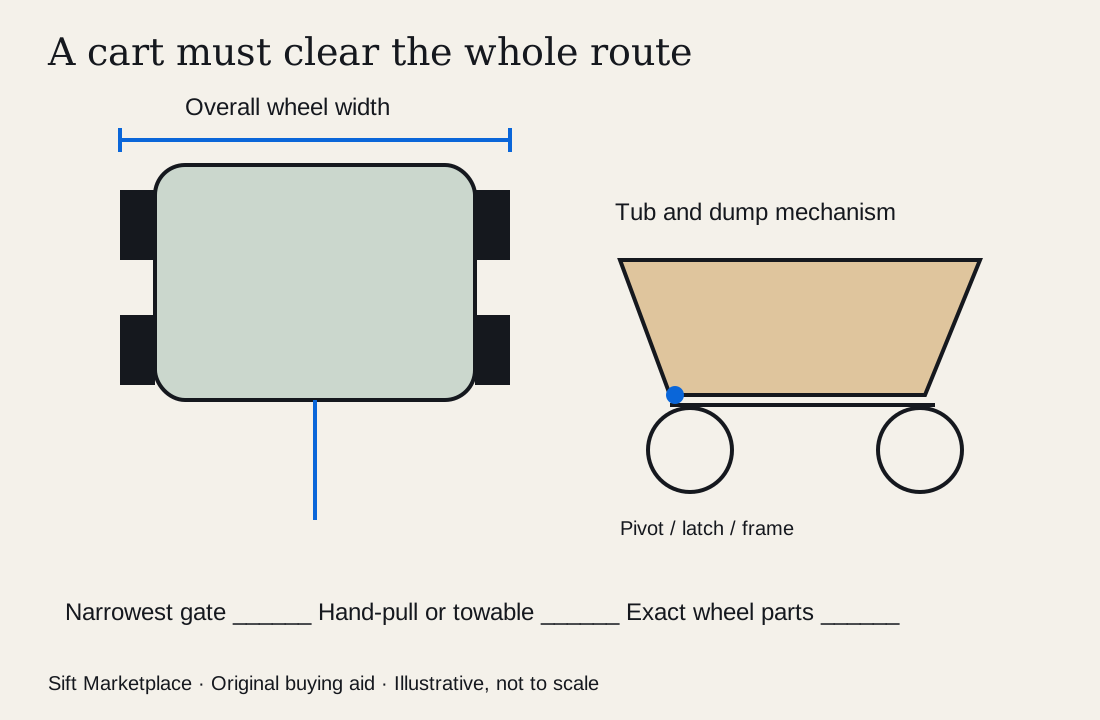
Write down the narrowest gate, turn beside a raised bed, storage doorway and ordinary ground surface. Compare overall wheel width and handle sweep, not only the tub dimensions. Decide whether you need to tip loose material, carry long items or remove side panels. A deep tub can suit mulch yet be inconvenient for a wide flat load.
Separate capacity by volume from capacity by weight. A load can fill the tub without reaching the weight limit, or reach the limit before filling it. Use the exact manufacturer’s instructions for loading and terrain; do not interpret a large printed number as permission for every slope or material.
 Enlarge diagram
Establish exactly which cart is offered
Ask for the model/lot label and pictures of the underside, axles, wheels, handle connection and dump latch. Confirm included removable sides, pins and adapters. If the seller describes it as towable, check the manual. For example, Gorilla lists the GOR4PS as a straight-handle cart that is not towable; resemblance to another model does not add an approved towing arrangement.
That same manufacturer page distinguishes some replacement wheels by lot number. Use exact part information, axle dimensions and manufacturer confirmation where required. A wheel with the right outside diameter may still have the wrong bearing or mounting arrangement. Price delivered parts before treating four mismatched wheels as an easy fix.
Inspect tub, frame and running gear
Look inside and beneath the tub for cracks, worn mounting points, holes and patched areas. Ask what it has carried, including chemicals, and decide whether its history suits your intended garden use. Staining and residue deserve a different discussion from a clean cosmetic scrape.
Look along the frame and steering linkage for distortion, damage and missing fasteners. Check visible wheel retention, tire condition and ordinary handle movement. Observe whether all wheels sit naturally on appropriate level ground. Do not crawl beneath an unsupported tipped tub or put hands into the dumping mechanism.
Have the seller demonstrate empty rolling, turning and, if fitted, the dump release and re-latching according to the manual. Note rubbing, dragging wheels, unexpected looseness or failure to latch. An empty demonstration is useful evidence of movement; it does not prove capacity under a heavy load or reliable operation on your steepest path. Do not stage a maximum-load test at a viewing.
| Finding | Response |
|---|---|
| Complete, suitable route width, normal empty operation | Continue to price and transport comparison |
| One worn compatible tire with sound wheel and axle | Get an exact replacement quote |
| Missing proprietary latch or handle fitting | Verify availability before offering |
| Bent steering, cracked mounting or unreliable dump lock | Resolve through appropriate repair assessment or pass |
| Cart too wide for the only access gate | Choose another size, regardless of capacity |
Compare a complete cart with a project
A hypothetical $40 cart needing two confirmed $28 wheel assemblies and $15 pickup totals $111. A suitable complete cart at $85 with $15 pickup totals $100. If the first also has a questionable axle, do not turn that uncertainty into a fictional $10 repair.
For a folding fabric wagon, apply the same route logic but inspect the folding frame, locks, fabric attachments and base separately. Do not borrow a rigid garden cart’s load rating or assume the wagon’s floor panel is optional. For a towable model, obtain the exact towing limits and hitch compatibility before considering a powered vehicle.
Make collection part of the purchase
Measure the cart in its permitted transport configuration, including the handle and wheel width. Agree whether any removal is necessary and who keeps the correct washers, pins and hardware together. Do not casually remove steering parts to squeeze it into a car without a reassembly plan.
A useful enquiry is: “What are the model and lot number, overall wheel width and included fittings? Has the tub or steering been repaired? Can I see the empty cart turn and the dump latch work?” Use the cost calculator to compare the actual price, transport and confirmed parts. Buy when the route and condition fit your job; negotiate a known replacement, not a guess about the frame.
Sources
- 01Gorilla GOR4PS product, manual and parts