How do you inspect a used cooler before buying?
Quick answer
Check usable internal space and the size and weight you must carry. Inspect the shell, lid, hinges, latches, drain and gasket where fitted, and ask about previous contents. A water-leak check and an ice-retention claim answer different questions. Price exact replacement parts and choose an item whose condition suits its intended use.
Start inside the cooler, then measure outside
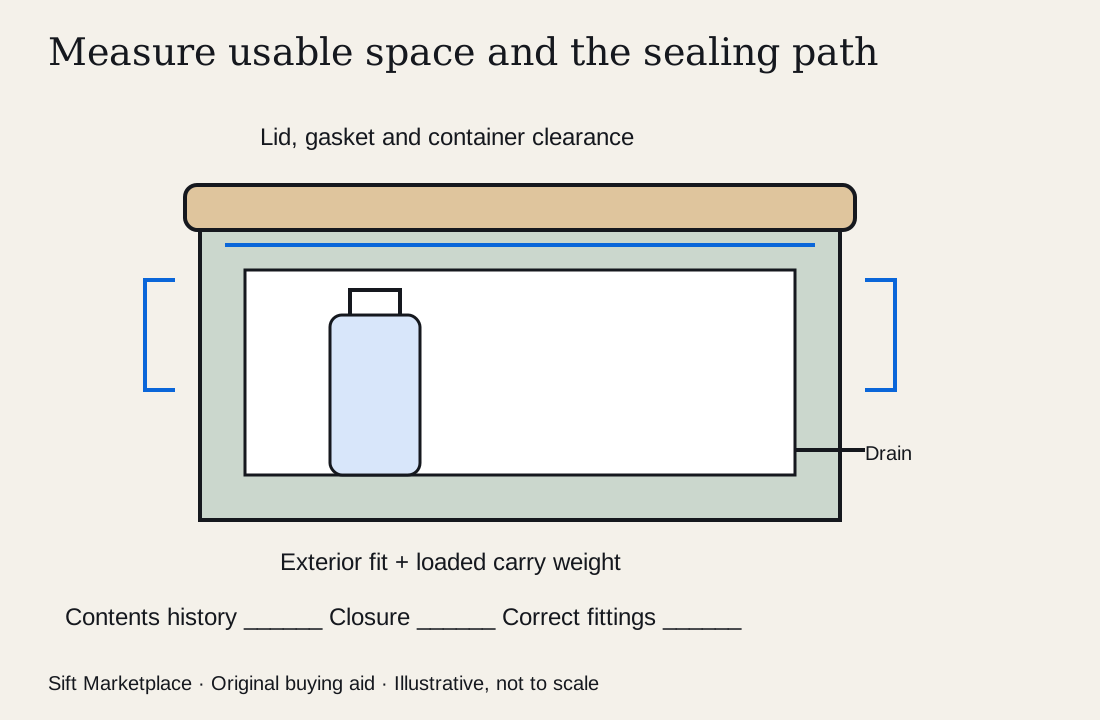
List what must fit: food containers, bottles, ice packs and any basket or divider. Measure internal length, width and height at the narrowest relevant points, including the lid intrusion. A product number is not necessarily a litre capacity, and gross volume does not guarantee your tall container fits upright.
Then record exterior dimensions including handles, wheels and protruding hinges. Check the vehicle opening, storage space and the place you intend to set it. Consider empty weight plus the contents you plan to carry. A large rugged cooler may be inconvenient on a long walk even when it fits in the boot.
 Enlarge diagram
For a wheeled cooler, check the route’s ground surface and whether you can lift the loaded unit where rolling stops. Do not value it as a seat, step or towing attachment unless the exact manufacturer instructions support that use.
Establish model, history and included fittings
Request the model, all-side photographs, the interior and the drain area. Ask what it has held, how it was cleaned and whether the lid, shell or hinges have been repaired. A cooler used for ordinary food transport presents a different history from one used for chemicals or unknown workshop materials. Persistent contamination is not just a bargaining point if it conflicts with your intended use.
Inventory baskets, dividers, drain plugs, caps, feet and detachable handles. The YETI Tundra manual illustrates a model with particular gasket and drain features; other coolers use different seals and closure systems. Confirm the actual replacement part before assigning a small cost to a missing plug or latch.
For a soft cooler, identify its exact closure type and care instructions. A waterproof zipper or welded liner needs a different inspection from a simple insulated picnic bag. Do not assume a conventional zipper replacement restores a specialized closure’s original performance.
Inspect the sealing path and the shell
Open and close the lid normally. Observe whether hinges move freely, latches engage as designed and the lid sits evenly. Inspect the gasket, if fitted, around the entire perimeter for damage, detachment or contamination. Look for shell cracks, distorted corners, repairs and damage around hinge or handle mounts.
Inspect the drain plug and seal without forcing threads. Ask the seller to demonstrate any ordinary water-retention check permitted by the instructions, in a suitable place and with contents you have agreed. Record where moisture appears. Do not tip or pressurize a cooler to prove a performance claim the model never made.
A dry exterior during a brief check is useful evidence about that condition. It does not establish how long ice will last. YETI’s FAQ explains that starting temperature and use conditions affect ice retention. Treat a seller’s “five days” as a claim needing context: initial ice and contents, ambient conditions, opening frequency and what remained at the end.
| Observation | What it supports |
|---|---|
| Intact shell and normal complete closure | Basic condition evidence |
| Missing correct drain plug with available replacement | A specific cost to negotiate |
| Water appears at a damaged drain fitting | Resolve fitting and shell condition before buying |
| Strong persistent odour or unknown chemical use | Prefer an item with suitable documented history |
| Seller’s old trip photo with ice | Evidence of that photo, not present thermal performance |
Compare cost without inventing a performance test
Suppose a used cooler costs $80, with $24 for a confirmed replacement plug, $18 for a missing foot and $15 collection. Its hypothetical total is $137. A complete suitable alternative at $115 with $15 collection totals $130. These examples do not imply that any named manufacturer’s parts have those prices.
For a premium model, verify any service or warranty promise for a second owner before valuing it. If a repair affects the insulation cavity, lid geometry or a welded liner, obtain manufacturer guidance rather than assuming cosmetic repair restores function.
This guide concerns passive coolers. An electric compressor fridge adds power supply, controls, cooling and electrical condition checks; a fan running does not establish that system’s performance.
Ask: “What are the usable internal dimensions, exact model and included parts? Has it held anything besides food and drinks? Are there repairs around the drain, lid or handles?” Use the cost calculator for confirmed additions. Choose a cooler you can carry, clean and close reliably, and keep thermal claims within the evidence available.
Sources
- 01YETI Tundra owner manual
- 02YETI Tundra FAQ