How do you decide whether a used sleeping bag suits your trip?
Quick answer
Identify the exact bag, size, insulation and rating category. Check fit and the whole shell, lining, zipper and fill distribution. Published ratings describe the original tested design, not a new certification of a used bag. Buy only with a suitable sleep-system plan and enough confidence for the conditions; an unknown bag is a poor basis for a cold-weather commitment.
Read the label before the number in the advert
Ask for clear photographs of the model label, length/size, fill information and temperature label. A headline such as “minus ten bag” leaves unanswered whether the number is comfort, limit, extreme or a seller’s recollection. Record the unit too. Do not compare a Celsius figure with a Fahrenheit figure as though they were the same.
Therm-a-Rest explains the separate EN/ISO categories and the variation between sleepers. Treat the extreme category as an emergency boundary, not a comfortable trip target. Use the exact model’s published information and your own appropriate margin; no universal subtraction turns a limit figure into your personal comfort rating.
A used bag’s label has not re-tested its present insulation. Compression history, moisture, contamination, damage and missing fill can change the purchase decision even when the original specification is suitable. If identity is missing, call the thermal specification unknown rather than guessing from colour or thickness.
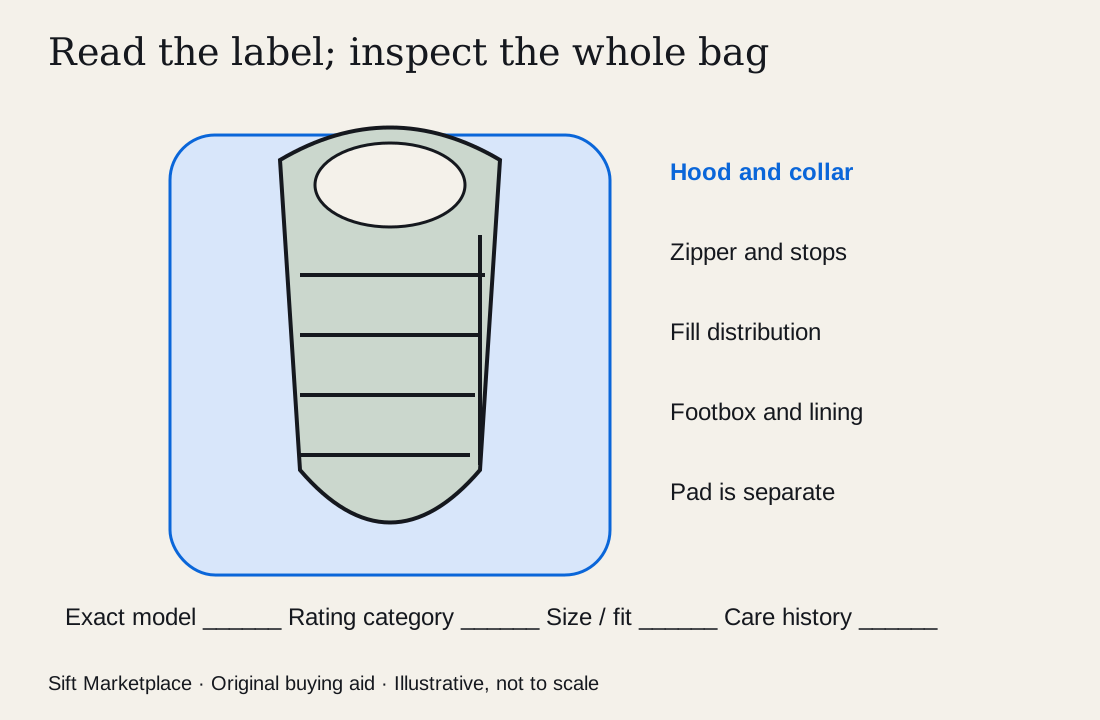 Enlarge diagram
Fit is more than your standing height
Compare the manufacturer’s fit dimensions and try the bag cleanly with permission, wearing ordinary sleep layers rather than sharp outdoor equipment. Check room at shoulders and hips, foot position, hood closure and your usual sleeping posture. A narrow bag that compresses insulation where you press against it may feel different from a roomier model with the same label.
For a quilt, identify the intended pad attachments, footbox closure and width. A quilt sold without its required straps is a different bundle. For bags that zip together, confirm the actual zip system, side and compatible partner; matching brand names do not establish compatibility.
Check how the bag fits in your pack with the storage and weather protection you actually plan to use. A very compact seller photo may simply show unusually hard compression, not an appropriate long-term storage method.
Inspect it fully opened and dry
Lay the bag out on a clean surface with the seller. Inspect shell and lining, especially the hood, footbox, zipper track and seams. Look for tears, patches, worn fabric, separating seams, staining and persistent odour. Ask what each repair addressed and whether it was performed with a suitable method.
Look and feel for uneven fill distribution without tugging at baffles or tearing the lining. Clumps or visibly empty areas are observations, not proof that washing will fix everything. Ask about wet storage, cleaning products, professional cleaning and whether fill has ever been added or lost. Do not accept fragrance as evidence of cleanliness.
Operate the zipper over its full normal travel. Check sliders, stops, snag guards, drawcords and toggles. A broken pull tab can be a small repair; damaged zipper teeth or fabric caught repeatedly at a seam can require different work. Get a relevant repair quote when it determines value.
Use the maker’s care instructions for the exact down or synthetic construction. Do not prescribe one detergent, dryer setting or washing machine for every bag. A cleaning quote should identify the bag and the work, not promise restoration to its original temperature rating.
Choose according to what the evidence supports
| Evidence | Sensible outcome |
|---|---|
| Known suitable model, good fit and intact dry condition | Compare full cost and planned conditions |
| Known small repair with confirmed suitable service | Negotiate the actual repair cost |
| Unidentified temperature rating or fill | Keep warmth capability unknown |
| Persistent damp odour, substantial fill loss or failing baffles | Prefer a better-understood alternative |
| Seller offers only a packed photo | Request an opened inspection before committing |
A viewing cannot reproduce a controlled thermal test or prove you will sleep comfortably on a particular night. For a demanding or remote trip, choose equipment whose specification, condition and suitability you can establish with appropriate advice and a low-consequence trial beforehand. Do not use the first night of a committed trip to resolve major uncertainty.
Compare the complete sleep setup
In a hypothetical example, a $90 bag needs $45 appropriate cleaning, $35 confirmed zipper work and $15 collection: $185. Another suitable bag costs $160 with $15 collection: $175. The first bag’s premium original label does not erase present condition or repair cost.
Include a suitable sleeping pad, storage sack and any required quilt straps in your plan. Those may be costs shared by both candidates rather than reasons to favour one. Use the cost calculator for known amounts; keep uncertain insulation performance written as uncertainty.
Ask: “Could you send the complete label, an opened photo of the lining and footbox, and details of cleaning, storage and repairs? Are the storage sack and all quilt straps included?” Buy the bag you can fit, identify and inspect, not a temperature number detached from its meaning.
Sources
- 01Therm-a-Rest EN/ISO sleeping-bag ratings
- 02Therm-a-Rest Care FAQ