What should you check before buying a used sleeping pad?
Quick answer
Identify the model, size, construction and documented R-value method. Inspect its surfaces, seams and valve; inflate it only as instructed and record the observation conditions. A short firm feel does not prove overnight air retention or insulation. Distinguish a confirmed repair from unexplained air loss, damaged internal structure or an unknown model.
Choose construction and insulation for the trip
Closed-cell foam, self-inflating and air pads have different inspection priorities. Foam has no air valve to leak, but crushed areas, cuts, missing sections and unsuitable dimensions still matter. Air-containing pads need evidence about seams, valves and internal shape as well as their shell.
Ask for the exact model, size and generation. Names can persist while construction and published insulation figures change. Therm-a-Rest’s explanation of standardized R-value describes why a common method matters for comparisons. A thick pad is not automatically a warm pad, and an unqualified “four-season” advert is not a substitute for the exact specification.
Choose insulation as part of the complete sleep system and expected conditions. Do not convert an unidentified pad’s thickness into a temperature promise. A manufacturer rating belongs to that original design, not a laboratory re-test of this used example.
 Enlarge diagram
Inspect before and after normal inflation
Request photos of both sides, all seams, the valve and every patch. Ask how air loss was noticed, what was repaired and whether the pad has been stored damp or compressed. The manufacturer’s storage guidance distinguishes product types; do not assume the same storage method suits every pad.
Inspect on a clean surface without sharp objects. Note abrasion, fabric separation, patch edges, stains, odour and damaged valve parts. Have the seller inflate it using the model’s instructions and suitable pump or pump sack. Do not use an unapproved high-pressure compressor or inflate beyond the maker’s instructions.
Look for abnormal bulges or distorted chambers. These are different from a small known puncture. A pad with internal separation should not be valued as though a basic patch kit will necessarily repair it. Confirm manufacturer assessment or pass when shape and structure are in doubt.
With permission, lie on it normally on an appropriate surface to check length, width and ordinary comfort. Do not jump on it or stand on a section to force a leak. Include the tent’s usable floor space and whether your shoulders or hips stay supported in your normal position.
Keep an air-retention observation log
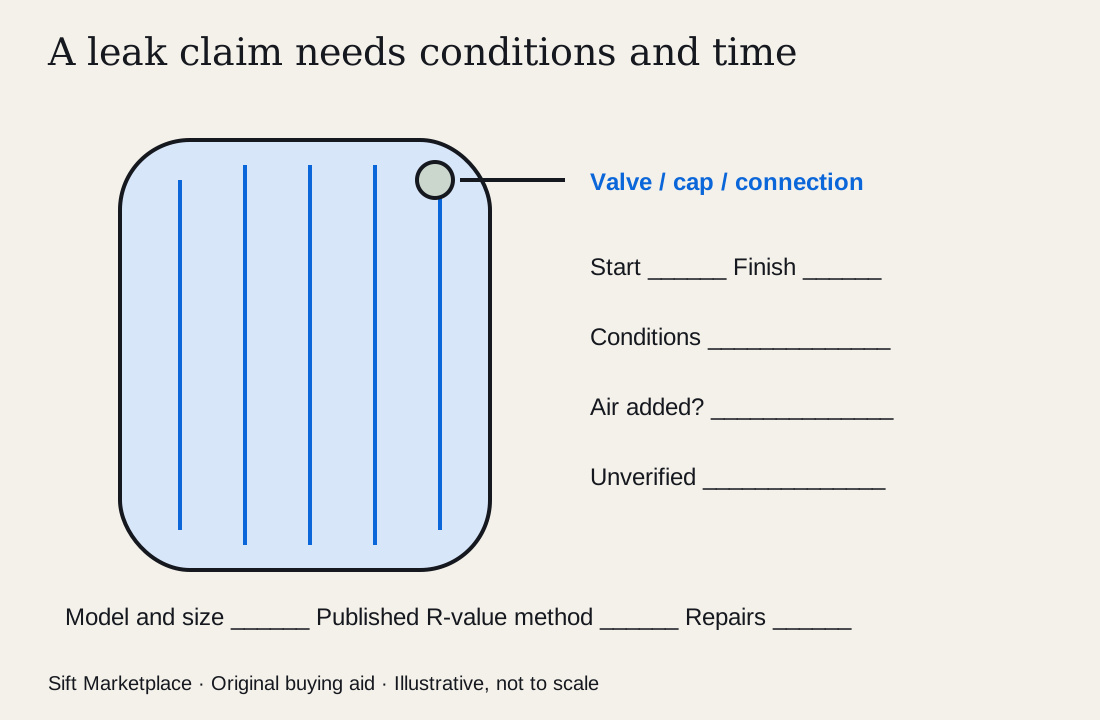
Agree what the seller can demonstrate before travelling. A pad inflated earlier with recorded conditions is more useful than one inflated seconds before you arrive, but still does not prove every trip condition.
| Record | Example of useful wording |
|---|---|
| Exact item | Model, size, valve generation and patch locations |
| Setup | Inflated by the instructed method, indoors on a clean floor |
| Timing | Start and finish times, rather than “held all day” |
| Conditions | Whether the room cooled or the pad moved elsewhere |
| Observation | Shape and firmness at the start and finish; any known air addition |
| Limit | Overnight use under body weight not observed |
Temperature changes can affect how an inflated pad feels. That is a reason to record conditions, not a reason to dismiss repeated unexplained softening. Do not invent a universal acceptable pressure loss or a mandatory test duration. If the observation cannot distinguish an unresolved leak from the conditions, keep the problem unresolved.
A model-approved leak check or professional repair assessment may be appropriate, but follow the exact maker’s method. Do not submerge or apply chemicals to every pad on the assumption that all valves, coatings and internal materials tolerate it.
Price repairs and accessories honestly
Confirm the correct pump-sack connection, valve cap, repair materials and storage bag. An accessory from the same brand can still belong to another valve generation. For a repaired pad, ask whether the maker considers the repair suitable and whether warranty or service applies to this owner; do not assign warranty value without checking the terms.
A hypothetical $55 pad with $25 confirmed repair and $20 compatible pump sack totals $100, excluding collection. A suitable intact alternative at $85 with its pump sack may be the better buy. An unexplained recurring leak does not become a confirmed $25 repair simply because that is the amount you hope to spend.
Use the cost calculator for actual quotes. Pair the pad choice with your sleeping bag assessment. Buy a documented, suitable pad with evidence adequate for your intended use; negotiate a known serviceable omission, and pass when structure or air retention remains a central unresolved risk.
Sources
- 01Therm-a-Rest Sleeping-pad R-value
- 02Therm-a-Rest Pad and bag storage