How do you assess a used foosball table?
Quick answer
Identify the table, measure the full playing and moving space, and inspect its cabinet, surface, rods, bearings and players. Try normal play after appropriate setup. A famous brand or fast-spinning rod does not establish a level surface or a complete serviceable table. Confirm exact parts and a viable move before committing.
Measure the space in two different ways
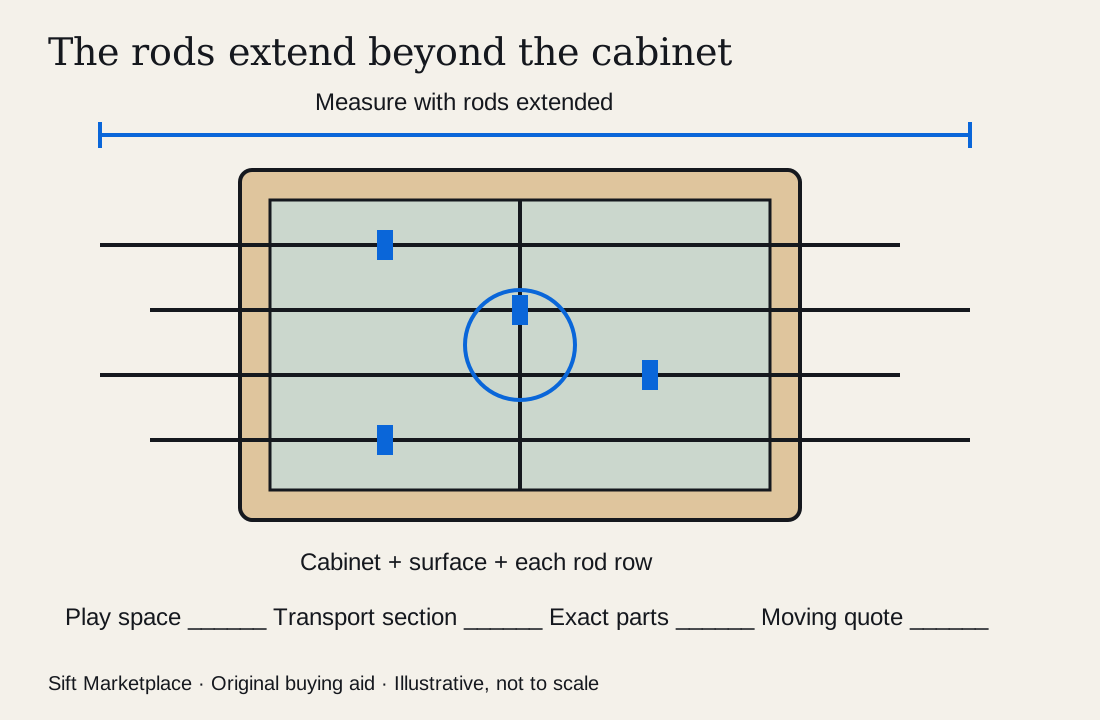
First measure the playing area: cabinet length, width with rods extended, space for players and access to the ball return. Mark this on the floor where you intend to put it. Then measure the collection route, stair turns and vehicle opening for the largest permitted transport section. A table can fit the room yet fail the journey to it.
Ask for the exact model and cabinet construction, not only the brand. Home tables, folding tables and commercial coin-operated models can have different weights, legs, bearings and ball-return systems. Valley-Dynamo’s FAQs also caution that historical serial information is not available to date every vintage Tornado table. Do not turn a seller’s approximate age into a confirmed manufacturing year.
 Enlarge diagram
Inspect the cabinet and field before the accessories
Look underneath and around the corners for swelling, separated joints, cracks and repairs. Ask whether it has been stored in a damp garage or outdoors. A playing field that is warped or separating can be more consequential than missing scoring beads.
Examine the surface in good light for lifted material, chips, sagging and damage around goals. Check that legs and levelers are complete and appropriate for the model. Do not climb on the table or assume adjustable feet will correct a distorted cabinet.
Have the seller set it up correctly on suitable ground. Observe how the ball behaves during ordinary play. A consistent drift is useful evidence to investigate, but it does not by itself distinguish an uneven floor, incorrect leveling or a damaged field. Ask for the setup issue to be resolved before accepting “easy to level” as the explanation.
Check every rod and player row
Move each rod through its normal travel, rotate it gently and inspect for visible bends, damaged handles, missing bumpers and cracked players. Keep clear of rod ends and pinch points. A bent rod can feel different at various positions; one free-spinning row says nothing about the rest.
Count players, bearings, retainers, balls, scoring parts and any cabinet keys. For a coin-operated model, verify permitted access to the mechanism and how normal ball release works. A missing key or locked service compartment can leave part of the purchase uninspected.
Use the exact parts drawing to identify replacements. Rod length, diameter and player attachment are not universal. The maker’s maintenance procedure is the place for model-appropriate care; do not spray a random lubricant to make the viewing feel smoother.
| Finding | Buying response |
|---|---|
| Sound cabinet and field, all rows operate normally | Compare delivery and final setup cost |
| Missing balls, scoring beads or confirmed handle | Price exact replacements |
| One damaged rod with an available correct assembly | Obtain full parts and fitting quote |
| Swollen cabinet or distorted field | Assess repair viability before valuing the brand |
| Seller cannot open a necessary compartment | Keep that system unverified |
Price the room-ready table
In a hypothetical comparison, a $180 table needs $95 confirmed rod/player parts and $180 professional transport: $455. Another suitable complete table at $300 with $120 transport totals $420. The amounts are illustrative; the important point is to price the same outcome.
Include reassembly and any quoted setup separately from the pickup van. Ask the mover whether rods, legs or the cabinet may be removed using the model’s instructions, what the largest remaining piece is and whether access affects the quote. Do not assume handles or rods are safe lifting points.
Ask the seller: “What model is it, has the cabinet been damp, are any rods bent, and are all keys and balls included? Could I see normal play on all rows and photograph the underside?” Use the cost calculator for known parts and delivery. Buy the table whose playing system and move are understood; negotiate specific components, and pass when the apparent saving depends on an unknown field or cabinet repair.
Sources
- 01Valley-Dynamo Tornado FAQs
- 02Valley-Dynamo Tornado parts diagrams
- 03Valley-Dynamo Foosball maintenance procedure