How do you choose and inspect a used garden tiller?
Quick answer
Start with the job and access width, then identify the exact tiller and complete tine, guard, wheel and depth-control equipment. Inspect externally with power isolated and arrange an ordinary seller demonstration on a suitable area. A running engine does not prove the working mechanism is sound. Price confirmed service and loading before buying.
Distinguish cultivating from the job you hope to do
Describe the intended ground, bed size, access width and whether you are maintaining prepared soil or tackling a more demanding job. A compact cultivator and a larger tiller can have very different operating scope. Read the maker’s description for the exact model rather than assigning capability from engine size or tine width alone.
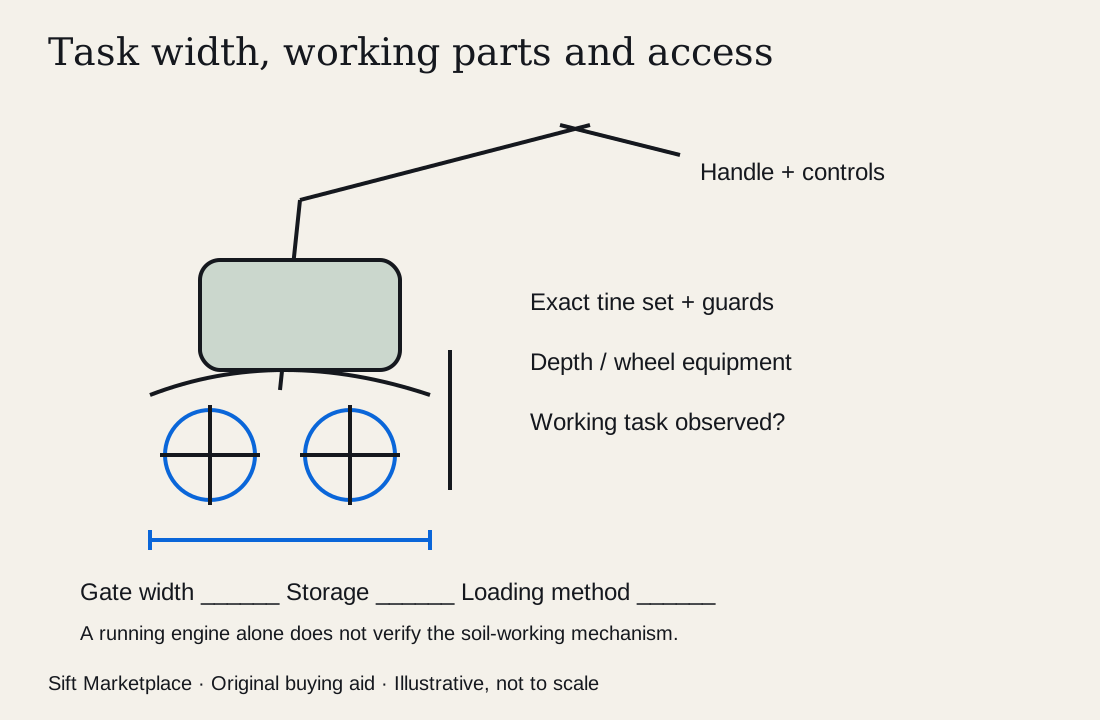
Measure gates, the route to the bed and storage space. Consider whether you can maneuver and transport the machine as its manual requires. A larger machine may suit a task but be inaccessible through the only gate.
The Honda FG110 owner manual illustrates a model-specific reference for controls, equipment and operation. It is not a generic procedure for every front- or rear-tine machine. Match the sold unit’s model and serial range to its own manual.
 Enlarge diagram
Request the whole equipment inventory
Ask for label photos and both sides of the machine. List the correct tine set, shields, depth stake or other depth-control equipment, wheels, handles, controls and any approved attachments. Confirm which pieces are included rather than assuming everything pictured transfers.
Ask about storage, service, starting problems, leaks and repairs to the working drive. Request receipts where available. A seller’s “carburetor clean” explanation does not establish the cause of a non-running machine, and it says nothing about the tine drive.
With the machine safely isolated according to its manual, inspect accessible tines for damage or missing pieces, guards and fasteners, handles and the frame. Look for cracks, bent parts, obvious leaks and modifications. Do not reach into a mechanism that could move or remove guards for a live inspection.
Agree on a suitable ordinary demonstration
Use a competent operator, a clear appropriate area and the manufacturer’s requirements. Do not request a destructive trial in stony ground, deliberately stall the machine or stand near rotating tines. If the seller cannot provide a suitable working demonstration, distinguish engine operation from the unobserved soil-working task.
| Check | Record |
|---|---|
| Start and normal controls | Observed conditions and any difficulty |
| Intended working task | Suitable ground used, ordinary operation observed or not |
| Depth and maneuvering controls | Correct equipment present and normal response |
| Noise, leaks or interruptions | Specific symptom, without naming an unconfirmed failed part |
| Shutdown and handling | Manual-directed operation and practical storage/loading plan |
A rough result may involve the soil, setup, wear or a fault. Do not diagnose a transmission from a noise alone. If a material concern persists, get a competent assessment and quote or pass. Missing guards or altered controls are reasons to resolve the configuration before use.
Compare the ready-to-work cost
A hypothetical $160 tiller needing a confirmed $65 tine set, $75 service and $40 transport totals $340. A complete suitable candidate at $290 with $35 transport totals $325. These invented amounts illustrate the decision. The first total is meaningful only if the repair scope is actually established.
Check availability of the exact tines and control parts, including labor and shipping. Use the cost calculator for known costs and compare the machine’s task fit separately. A low price cannot make an inaccessible machine useful.
Ask: “What is the full model and serial range, which tine/depth/wheel parts are included, and what repairs or operating issues has it had? Can a competent operator demonstrate normal use on suitable ground?” Before collection, follow the manual’s fuel, transport and handling instructions and confirm adequate loading help. See used power tools for the broader distinction between a complete tool and a claimed easy repair.
Sources
- 01Honda FG110 owner manual