What should you inspect on a used hedge trimmer?
Quick answer
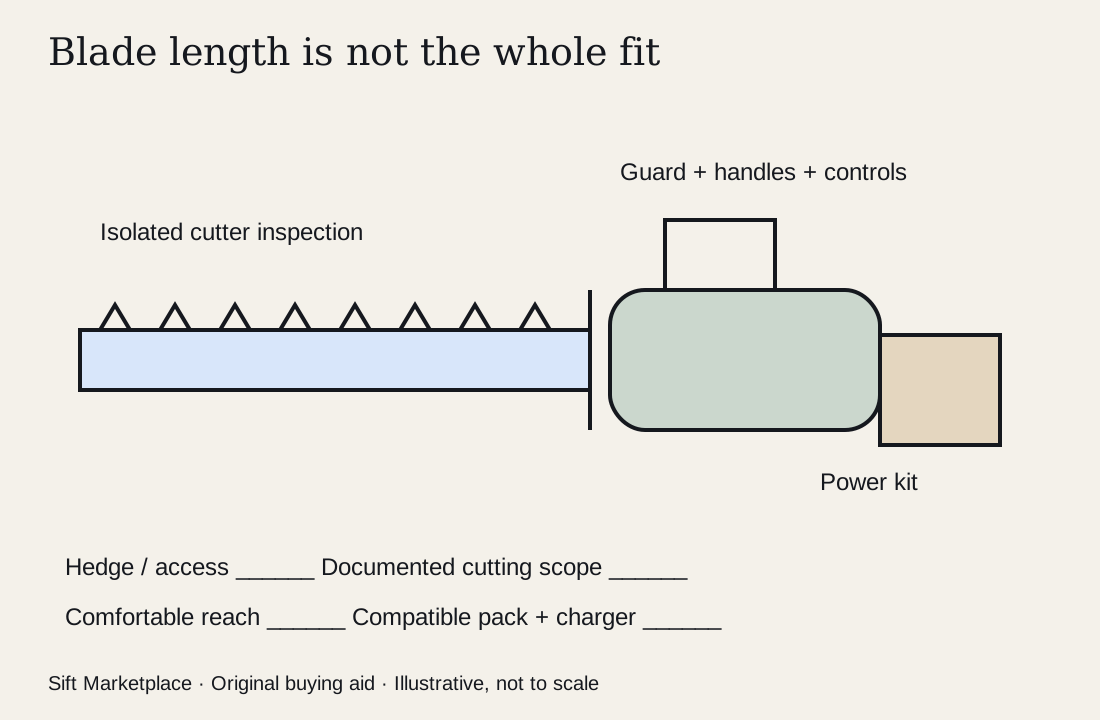
Choose the correct reach and documented cutting scope, then identify the exact tool, guard, sheath and power equipment. Inspect the cutter externally with power isolated and observe normal operation only in a suitable setting. A long blade is not proof of suitable reach, and a short run does not establish battery runtime or a cheap repair.
Start with hedge height, access and the actual cuts
Record the hedge height, width, access along both sides and the type of trimming required. Compare the exact maker’s cutting scope rather than assuming blade length equals branch capacity. Decide whether a standard or approved pole design is appropriate; do not plan an unsupported extension or awkward ladder demonstration to make a bargain usable.
Check whether you can handle the tool comfortably in ordinary permitted positions. Include the intended battery if cordless, because a bare tool’s balance is not the complete setup. The DEWALT DCHT820 manual is a specific example of cutting and handling instructions; use the manual for the exact sold model.
 Enlarge diagram
Inspect the isolated cutter and complete tool
Ask for the model/type label, both sides of the cutter bar, handles, guard, sheath and battery/charger labels. Confirm any repairs or replacement blades and whether the tool has struck wire, stone or another hard obstruction.
With the power safely isolated according to the manual, look for obvious bends, damaged teeth, corrosion, loose components and cracked handles or guards. Do not run fingers along sharp edges, force the blades to move or adjust blade clearances during a viewing. A visible concern needs competent assessment; a motor spinning does not establish sound cutting components.
Check accessible wiring and plug condition on corded models. For cordless tools, keep the tool, pack and charger identities separate. A pack fitting the slide is not a complete compatibility check, and an unknown aftermarket supply should not be treated as equivalent to an approved one.
Observe normal use without testing the limits
If the tool’s condition permits it, have a competent seller demonstrate ordinary operation with the correct guard and supply, suitable protective equipment and a clear area. Only use material and a cutting task permitted by the exact manual. Do not deliberately jam the cutter or cut oversized branches to test its strength.
Record control response, ordinary cutting behavior, unusual vibration or noise and any interruption. If a safety-related control is damaged or bypassed, stop. Do not accept “just needs sharpening” as a diagnosis for binding or poor operation without an appropriate service assessment.
| Finding | Purchase response |
|---|---|
| Correct task, complete guards and normal operation | Continue to price and power-kit comparison |
| Missing correct sheath | Confirm replacement for safe storage/transport |
| Bent cutter or persistent abnormal vibration | Seek assessment or pass |
| Bare tool works on seller’s battery | Your own compatible power kit still needs pricing |
| Short cordless demonstration | Long-session runtime remains unverified |
Compare the complete hedge-trimming setup
A hypothetical bare tool at $65 plus a confirmed $80 compatible pack, $35 charger and $10 collection totals $190. A complete suitable kit at $160 plus $10 collection totals $170. These are invented numbers. If you already own an approved compatible pack and charger, your comparison changes; record that explicitly rather than assuming every buyer starts with the same equipment.
Add a genuine cutter-service quote only after the issue is assessed. Use the used-power-tool guide for battery evidence and the cost calculator for known costs. A cheaper tool with the wrong reach is not a saving for your hedge.
Ask: “Please show the full model label, cutter bar and all power parts. Has it struck anything or had cutter work? Can we observe a normal suitable trim with its original controls and guard?” Confirm included parts and follow the manual’s shutdown, sheath and transport instructions before taking it home.
Sources
- 01DEWALT DCHT820 Type 1 owner manual