How do you buy a used leaf blower and vacuum bundle?
Quick answer
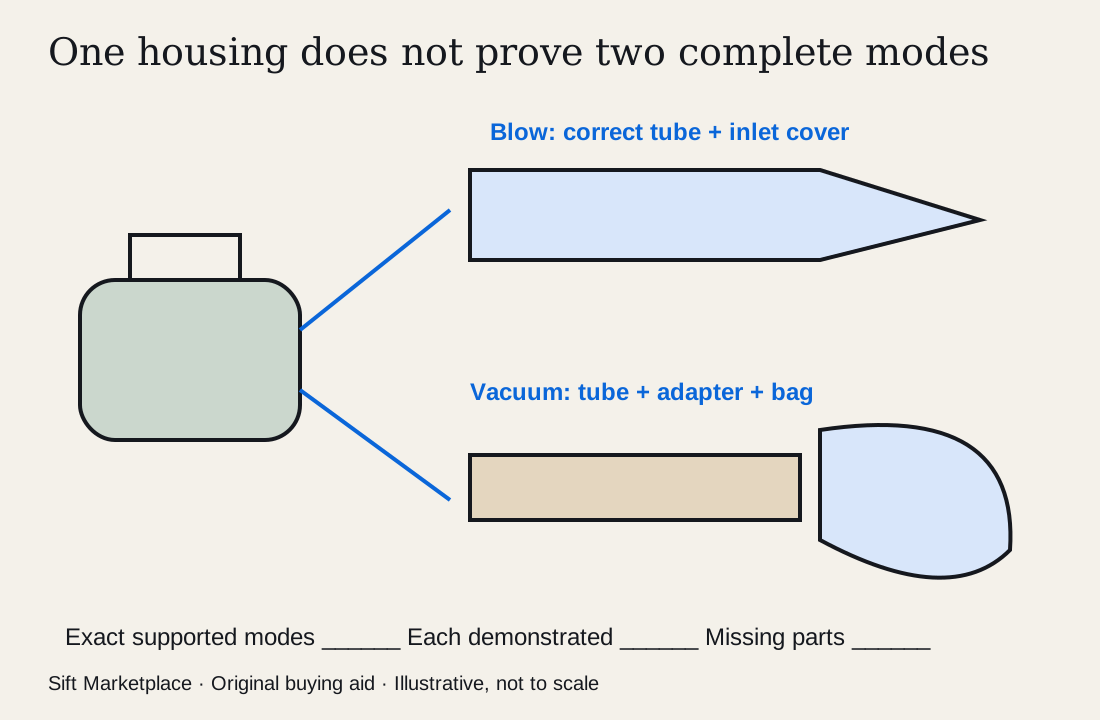
Establish whether the exact model blows, vacuums or supports both. Inventory the correct inlet cover, tubes, collection bag and power parts for each intended mode. Inspect with power isolated and observe ordinary operation with the complete guarded assembly. A working blower does not prove the vacuum conversion or bag is usable.
Decide whether you need blowing, collection or both
Describe the area, normal debris and disposal route. If collection is essential, do not buy a blower on the assumption that a vacuum tube can be added. Verify the exact model’s supported modes and materials, not a similar product-family photograph.
For cordless equipment, identify the battery and charger as separate items. For a corded or engine-powered model, confirm the correct supply and suitable operating setting. Measure storage length and decide whether the weight and bag arrangement are comfortable for the task.
Toro’s operator manual shows distinct blower and vacuum configurations. The buying lesson is the complete assembly: the required inlet cover, tube or bag is not an optional cosmetic accessory. Follow the matching manual for your candidate.
 Enlarge diagram
Lay out every conversion part
Ask for the label and all included pieces in one photograph. Identify blower tubes/nozzles, the correct inlet cover, vacuum tubes, bag adapter, bag and straps where required. Look up part identifiers before treating a replacement bag as generic.
Inspect bag seams, fabric, zipper and mounting collar. A bag that attaches but is torn or deteriorated is not a complete collection system. Check tube latches and the accessible housing for cracks or repairs with the power isolated as the manual specifies.
Do not access the impeller while energized or while it is still moving. Do not defeat an interlock or run a machine with a missing guard to prove the motor works. A seller who has lost a required cover needs the correct replacement before that operating mode can be demonstrated.
Observe the actual task, not only the sound
Arrange ordinary use on suitable dry debris and in a clear area, following the exact instructions. A competent seller should demonstrate the required configuration. Keep bystanders clear and do not use stones, wet material or other unsuitable debris as a stress test.
Record blowing and vacuum collection separately. Does the relevant attachment remain secure? Does collection reach the bag under normal use? Are controls responsive, and is there unexpected vibration, smell or interruption? An abnormal result needs assessment; it does not establish that a single cheap impeller or switch fixes the machine.
| Observation | Decision |
|---|---|
| Blower works; vacuum parts missing | Value as a blower unless exact completion parts and function are established |
| Bag worn; correct replacement available | Include the full replacement cost |
| Both ordinary modes work | Continue to task fit and power-kit comparison |
| Short cordless run only | Battery runtime remains uncertain |
| Damaged housing, guard or latch | Resolve before operating; consider another candidate |
Compare the complete bundle
In a hypothetical example, a $45 machine needs a $35 correct bag, $25 vacuum tube and $10 collection: $115. A complete model at $90 with $10 collection totals $100. These figures are invented. If you only need blowing, the vacuum extras may have no useful value to you; if you need collection, they are central.
A cordless bare tool also needs compatible power parts. Use the used-power-tool guide for that evidence and the cost calculator for known additions. Do not give a seller’s tired battery full replacement value because it starts the motor once.
Ask: “Please confirm the full model, all blower/vacuum conversion parts and bag condition. Can you demonstrate the modes I need with the correct covers fitted? Are there any persistent vibration, starting or battery issues?” Confirm inclusions, clean permitted removable parts as instructed and store the complete kit together after collection.