Buying a used mechanical watch
Quick answer
Confirm the reference and fit, observe normal functions, and use an appropriate watchmaker assessment when authenticity, service condition or water resistance matters.
A mechanical watch running at a meetup has demonstrated that it runs at that moment. It has not proved originality, long-term accuracy, service condition or water resistance. Decide which of those claims matter to your purchase and arrange evidence proportionate to the price and purpose.
Identify the reference, then check fit
Ask for the full reference, approximate age, movement or calibre if known, case size and included bracelet links, straps, box and documents. Request clear photographs of the dial, case, back, crown, clasp and both sides of the bracelet. Do not rely on a familiar dial design or a model family name to identify the exact watch.
Ask about service, replaced hands or dial, polishing, crystal replacement, bracelet repairs and water exposure. Replacement parts can be appropriate maintenance while still mattering to a collector seeking original components. Keep those questions separate from whether the watch tells time.
Try the watch on with permission. Check case overhang, thickness under your sleeve, crown contact with your wrist and whether the bracelet can fit without unavailable links. Count spare links and identify their correct type. A strap of the right width does not solve every fit or attachment issue.
 Enlarge diagram
Inspect visible condition without opening it
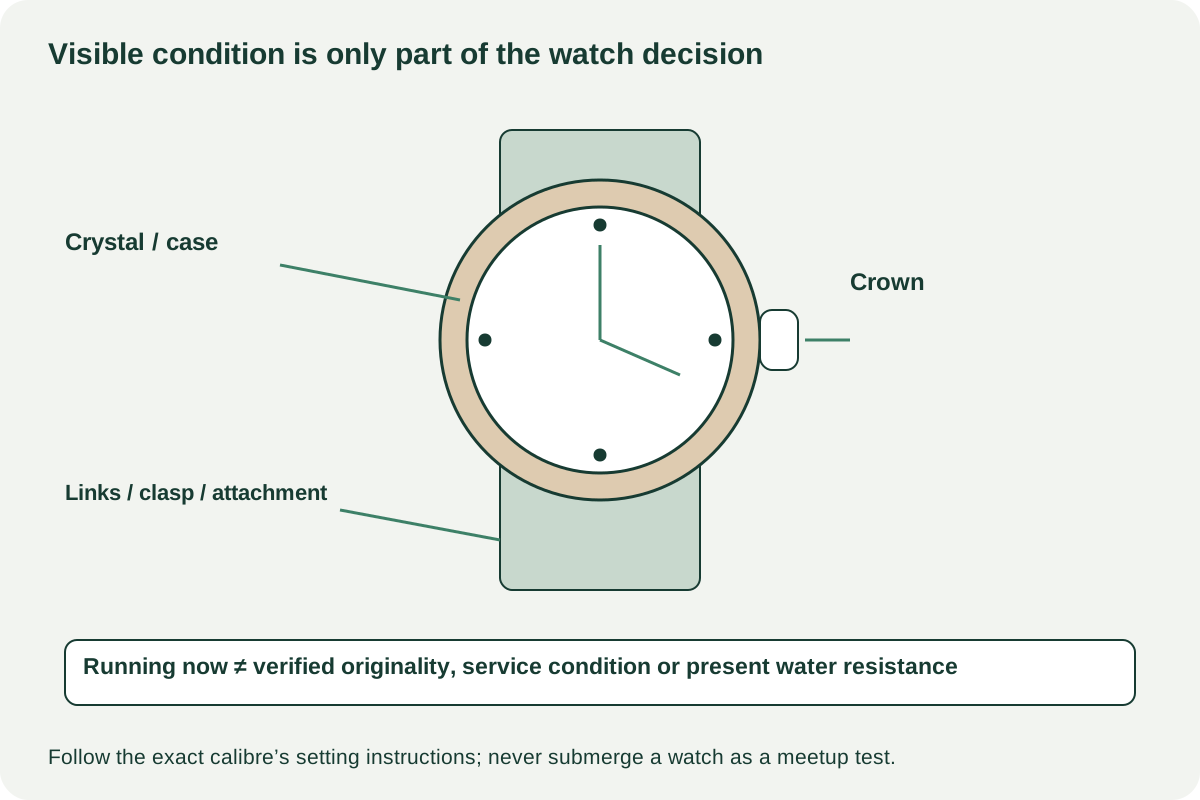
Examine crystal edges, case joints, crown, lugs, bracelet pins or screws and clasp operation. Look for corrosion, condensation, cracked parts, loose attachments or signs of a poorly fitted replacement. Surface scratches are not equivalent to moisture inside the watch. Do not open the case or remove parts without appropriate equipment, expertise and the seller’s agreement.
Check that the clasp closes and releases normally and that the strap or bracelet is secure. Avoid pulling hard on spring bars as a test. If attachment condition is uncertain, do not wear the watch in a way that risks dropping it.
Observe the dial and hands under normal light. Misalignment or a visually unusual component is a reason to ask for explanation and assessment; it is not enough to authenticate or condemn a watch from a photograph. High-value or frequently counterfeited models warrant a knowledgeable independent inspection before payment, with a clear agreement about who will inspect it and what their opinion covers.
Demonstrate only the functions permitted by its manual
Ask the seller to show ordinary winding, time setting and other functions according to the exact calibre’s instructions. Crown positions, screw-down procedures and calendar restrictions vary. The Seiko 4R35/4R36 instructions are an example of why the movement-specific manual matters; do not transfer a setting sequence to a different mechanism.
Never force a stiff crown or change a calendar at a time prohibited by the model’s manual. For a chronograph or complication, test the supported start, stop, reset or setting sequence only when you understand it. A hand returning to an unexpected position deserves assessment rather than repeated forceful operation.
Note whether the watch continues running during the meeting and whether functions respond consistently. A seller’s multi-day timing record is useful if it identifies dates, winding and wearing conditions, but it remains seller-provided evidence. A brief comparison to a phone cannot establish daily accuracy or power reserve. A watchmaker’s measured results also need interpretation for the calibre and test conditions; do not treat one number as a full health certificate.
Ask what “serviced” actually included
Request the date, provider, itemised work and parts replaced, plus any stated warranty and its terms. “Serviced recently” might mean anything from a regulation to substantial overhaul. Contact the provider with the owner’s permission if a material claim needs confirmation. A service record should match the watch and reference, not merely show a payment to a watch shop.
Seiko’s service explanation describes inspection and service operations, but your purchase needs evidence of what was done to this watch. If its history is unknown, get an estimate for an appropriate assessment and likely service scope rather than assuming a fixed universal service price or interval.
Water resistance is a separate claim. Seiko explains that it can change with gasket condition and other factors in its care guidance. Do not submerge a used watch to test it. If swimming or another water use is essential, confirm the model is suitable and arrange a professional pressure test and advice for its present condition. An original rating printed on the dial is not current proof.
Price fit, service and uncertainty honestly
Imagine a hypothetical $400 watch needing $60 correct links and a $220 quoted service, plus $20 travel: $700. A $650 correctly fitting watch with documented relevant service and $20 travel may cost less to put into your intended use. Those numbers are examples only. A service estimate does not resolve authenticity, and a claimed collectible premium should not be justified by a repair budget.
Ask yourself which unknown would make you regret the purchase: a replacement dial, unavailable links, unsuitable water use or an unpriced movement fault. Resolve that question before negotiating smaller cosmetic issues.
Buy when identity, fit and evidence meet your purpose. Negotiate disclosed cosmetic wear or a properly scoped service need. Pass when independent assessment is necessary but refused, provenance conflicts with the item, or the sale relies on “it ticks, so it is fine”. For a watch whose value depends on expertise you do not have, arranging that expertise is part of buying well.