Buying used action figures
Quick answer
Match the exact release and included parts, inspect joints without force, and decide whether the evidence supports a display purchase or a collectible premium.
Start with the role the figure will fill: play, open display, customisation or a collection where original packaging and parts matter. A loose figure with a replacement accessory may be excellent for display and unsuitable for someone seeking an original complete release. Make that distinction before comparing prices.
Identify the exact release
Record the manufacturer, line, scale or advertised size, character, release identifier and variant. Familiar characters are often released repeatedly with different paint, articulation, accessories or packaging. Ask for front, rear and base markings where present, plus clear images of the actual included accessories.
Use the manufacturer’s page for the specific release. For example, Hasbro’s Boba Fett product record lists the accessories supplied with that release. That inventory is evidence for that product, not every figure depicting the same character. A generic checklist from another edition can make a complete figure appear incomplete or conceal a missing part.
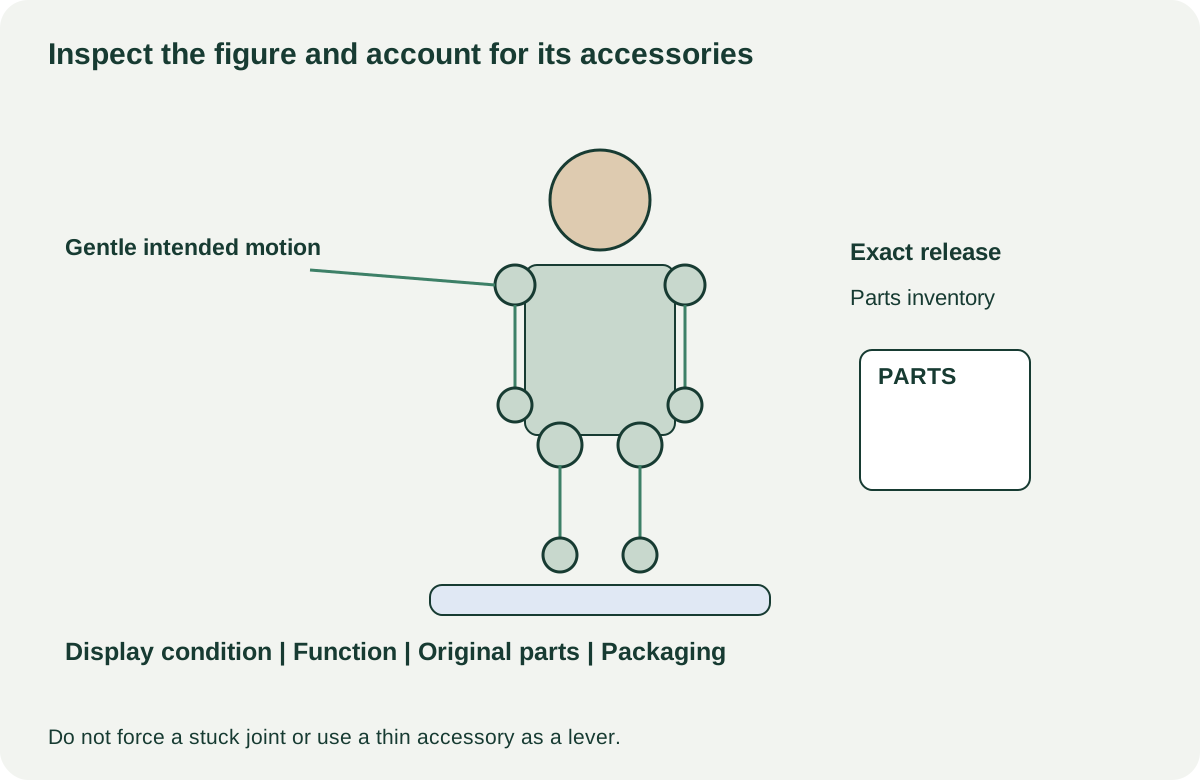
Build a short inventory: figure, alternate hands or heads, clothing, weapons, stands, effect pieces and packaging. Mark each as original, disclosed replacement, missing or unknown. Do not assume a sealed-looking bag or logo establishes authenticity.
 Enlarge diagram
Inspect finish and structure separately
Under ordinary light, examine the face, printed details, exposed edges, joints and contact points with clothing or accessories. Look for paint transfer, chips, fading, sticky surfaces, cracked joints, bent pegs and visible glue. Ask about sunlight display, smoke, repairs, repainting and long-term poses that may have stressed parts.
Photographs should show the actual figure, including its less flattering angles. A stock promotional photo is useful for identifying a release but cannot establish the condition of the item being sold. Request a closer image where glare hides the face or joint.
Ask before handling. Support the figure and move only the joints intended to move, using gentle ordinary motion. Do not force a stuck joint, pull a head to see whether it detaches, heat parts at pickup or use a weapon as a lever. If the correct movement is unclear, consult the instructions or leave it untested.
A figure that holds a simple ordinary pose has demonstrated that pose at that time. It has not proved that every joint is sound or that it will hold an extreme display position indefinitely. A loose ankle may matter more to your shelf display than a scuff on the back; judge condition against your intended use.
Check accessories for fit, not just count
Lay accessories out with the seller and compare them with the agreed list. Inspect thin pieces for cracks, stress marks, glued breaks and missing ends. A replacement may look plausible in a photograph but fit poorly. With permission, demonstrate ordinary supported attachment without forcing a peg or grip.
Soft goods deserve their own inspection: seams, fasteners, holes, colour transfer and deterioration can be separate from the figure’s plastic condition. A removable stand may be essential for your preferred display even if it was optional in the original package. Include a suitable display solution in your cost if stability matters.
For a lot, count each figure and its accessories rather than assuming a mixed box of hands and weapons contains every match. Take an agreed inventory photograph before packing so the loose parts travel with the correct figure.
Treat packaging and provenance as distinct claims
A box can be original but belong to another release. It can also be resealed, damaged or repaired. If sealed condition drives the price, do not treat a surface glance as authentication. Opening the item changes what is being sold, so agree on the inspection basis before payment. A buyer seeking a high-value collectible should obtain appropriate independent expertise and provenance when those claims cannot be established locally.
Receipts and a consistent ownership story are useful context, not proof of every part. Serial markings, brand stamps and convincing packaging alone do not exclude replacements. Ask direct questions: “Has anything been repainted, repaired or replaced? Are all these accessories from this release? Is the packaging original to this figure?” A clear disclosed custom figure should be evaluated as that custom work.
For children’s play, use the manufacturer’s age guidance and safety information for the exact product. An adult collectible with small removable parts should not be assumed suitable because it resembles a familiar toy.
Price the display you can actually complete
Suppose a hypothetical $55 loose figure needs a verified $25 original accessory and $10 travel: $90. A $80 complete figure with $10 travel reaches the same total. If the replacement accessory is merely similar, it does not make the first listing equivalent for a collector. If you do not need that accessory for display, the cheaper figure may still suit you.
Avoid valuing a bundle by promised resale of the characters you do not want. Compare the items you will keep and the real work needed to display them. Use listing comparison notes for missing parts, repairs and the exact release so superficial likeness does not hide a meaningful difference.
Buy when the identity, condition and completeness satisfy your purpose. Negotiate a disclosed missing accessory or cosmetic flaw you accept. Pass when an originality premium rests on uncertain parts, a necessary joint remains untested, or the seller’s description conflicts with the item in front of you.