Buying used tabletop miniatures
Quick answer
Choose for display, painting or a specific game, then inventory each model and verify the current rules and event requirements that matter to you.
A large miniature lot can be impressive and still contain very little you need. Decide whether the goal is painting practice, display, casual play or an army for a particular rules environment. The same converted or incomplete model can be welcome in one use and unsuitable in another.
Build a model-level inventory
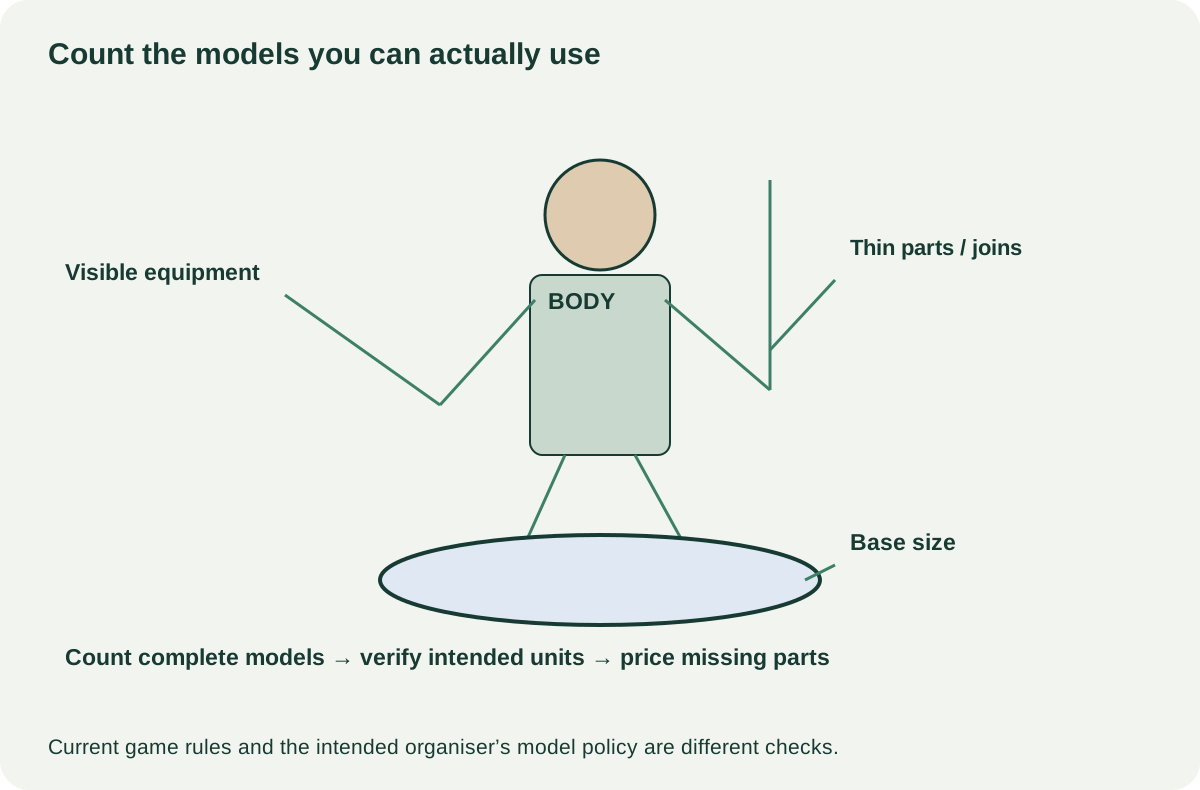
Ask for models laid out in small labelled groups rather than one crowded army photograph. Record the game, faction, claimed unit, number of complete models, base shape and size, visible equipment and loose parts. Separate unopened kits, partly built kits, assembled models and painted models. “A thousand points” is not an enduring inventory because rules and point values change.
Use the publisher’s current rules and the requirements of the place you will play. The Warhammer download centre and its 2026 core-rules release show why an old army list should not be treated as current evidence. Check your exact game and faction; do not assume every model with a familiar name remains used in the same way.
| Inventory field | What it prevents |
|---|---|
| Actual complete model count | Paying for bodies that cannot form the intended unit |
| Equipment and optional parts | Discovering the desired configuration is absent |
| Base dimensions and attachment | Underestimating rebasing work or damage risk |
| Material and assembly condition | Treating different repair jobs as equivalent |
| Current intended use | Buying a collection that does not meet your local play requirements |
 Enlarge diagram
Inspect assembly under ordinary light
Look from several angles at joins, seams, gaps, weapon alignment, thin pieces and contact with the base. Check for thick glue, broken pegs, missing hands, unsupported poses and detached parts. Ask whether conversions use original kit parts, third-party components or printed replacements. A clear disclosure lets you decide suitability; an attractive paint finish does not establish what is underneath.
Do not bend a spear or remove a base to test strength. A seller can gently demonstrate how a part is attached if that is safe, but a meetup is not the place to disassemble fragile work. If hidden joins matter to a restoration plan, accept that their condition may remain uncertain until specialist work starts.
For partly built kits, compare sprues and loose parts with the actual assembly instructions. Count essential components, not just plastic frames. A spare weapon from another kit may not attach as expected. Treat an unverified bag of bits as extras, not as proof that every incomplete model can be finished.
Decide whether you want the existing paint
Look for obscured detail, rough texture, accidental thick areas, chips and paint on joint surfaces. Ask whether the seller applied primer, paint and varnish, and whether they know which products were used. Good photographs can reveal appearance but do not establish every layer or repair beneath it.
Buying painted models makes most sense when you like them as they are. If your plan depends on stripping and rebuilding, price it as a restoration project. Do not assume that an unknown coating will come off cleanly or that a solvent suitable for one material is safe for another. Avoid chemical experiments at pickup; obtain material-specific guidance before any restoration.
For a commissioned or premium painted collection, ask for close photographs of representative ordinary models as well as the showcase leader. Check the whole lot for consistent finish, transport wear and completed bases. Your willingness to pay for labour should follow the result you want, not an unverifiable claim about hours spent.
Confirm play expectations with the actual organiser
A publisher’s rules and an event’s model policy are different questions. If conversions, alternative parts, old bases or printed components are material to the purchase, confirm acceptance with your club or event before paying. Do not ask a seller to guarantee an independent organiser’s decision.
For casual play with friends, agree on identification and equipment expectations before buying a proxy collection. For display or painting practice, those rules may be irrelevant. Keeping the purpose explicit prevents paying a premium for tournament suitability you have not verified or rejecting an enjoyable display model for a rule that does not apply.
Calculate the cost per usable project
Imagine a hypothetical $180 lot with 30 figures. If only 12 suit your planned force, dividing $180 by 30 creates a misleading comparison. Add $35 verified missing parts, $20 bases and $15 transport: the project is $250, plus your repair time. Compare that against a smaller complete collection that meets your plan. Do not assume unwanted models will resell for a particular amount.
Use a simple decision for each group: ready for my purpose; needs identified work; unsuitable or uncertain. Negotiate around the second group using actual parts and your own willingness to work. Exclude the third group from the value you rely on.
Ask the seller for a final laid-out inventory before packing. Transport fragile models in appropriate protection rather than a loose bag. Buy when the useful models, condition and rules fit are clear. Pass when the sale depends on uncounted completeness, hidden construction or an assurance of legality that only your intended organiser can give.