Buying used model trains
Quick answer
Identify the exact model and your layout requirements, then demonstrate compatible power, running, couplings and functions without forcing an uncertain electrical setup.
The first question is whether the train belongs on your layout. An attractive locomotive can be unsuitable because its gauge, electrical system, controller, minimum curve requirement or coupling arrangement does not match. Start with the railway you have, then evaluate the condition and completeness of the model.
Make a layout compatibility record
Record the manufacturer, catalogue number, scale and gauge separately. Scale describes the model’s proportions; gauge concerns the track spacing it runs on. Do not use a photograph of track as the only compatibility check. Add the intended power/control system, actual smallest curve, relevant points and crossings, clearances and the couplings used by your rolling stock.
Manufacturer product records can specify these constraints. For example, a Hornby locomotive listing identifies scale, decoder provision and curve requirements together. Look up the exact catalogue number rather than transferring a specification from another locomotive in the same family.
| Item to match | Question for the seller |
|---|---|
| Track and electrical system | What track and controller was this operated on? |
| Decoder | Is it fitted, and what exact decoder is installed? |
| Address and functions | Can these be demonstrated and documented for handover? |
| Curves and clearances | What minimum requirements does the manufacturer state? |
| Couplings | Are the correct couplings present, modified or missing? |
| Details and accessories | Which optional and essential parts are included? |
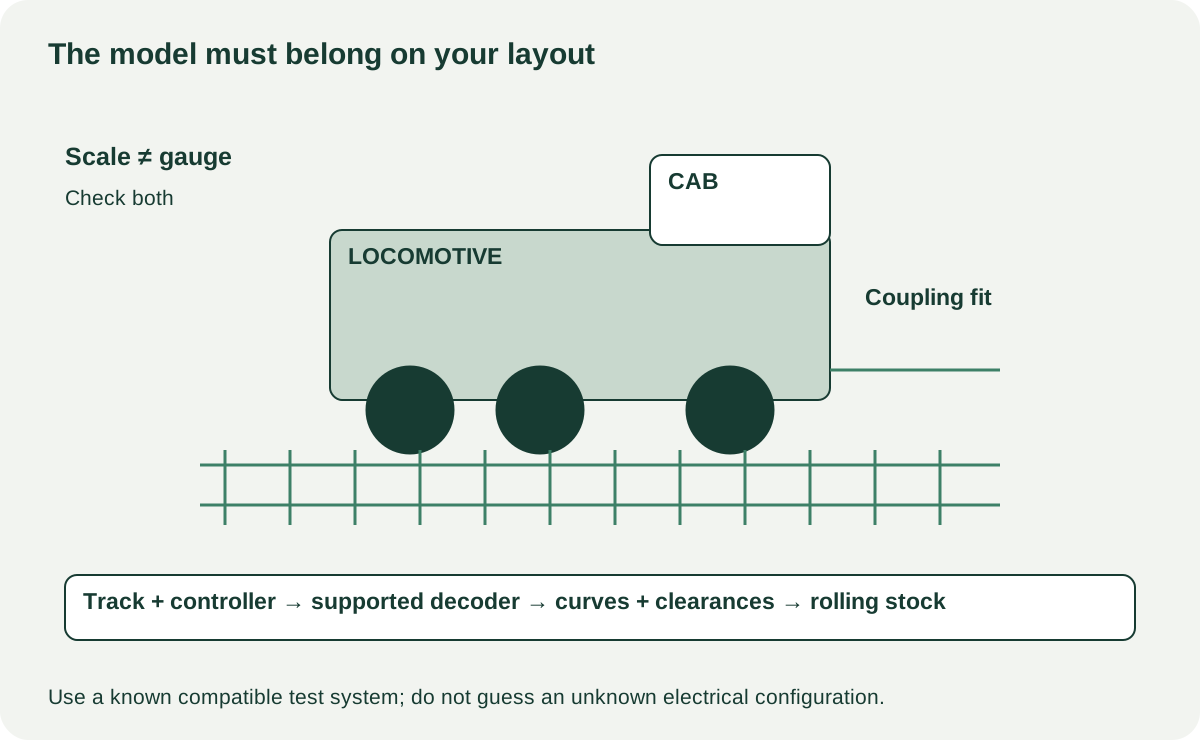 Enlarge diagram
“DCC ready” is not “decoder fitted”
Ask whether the model is analogue, decoder-ready or already equipped with a decoder, and whether that condition is original or modified. Hornby’s HM7000 FAQs show why decoder selection and supported operation are specific to the model and system. Do not connect an unknown locomotive to whatever controller happens to be available.
For a modified model, request the decoder model, installation record, settings relevant to operation and any removed parts. Sound functions, lighting and smartphone features need their own compatibility checks. An address scribbled on a box may be useful, but it is not a complete specification.
If neither party can identify a safe supported test configuration, defer the demonstration to a knowledgeable hobby shop or experienced operator. A lower price does not resolve an unknown electrical setup.
Inspect the model before running it
Use a stable, well-lit surface and handle the model by the manufacturer’s recommended areas. Look for missing handrails, cracked steps, detached detail parts, damaged wheels, loose couplings and signs of poor repairs. Check whether a steam locomotive’s tender and its connecting parts belong to the model. Ask before removing a body shell; many details are delicate and not designed for casual inspection.
Distinguish display damage from functional damage. A missing cosmetic part may matter greatly to a collector and little to an operator. A missing coupling, bent wheel or damaged connecting component can prevent the intended use. Bagged accessories should be counted against the actual model’s parts list rather than assumed to fit.
For rolling stock, inspect free movement on compatible track, wheel condition, coupling height and whether the cars negotiate the relevant layout features. Do not force a model around a curve tighter than its documented requirement.
Watch it run in both directions
Use a clean, known-working compatible test track and appropriate controller. Start gently and observe low-speed movement, ordinary running and stopping in both directions. Watch for consistent stalls, jerking, wheel slip without a load, repeated derailments or unusual noise. Test lights and other advertised functions individually.
A short straight track can establish basic motion but cannot prove suitability on your curves, points or full layout. If pulling capacity matters, agree on a reasonable demonstration with appropriate rolling stock rather than inventing an excessive load. A stall can arise from track, pickups, settings or the locomotive; change known variables carefully and do not diagnose a motor from one hesitation.
For a set, run every powered unit. Inspect each coach and wagon you value. A photograph of one moving locomotive does not verify a box of mixed items. Count the track pieces and confirm the controller and power supply actually belong to the set.
Price the completed railway task
In a hypothetical example, a $110 locomotive requiring a $45 compatible decoder, $40 professional fitting and $15 travel totals $210 before any other issue. A $190 properly equipped, tested locomotive with $15 travel totals $205. These figures are only illustrative. Verify actual compatible parts and labour before negotiating.
For a starter layout, compare a complete working set against assembling a collection of mismatched bargains. Include essential controller, supply, track and couplings, plus appropriate storage for fragile models. Do not count a seller’s “rare” description as a verified collectible premium.
Buy when the model fits your layout and the relevant functions are demonstrated. Negotiate known missing details or a documented conversion you intend to undertake. Pass when the system is uncertain, critical parts are unavailable, or the operating evidence does not support the intended use. A model suited to display can still be a good purchase if it is priced and described as a display item.