Buying used retro game cartridges
Quick answer
Match the cartridge to your console and region, test the actual game and its save method, and treat authenticity and completeness as separate evidence questions.
Decide whether you want a game to play, a particular regional release, or a collectible complete copy. Those goals require different evidence. A cartridge can boot and still have a failed save function, a replacement label or a mismatched box. Conversely, a visibly worn genuine copy may suit a player better than a pristine but poorly documented listing.
Identify the game beyond its title
Record the console, title, region, language, product code and claimed edition. Ask for clear photographs of the front, back, edge and included box or manual. Compare the specific release with reliable publisher information where available. Do not assume that a familiar title has the language, content or compatibility of the version you remember.
Check the exact console you will use, including any legitimate compatibility limitations. A test on an altered or multi-system device can be useful context but may not establish operation on your own original console. Arrange a demonstration on an appropriate system, ideally the model you plan to use.
Make an inventory with three columns: claimed item, photographed item, verified item. “Complete” should become an explicit list, not an adjective. Box, manual, inserts and cartridge may have different wear or regional identities. Ask whether any component is a reproduction, replacement or repaired part.
 Enlarge diagram
Inspect without damaging the cartridge
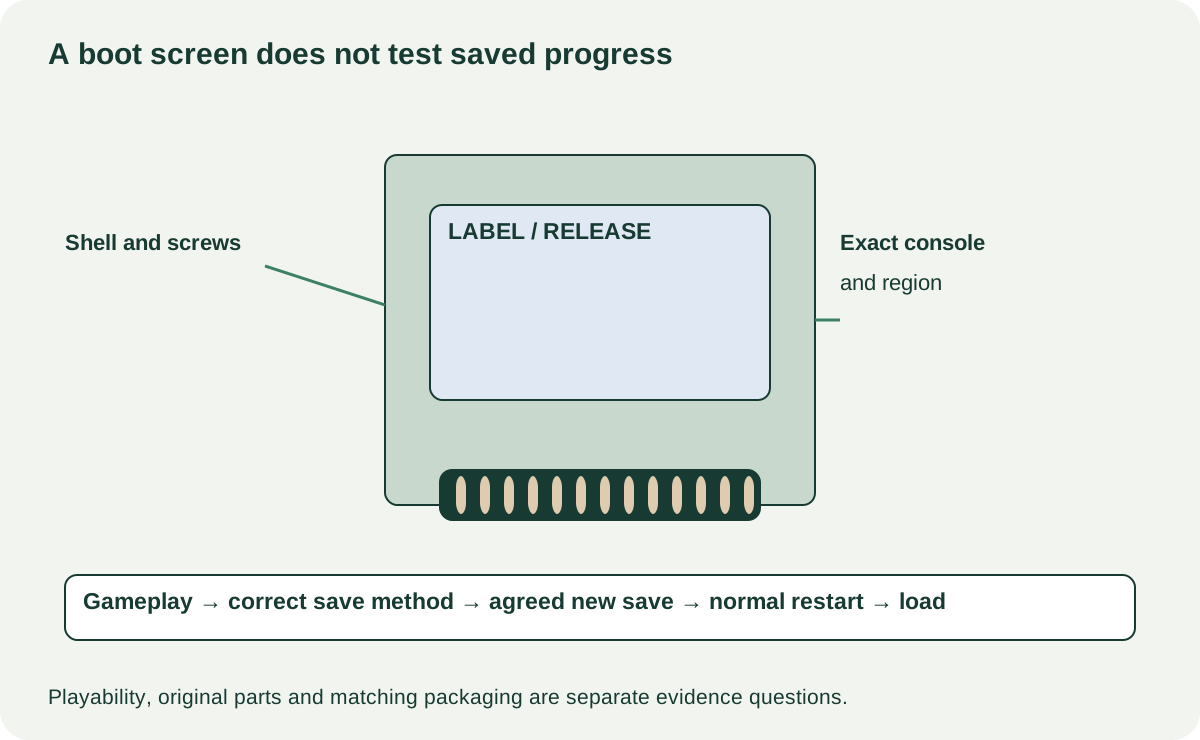
Look for cracked shells, missing screws, distorted plastic, corrosion and residue around accessible contacts. Check label wear and alignment as observations, not a definitive authentication formula. Labels, shells and even packaging can be replaced. Nintendo warns about counterfeit products in its intellectual property and piracy FAQ; a convincing sticker or low price does not resolve provenance.
Do not scrape contacts, blow moisture into the cartridge, apply chemicals or take apart a valuable item without permission and appropriate expertise. If an internal inspection is necessary to substantiate a high-value originality claim, arrange a knowledgeable independent assessment with the seller. Do not improvise a screw-opening test at the curb.
Ask about battery replacement, board repair, replacement shells and labels. A documented save-battery replacement may be useful for a player while changing what a collector considers original. Keep both facts visible instead of treating “repaired” as automatically good or bad.
Booting is the first test, not the whole test
With the system off, insert the cartridge according to the console instructions. Start the game normally, move beyond the title screen and play through representative menus and an ordinary gameplay section. Check visible graphics, sound and controls. One successful start establishes only that run; repeated failures should not be waved away as “all old games do that”.
A known-good console and another known-good game help separate a system problem from a cartridge problem. If the seller’s console has dirty or unreliable connections, mark the result unresolved. Repeatedly reseating a cartridge until it works once is weak evidence of reliable use.
Save methods differ. Some games save within the cartridge, others use a separate memory accessory or passwords, and some do not save progress. Nintendo’s Nintendo 64 accessories information illustrates why the game’s actual requirements matter. Identify the save method before promising yourself that a new battery will fix it.
With permission, create a new save in an unused slot, shut down normally, wait and restart to confirm it can be loaded. Never erase the seller’s progress without agreement. Nintendo’s Game Boy care guidance cautions against rapid power cycling where saved data is involved. A brief save test is useful but cannot guarantee long-term retention.
Separate playability, originality and condition
Use separate notes rather than one overall score. “Plays on tested console; save untested; replacement label disclosed; manual missing” is more useful than “8/10”. A sealed copy cannot also be freely play-tested without changing what is being sold. If the value rests on unopened status or a particular release, obtain appropriate independent expertise and provenance rather than borrowing confidence from ordinary gameplay checks.
For a lot, list the titles you actually want and individually test the valuable or important ones. Do not divide the total price by every cartridge and assume equal value. Duplicates, incompatible regional releases and untested extras may contribute nothing to your own use.
Compare the usable copy with the collectible copy
Suppose, hypothetically, a $45 loose cartridge needs a $25 assessed save-battery service and $10 travel: $80. A tested $70 copy with $10 travel totals the same. A missing original manual is a separate collectible question; buying a reprinted booklet does not make the first copy original or complete.
Ask: “Which exact version is this, are any parts replaced, can we test gameplay and the correct save method, and which box or manual belongs to this copy?” Buy when the evidence meets your stated purpose. Negotiate disclosed cosmetic wear or a verified service need you accept. Pass when originality is essential but unsupported, the required save function remains untested, or a seller will not distinguish original from replacement parts.