Buying a used fountain pen
Quick answer
Identify the pen and filling system, inspect without disassembly, try ordinary writing with permission, and price any nib or filling repair before agreeing.
Choose a used fountain pen for the writing you want, not only the name engraved on its cap. Size, grip, nib width, filling system and condition can make two attractive pens very different daily tools. For a collectible pen, originality and provenance add questions that a writing sample cannot answer.
Identify the complete pen
Ask for the model, approximate age, nib marking, filling system and included converter or cartridges. Request photographs of the whole pen, nib, cap, barrel and any visible damage. Ask whether the nib, feed, cap or filling components have been replaced, and whether the pen has been serviced or modified.
A cartridge/converter pen, piston filler and vintage filling system need different handling and support. LAMY’s care guidance separates converter, piston and model-specific procedures. Find the instructions for the actual pen rather than copying a cleaning or disassembly routine from a visually similar model.
Write down your preferred line width, grip diameter, weight, whether you post the cap and what paper you use. Nib-size names are a starting point; the actual line depends on the pen, ink, paper and your hand. Try the intended pen rather than assuming a marking guarantees your familiar result.
 Enlarge diagram
Inspect before filling or writing
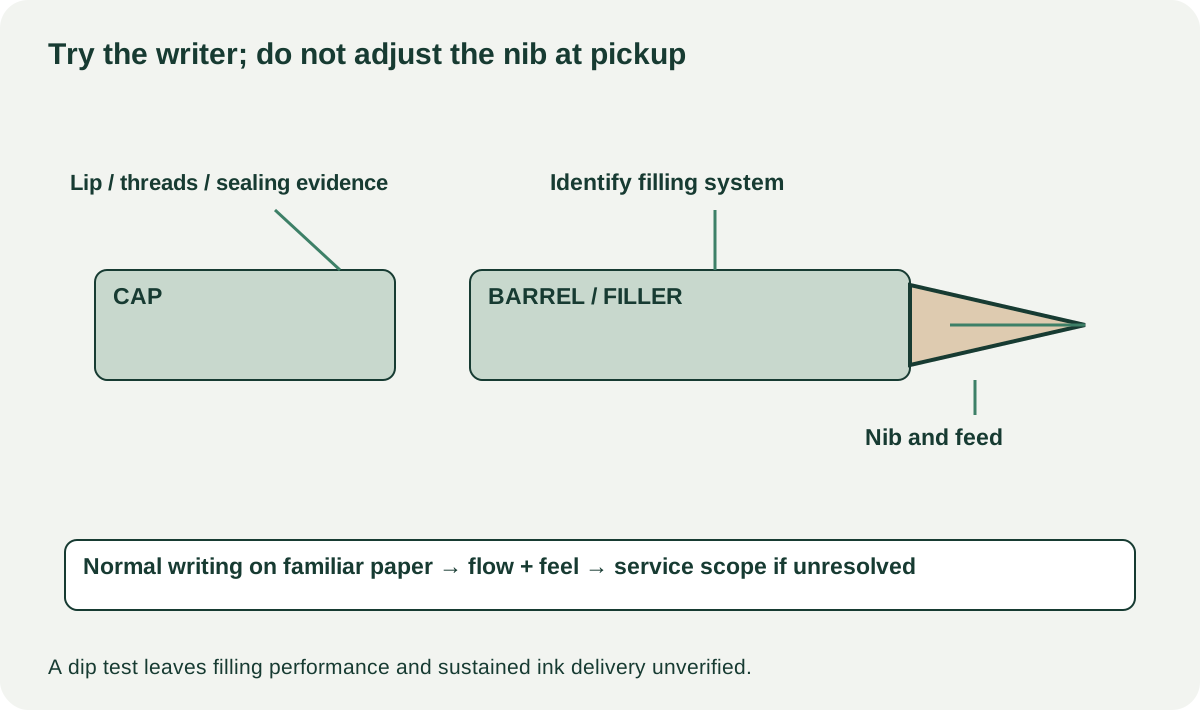
Look along the nib and feed without pressing or bending them. Observe visible asymmetry, damage, missing tipping, cracks or signs of an aggressive modification. Do not attempt to align tines, polish a nib or pull a feed at a meetup. A small-looking nib issue can require skilled work, and a rushed adjustment can make it worse.
Inspect the section where you grip, cap lip, threads, barrel and filling knob. Look for cracks, corrosion, heavy staining, loose parts and signs of leakage. Ask the seller to demonstrate ordinary cap attachment. It should operate as designed without forced tightening. A cap that looks fine may still have a sealing issue that only becomes apparent after storage; a short meeting cannot establish resistance to drying over several days.
If a filling mechanism is stiff, do not force it. Ask what ink has been used and whether the pen was cleaned before storage. Dried ink is one possible explanation for poor behaviour, not a diagnosis that makes every non-writing pen a simple cleaning bargain.
Agree on a useful writing test
Bring familiar paper and ask permission before using the pen. The seller should provide or approve suitable fountain-pen ink and the method of filling. Do not introduce an unknown ink or mix fluids in a pen you do not own. If the pen is being sold unused or as a collectible that the seller will not ink, decide whether that limitation fits your purchase; do not imply it has been writing-tested.
Write at your normal angle with light ordinary pressure. Try a few lines of familiar text, gentle loops and strokes in several directions. Pause briefly and start again. Observe skipping, hard starts, inconsistent flow, excessive wetness or scratchiness that catches on paper. A nib designed for a particular writing style may feel wrong to you without being defective.
A dip test can demonstrate some nib behaviour while leaving the filling system and sustained ink delivery untested. A filled writing test gives more useful evidence about the whole pen, but still cannot prove long-term cap sealing or leak resistance in travel. Record what was actually tested.
| Observation | Buying consequence |
|---|---|
| Comfortable, consistent ordinary writing | Supports suitability for your hand and tested ink/paper |
| Persistent catching or skipping | Obtain an assessed nib/flow diagnosis before pricing it as ready to use |
| Stiff piston or uncertain old filling system | Stop manipulation and seek specialist service advice |
| Ink around a crack or joint | Treat as an unresolved condition issue, not cosmetic staining alone |
| Dip test only | Keep filling and sustained delivery unverified |
Separate serviceability from collectibility
For a daily writer, a correctly fitted replacement nib may be a benefit if it suits you. For a collectible, the same replacement may affect the reason you are buying it. Ask for service documentation and distinguish the maker’s parts from aftermarket work. A box or engraving alone does not establish authenticity or originality.
Check that a suitable repairer will accept the model and what the initial assessment covers. Pelikan’s repair contact is one example of a manufacturer service route; availability, shipping and scope should be confirmed for the actual pen and your location. Do not assume every vintage mechanism or discontinued part can be economically replaced.
A seller saying “just needs a new nib” has described a possible repair, not supplied a quote. Before negotiating, identify the correct part, fitting requirements and whether the remaining pen has been assessed. If the scope cannot be established, decide whether you knowingly want a restoration project.
Compare the writing-ready cost
As a hypothetical example, a $70 pen needing a $20 compatible converter, $65 assessed nib service and $15 shipping totals $170. A $140 pen already demonstrated as a comfortable writer plus $10 travel totals $150. These are illustrative numbers; obtain actual costs and do not assume service will restore collectible originality.
Buy when the pen fits your hand, behaves as needed and has an understood filling system. Negotiate a known missing converter or documented service item. Pass when the purchase depends on forcing a mechanism, an unverified authenticity premium or a repair you cannot price. A beautiful pen that you dislike writing with is still the wrong everyday pen.