How do you assess a used rain jacket’s condition?
Quick answer
Identify the exact shell and care label, check fit with your layers, and inspect seam tape, lining, fabric and closures. Surface beading does not certify a waterproof garment, and reproofing does not automatically repair failed layers or seams. Buy according to the condition and weather protection you can reasonably establish.
Identify the shell and the job it needs to do
Ask for the model, approximate generation, composition/technology label and complete care instructions. Decide whether you need an everyday shower jacket, a packable shell or protection for an exposed outdoor trip. A brand logo does not answer which construction you are buying.
Try the jacket over the layers you intend to use. Check shoulder and sleeve movement, hem coverage, hood adjustment and whether pockets remain accessible with your pack. If helmet compatibility matters, use the appropriate helmet and ordinary fit checks rather than accepting a large hood as proof.
Record packed bulk and weight only if they matter to your use. A tiny worn shell that no longer provides dependable protection is not a useful weight saving.
 Enlarge diagram
Distinguish surface treatment from the garment’s barrier
GORE-TEX describes durable water repellent treatment as a surface feature of many products. It is not the same thing as the underlying waterproof construction. Water beading on a small patch does not establish that every seam, closure and worn area is sound.
Likewise, outer fabric wetting out does not by itself identify the cause of moisture inside. Condensation, openings, damaged construction and care can involve different questions. Do not promise that one wash or spray will solve an unexplained leak.
GORE-TEX’s care instructions include product-specific exceptions. Follow both the exact garment label and applicable maker guidance; do not prescribe a universal hot wash, tumble dry or reproofing product for every shell. Its FAQ also recognizes that age and wear can limit a garment despite care.
Inspect inside and out in good light
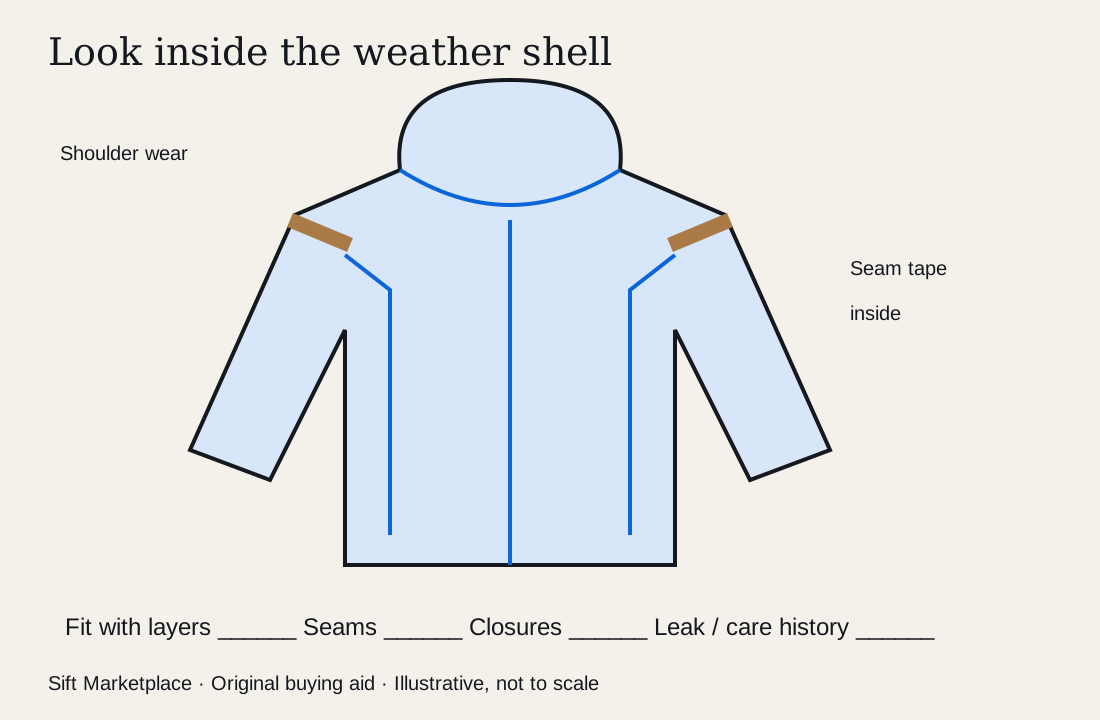
Open the jacket fully. Look around shoulders, neck, underarms, cuffs, hem, pockets and zipper attachment. Note abrasion from pack straps, holes, worn coatings, bubbling, peeling, lifted tape, sticky areas and repairs. Ask the seller to identify every patch or seam repair and the method used.
For a lined jacket, acknowledge the parts you cannot see without dismantling; do not cut or pull lining apart. For exposed seam tape, look gently rather than peeling a loose edge to test it. A small area of separation may require a specialist assessment of wider condition.
Operate zippers, vents, buckles, cord locks and hook-and-loop closures normally. Check that drawcords adjust and release, cuffs close appropriately and the main zipper engages consistently. A broken slider, damaged teeth and a torn zipper seam can have different repair paths.
Ask about cleaning products, storage when damp and where leaks have occurred. A specific history, like “moisture appeared at this shoulder during these conditions,” is more useful than “still waterproof.” Do not turn the seller’s explanation into a confirmed diagnosis.
Decide how much uncertainty suits your use
| Finding | Purchase consequence |
|---|---|
| Suitable fit, intact construction and credible care history | Compare price and ordinary preparation |
| Surface care due, with no other fault identified | Price the appropriate care, without promising restored performance |
| Known localized repair accepted by a suitable service | Obtain a quote and understand its limits |
| Widespread peeling, tape failure or unexplained leakage | Prefer a better-understood shell for important weather protection |
| Seller only shows water beading | Request full inside/outside condition evidence |
An ordinary viewing is not a controlled rain test. If protection is essential for a remote or exposed trip, unresolved leakage is a reason to choose another garment or obtain qualified assessment. Do not make the trip itself the first test of a doubtful shell.
Compare the wearable total
A hypothetical $65 jacket with $30 appropriate care, $45 confirmed zipper work and $15 collection totals $155. A suitable intact shell at $130 plus $15 collection totals $145. If the first has widespread layer separation, the repair total is not established by the zipper quote.
Ask whether manufacturer repair or warranty support actually applies to this item and owner before assigning it value. Use the cost calculator for confirmed amounts. A useful enquiry is: “Could you send the care label, inside seams and high-wear areas, and describe any leakage or repairs? I want to try it with my normal layers.” Buy a suitable shell with condition evidence, not a promise that reproofing fixes everything.
Sources
- 01GORE-TEX Outerwear care
- 02GORE-TEX DWR guidance
- 03GORE-TEX FAQs