How do you assess used wool or cashmere knitwear?
Quick answer
Read the fibre and care labels, measure the garment without stretching, and inspect both sides for holes, thinning and shape changes. Pilling is different from missing or damaged fabric. Price appropriate cleaning and any confirmed repair, and do not assume a shrunken or felted garment can be restored to its original size.
Use the current garment, not its original size chart
Ask for a full composition label and care instructions. “Cashmere blend” leaves the percentages unknown; softness alone does not identify fibre content or authenticity. Record the brand/model if relevant, but compare the fabric and condition you can inspect.
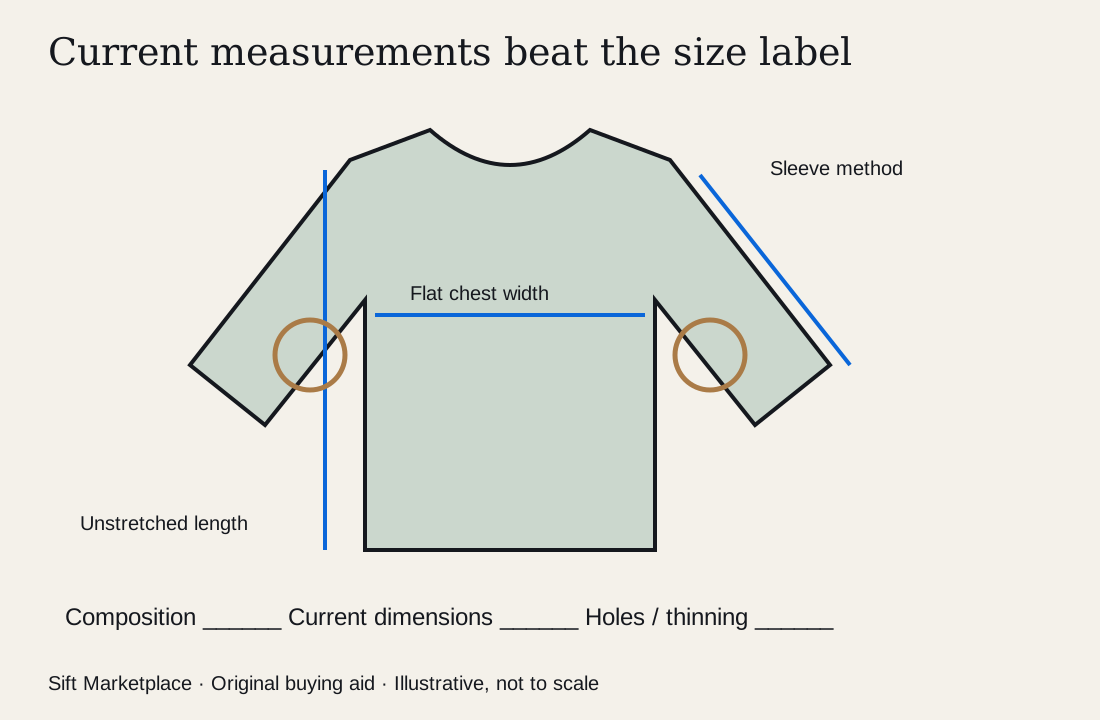
Request flat measurements on a smooth surface without stretching: chest width, body length, shoulder or upper-body width using a stated method, sleeve length and hem width. Compare with a knit you like, measured the same way. Raglan, dropped-shoulder and set-in sleeves need a clear start point to make the numbers useful.
Ask whether the garment has shrunk, been stretched or altered. A tagged large may now fit differently. Do not buy a too-small dense-feeling knit on the promise that soaking will reliably return it to its original dimensions.
 Enlarge diagram
Inspect the fabric rather than judging only softness
Lay the garment out in good light and inspect front, back and inside where accessible. Check elbows, underarms, cuffs, neck, hem and areas rubbed by bags. Look for holes, pulled loops, repairs, thin patches, stains and distorted seams. Gently view suspect areas against light without stretching them open.
Woolmark’s pilling factsheet describes surface fibre balls. They are not the same as a hole or a worn-thin area. A heavily de-pilled surface may look tidy while the underlying fabric still needs assessment; a few pills do not automatically make a sound garment unusable.
Ask about storage and any previous pest damage. If there are unexplained holes or signs of infestation, do not treat a fragrance or quick wash as proof that the issue is resolved. Choose another garment or obtain suitable textile/pest advice before bringing it into your wardrobe. Avoid making a confident cause diagnosis from one hole.
Inspect buttons, buttonholes, zippers and embellishments. Missing ordinary buttons may be straightforward to price, while a distinctive trim or patterned repair can be difficult to match. For a cardigan, check both front edges for distortion and whether it hangs comfortably when fastened.
Try the shape and comfort you will actually wear
With permission, try it over the intended layer. Check shoulder movement, neck comfort, sleeve length and how the hem sits. Do not stretch the garment to simulate a different size. Compare both sleeves and side seams for obvious asymmetry, keeping the original design in mind.
For scarves and blankets, replace body fit with usable dimensions and edge condition. Check fringe attachment and the full surface, not only the folded display corner. For a coordinated set, compare colour and texture together in the same light.
Get a repair quote when damage drives the price
Johnstons of Elgin’s FAQ describes specialist cleaning and repair options. Availability does not establish that every hole can be made invisible or that every garment qualifies. Show the actual damage to the service you intend to use and ask about appearance, durability, cost and timing.
Follow the garment-specific care label and appropriate wool guidance. Do not prescribe the same machine cycle, heat or chemical for every wool/cashmere blend. A cleaning service should understand the fibre, construction and stain; its quote is not a guarantee that shrinkage or missing fibre will reverse.
| Finding | Purchase consequence |
|---|---|
| Suitable current measurements and sound fabric | Compare price plus appropriate preparation |
| Surface pills with intact underlying knit | Consider the permitted care and your appearance preference |
| Small hole with accepted repair plan | Price the repair and accept its likely visibility |
| Widespread thinning or unwanted shape change | Prefer a sounder garment |
| Missing composition/care evidence | Keep those properties unknown rather than guessing |
Compare the garment after preparation
In an invented example, a $35 sweater needs $25 appropriate cleaning and $35 confirmed repair: $95. A similar suitable intact sweater at $65 with $25 cleaning totals $90. A luxury label does not make the first option cheaper, particularly if a second thin area remains unquoted.
Use the cost calculator for purchase, transport and confirmed preparation. Ask: “Could you send the fibre and care labels, flat measurements without stretching, and close photos of cuffs, underarms, elbows and any repairs? Has the garment changed size or had pest damage?” Buy the current fabric and shape, with a realistic preparation plan.
Sources
- 01Woolmark Care for wool
- 02Woolmark Pilling factsheet
- 03Johnstons of Elgin Care and repair FAQ