Arrange an independent inspection before buying used
Quick answer
Choose an inspector with relevant product experience who works for you, agree the scope and fee, and obtain the seller’s permission before booking. Ask for a report tied to the exact item that separates findings, inaccessible checks and repair estimates. An inspection reduces uncertainty; it cannot guarantee every hidden fault or future lifespan.
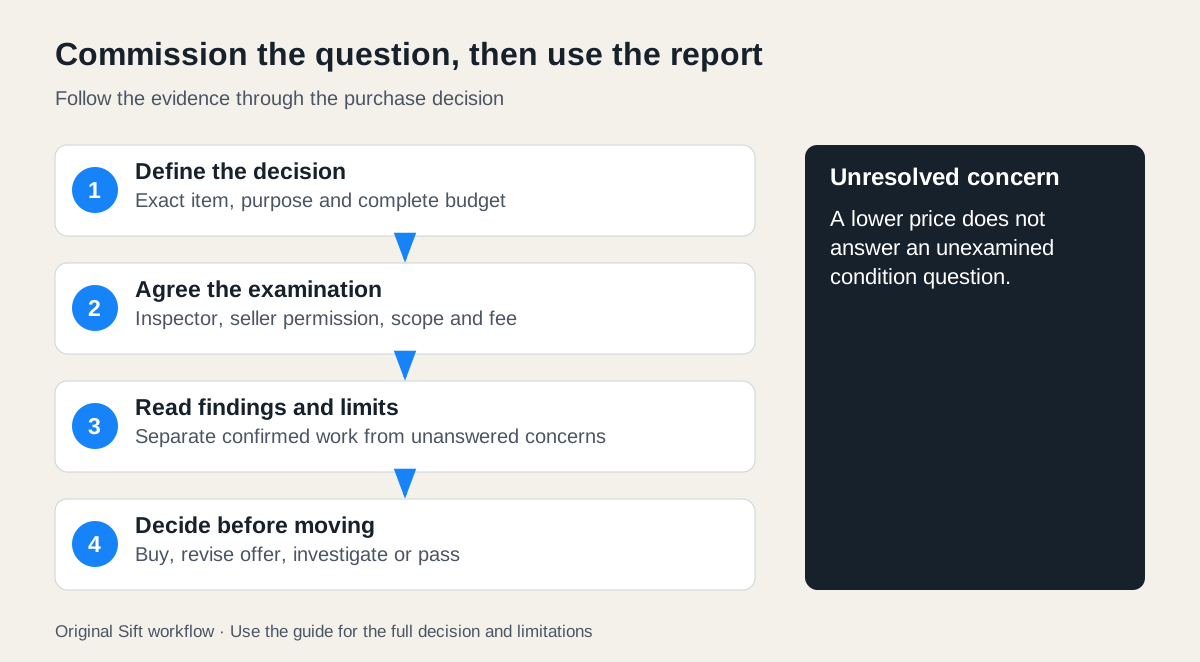 Enlarge diagram
Decide what you need an expert to answer
An independent inspection is useful when the purchase depends on a condition you cannot competently assess, especially where transport or subsequent work would be costly. First eliminate obvious mismatches such as the wrong model, inadequate dimensions or an unaffordable complete price. Paying to inspect a piano that cannot reach your room wastes the inspection opportunity.
Write the decision question in ordinary language: “Is this piano a reasonable candidate for regular practice within my total budget?” or “What immediate work and unresolved mechanical concerns should affect this vehicle purchase?” Avoid asking for a vague certificate that the item is “good.”
The FTC recommends independent mechanical inspection of used cars, including dealer-certified vehicles, and distinguishes that assessment from a vehicle-history report or a safety inspection. For pianos, the Piano Technicians Guild recommends a technician’s assessment before purchase. These examples require different expertise; a general handyman is not automatically qualified for both.
Choose the inspector before accepting the seller’s referral
Ask about experience with the exact product family, the proposed examination and the written output. A seller’s recommended professional may be capable, but establish who pays them, whom the report is for and any relationship to the seller or repair work being recommended.
The PTG technician directory explains the Registered Piano Technician qualification and offers a way to search. A directory entry is a starting point: confirm the person’s current services, availability and suitability for your instrument. For vehicles or regulated work, check relevant qualifications and local requirements for the service being commissioned.
Get the fee, travel charge, cancellation terms and any additional diagnostic charges before booking. Ask whether a repair estimate is a separate service. Do not request invasive work or a test drive without the owner’s express agreement and appropriate arrangements.
Agree access and limits with both parties
| Field | Vehicle example | Acoustic-piano example |
|---|---|---|
| Exact item | Make, model and VIN | Maker, model and accessible serial |
| Buyer’s purpose | Everyday transport within stated budget | Regular home practice |
| Seller permission | Agreed inspection location and allowed checks | Agreed visit, access and technician handling |
| Written output | Findings, limitations, immediate work and estimates | Condition, service needs, limitations and suitability advice |
| Separate work | Title, recall and registration checks | Specialist moving and destination assessment |
| Decision date | Before non-refundable purchase commitment | Before booking the move |
If a seller cannot permit one particular arrangement, ask whether a reasonable alternative exists, such as a mobile inspection. If meaningful assessment remains unavailable, decide whether to pass. Seller refusal is a limit on the available evidence, not proof of a particular hidden defect.
Vehicle case: a repair estimate changes the offer
In this hypothetical scenario, a vehicle is advertised at $7,000. The buyer has a $7,800 envelope for price, inspection and identified immediate work, separate from registration, insurance and other ownership costs. An inspection costs $180 and identifies $900 of work in a written estimate. The inspection also states that one concern needs further diagnosis.
Price plus inspection plus identified work is $8,080, already above that envelope. Reducing the offer to $6,700 would bring those known amounts to $7,780, but it would not resolve the undiagnosed concern. The buyer asks what further assessment is needed before making a purchase decision. They do not use an arbitrary $20 remainder as a repair reserve.
If the diagnosis is resolved and the complete purchase still fits, the report may support a revised offer. If the seller declines, the inspection fee remains spent, but the buyer has avoided a larger commitment outside the plan. Do not treat that fee as a reason to buy anyway.
Piano case: free does not mean ready to use
A fictional piano is offered for free. The buyer receives illustrative quotes of $180 for assessment, $450 for specialist moving and $220 for initial service if the instrument is suitable. The minimum planning total is $850 before any additional repairs or access costs.
The technician finds that a major condition question cannot be settled without more work, and the buyer’s intended budget cannot accommodate the proposed assessment and possible repair. The buyer declines before arranging the move. They do not interpret a cabinet in attractive condition as evidence that the musical mechanism is economical to restore.
Conversely, a report identifying manageable service needs is useful only alongside a suitable destination and moving plan. An inspection of the instrument is not automatically a survey of stairs, floors or access. Assign those questions to the appropriate provider.
Read the report as findings plus limits
Look for the exact item identifier, examination date, checks performed, observations, inaccessible areas and recommendations. Ask the inspector to distinguish immediate work from optional improvement and to explain uncertainty in language you can use.
“No fault found during this test” is not “will never fail.” A normal-use test, a specialist diagnosis and a complete dismantling have different scopes. Do not silently promote the least invasive inspection into the most comprehensive one.
Save the report and quote with your purchase record. In the cost calculator, inspection can be recorded under other purchase costs and confirmed repair work under repairs or servicing. Keep unresolved work outside a falsely precise total and decide whether more evidence is worth buying.
Make the decision before the next expensive step
Buy when the required condition, report limitations, access and complete cost are acceptable. Renegotiate only around an item you would still want at the revised terms. Postpone for a specific unanswered question. Pass when essential condition cannot be established or the project exceeds your ability to manage it.
Keep the product-specific inspection in its own guide, such as buying a used car. This workflow helps you commission and use an expert’s assessment; it is not a substitute for that assessment.
Sources
- 01FTC Buying a used car from a dealer
- 02Piano Technicians Guild Buying a piano
- 03Piano Technicians Guild Find a technician