Build a secondhand camping kit for a first frontcountry trip
Quick answer
Define the trip, assign every required equipment job, and buy only the gaps. Rehearse the complete kit before departure; unresolved shelter, sleep or destination requirements mean changing the plan.
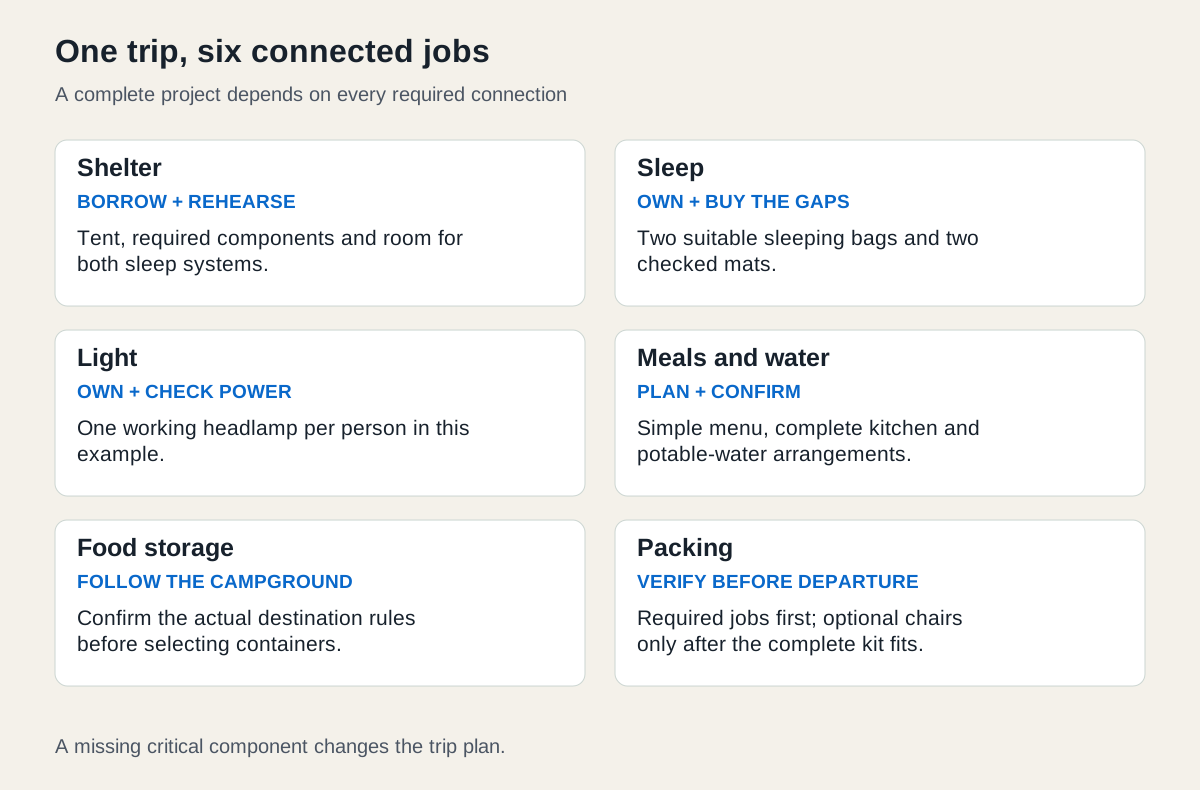 Enlarge diagram
Plan the trip before shopping for the kit
A camping bundle is useful only if its contents support your actual trip. Write down the number of people, booked site, dates, expected conditions, vehicle space and facilities. Then decide which jobs the kit must do: shelter, sleep, light, meals, water, food storage and personal care. A cheap tent does not compensate for an unsuitable sleep system or a missing way to store food as the campground requires.
The worked plan below is hypothetical: two adults, two nights at a vehicle-access campground, a mild-weather forecast, a nearby exit route and facilities confirmed before departure. It is not a kit specification for winter camping, remote travel or a backcountry expedition. If the forecast or destination changes, reassess the plan before buying equipment around it.
The National Park Service’s trip-planning guidance ties equipment to the setting, season, difficulty and duration, and recommends testing it before the trip. Use the destination’s current rules and your own needs to complete the inventory. A list of products cannot establish that a particular trip is appropriate for your experience.
Give each required job an owner
In this example, one person maintains a single inventory. “Alex has one” becomes “Alex will bring the identified item, including its required parts, and confirm it by Wednesday.” That small change prevents two people buying chairs while neither brings sleeping mats.
| Job | Planned source | What must be confirmed before departure |
|---|---|---|
| Shelter for two | Borrow a tent | Complete inner, fly, poles and required stakes; both sleeping mats fit; owner permits the loan |
| Sleep insulation and comfort | Use two owned sleeping bags; buy two used mats | Suitable for the planned conditions; clean, intact and rehearsed together |
| Light | Two owned headlamps | Each works and has an appropriate power supply for the trip |
| Meals | Borrow a complete camp kitchen; choose a simple menu | Equipment matches the menu; current site cooking rules and safe operation understood |
| Drinking water | Owned containers | Potable-water arrangements confirmed; enough suitable carrying capacity |
| Food and scented-item storage | Destination-approved arrangement | Follow that campground’s requirements; an ordinary tote is not automatically wildlife-resistant |
| Clothing and personal supplies | Mostly owned | Forecast, rain protection, necessary medicines, first aid and individual needs accounted for |
| Seating and organisation | Two used chairs and one owned tote | Optional comfort items fit after required equipment |
The table is an allocation plan, not a complete universal packing list. Work through the full destination checklist, including navigation, communication, rubbish and hygiene arrangements. Borrowing still requires time to collect, inspect, learn and return the equipment. Read the lender’s terms when borrowing from an organisation.
Buy the gaps, not another whole bundle
Suppose the buyers have a $220 equipment-and-collection allowance, separate from campsite fees, travel, meals and other trip costs. These are illustrative amounts, not market prices.
| Gap | Example cash allowance |
|---|---|
| Two used sleeping mats | $70 |
| Two used chairs | $30 |
| Small missing kitchen and lighting supplies | $35 |
| Collection travel | $25 |
| Unspent equipment reserve | $60 |
| Total allocation | $220 |
An advertised $120 bundle contains a tent, one mat, four chairs and an unidentified stove. It sounds larger than the $100 mat-and-chair plan, but only one mat and two chairs are wanted. The buyers would still need another mat and would need to resolve the stove’s identity, condition and suitability before assigning it any useful value. They do not count proceeds from selling the surplus.
Use the bundle price calculator to compare the pieces you would otherwise buy, then add collection and missing supplies in the used buying cost calculator. Keep campsite and travel spending in the wider trip budget so a low gear total does not hide the actual commitment.
Rehearse the kit while there is time to change it
Set up the borrowed tent with the owner’s instructions before the trip. Lay out the two mats and sleeping bags. Check that every required component goes back into the bag. Inspect a candidate tent using the used tent guide, rather than trusting a photograph of its packed size.
Try each mat long enough to notice obvious loss of support; a short demonstration cannot prove it will stay inflated all night. Check cleaning instructions and material condition. Rehearse the packing order too: items required first at the campsite should remain accessible, while food and scented items must travel and be stored as local rules require.
Ask the lender or seller: “Can we lay out the complete kit before I collect it? Which pieces belong to this model? Is anything repaired, missing or unreliable? Are the instructions available?” An answer such as “there should be another pole somewhere” leaves shelter unresolved.
Do not make a first trip depend on repairing an unfamiliar fuel appliance. Identify it, obtain its manual and have unresolved safety or condition questions assessed by an appropriate specialist. An inexpensive stove without usable instructions is not a complete cooking plan. A different menu or a properly supported borrowing arrangement may be the better solution.
What happens when a critical piece fails?
In the rehearsal, one borrowed tent pole is missing. The first branch is a confirmed, correct replacement that arrives before another full setup. The second is a complete alternative tent whose suitability and collection are confirmed. If neither can be completed in time, change or postpone the trip. Spending the reserve on extra chairs will not fix the shelter gap.
If a chair fails, remove it or replace it within the comfort allowance. If a sleeping mat fails, revisit the sleep system and conditions before departure. The distinction is whether the missing item prevents a required job from being met; price alone does not decide its importance.
Keep a final “packed and checked” column, separate from “owned” or “promised.” On return, dry, clean and store items according to their instructions, record faults and return borrowed pieces complete. That record becomes the shopping list for the next trip, when you will know which equipment you actually used.
Sources
- 01National Park Service Before the trip