Rent, borrow or buy used: choose around the job and the dates
Quick answer
Define the job, the dates and the complete kit first. Compare spending, cash tied up, collection and return work, damage obligations and storage. Borrowing or hiring can suit a short trial; buying used can suit repeated or uncertain dates. Count resale as an optional later outcome, never money available to fund today’s purchase.
 Enlarge diagram
Start with the job and the dates
Write down what you need to finish, when you can actually do it, and how often the equipment will be useful afterwards. “I need a machine” leaves the decision open-ended. “I want to sew three sets of simple cushion covers over the next six weeks” gives you a project to compare.
Separate the job from the object you first searched for. A class with equipment supplied, a borrowed machine or paying someone for a small job might meet the same need. If the task needs a qualified professional, hiring that professional is a different option from hiring equipment and attempting the work yourself.
Make a short brief before asking for availability:
- Required result: the project and materials the equipment must handle.
- Use windows: three known weekends, a continuous week, or dates still uncertain.
- Essential components: the parts needed to complete the job, not every optional accessory.
- Your preparation: instructions, consumables and any training needed before starting.
- After the job: another planned use, storage space, or no reason to keep it.
For a camping trip, the conditions and campsite facilities change the equipment needed. The National Park Service’s planning guide connects gear to the actual trip. Ask a suitable rental provider or experienced lender whether their equipment fits that plan. A choice that works for one gentle weekend does not establish a suitable kit for another season or location.
Check availability before comparing prices
A free loan that cannot cover your dates is not a usable option. Nor is a cheap hire that must be returned before the last part of the project is finished. Confirm both collection and return access, including opening hours and any time needed for cleaning or drying.
A friend’s willingness to lend an item once is not permission to keep it indefinitely or pass it to another person. Ask what use is acceptable, which parts are included and what to do if it stops working. Agree a return date even when no money changes hands. This makes an awkward situation less likely if your project takes longer than expected.
For a paid service, read the provider’s actual terms. As one UK example, Library of Things’ borrowing terms specify membership requirements, return to the original kiosk, responsibilities for parts and condition, and consequences for late returns. An extension depends on availability; it is not automatic. Those terms describe that provider, not every library or hire shop.
Before reserving, ask whether your intended material, location and type of use are permitted. A product being physically capable of a task does not mean the lender permits that task or covers the resulting damage.
A complete three-use comparison
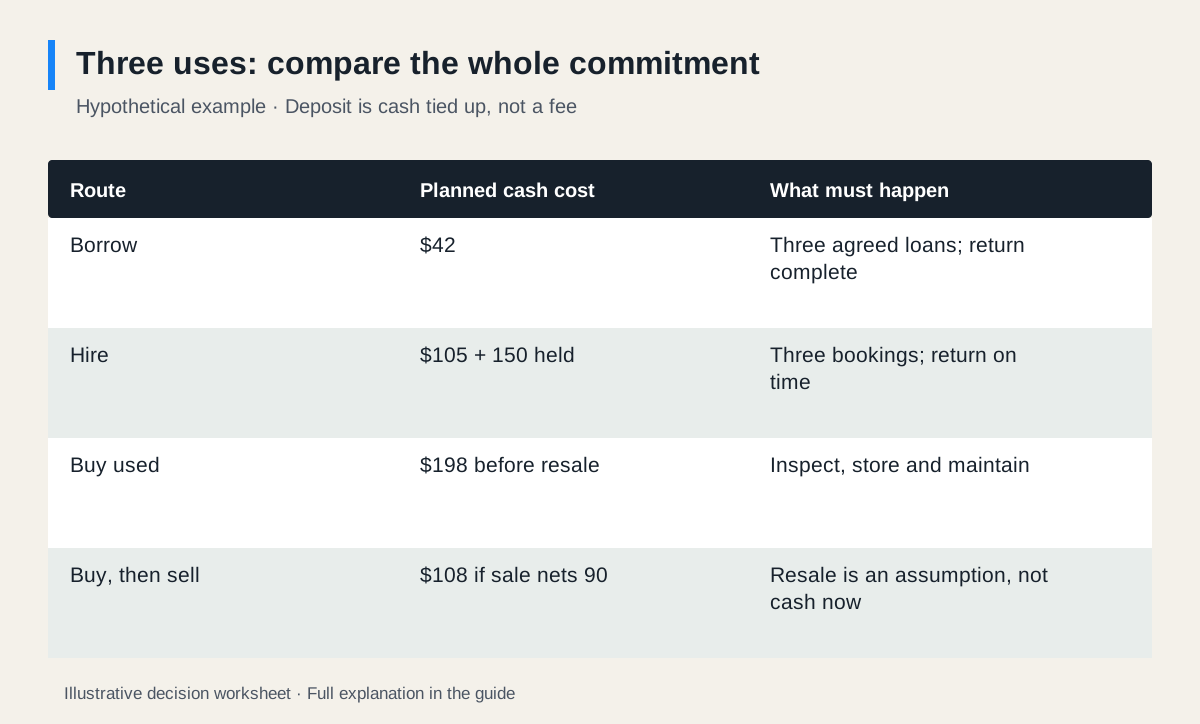
Here is a hypothetical planning example, not a provider quote or a claim about local prices. A beginner wants an ordinary domestic sewing machine for three separate project weekends. All options must be suitable for the chosen fabric, complete enough to use and supported by instructions. The buyer already has a suitable workspace.
| Cost or commitment | Borrow from a friend | Hire for each weekend | Buy a used machine |
|---|---|---|---|
| Item or hire fees | $0 | $75 total | $150 |
| Collection and return travel | $30 | $18 | $18 |
| Project consumables | $12 | $12 | $12 |
| Confirmed missing accessory | $0 | $0 | $18 |
| Planned cash spending | $42 | $105 | $198 |
| Refundable security amount | None agreed | $150 held per booking | None |
| End-of-project resale assumption | Not applicable | Not applicable | $90 net, uncertain |
| Cost if that resale occurs | $42 | $105 | $108 |
Travel includes both directions where a return is required. The rental figure assumes three separate reservations and that each is available. The used option has a known accessory to obtain, not a guessed repair that might solve an unknown fault. If suitability or working condition remains unproven, it stays off the comparable shortlist.
The rental deposit is shown separately. If fully returned, it is not $150 of spending. It still requires available cash or credit while held, and the terms may permit deductions. In this example the largest simultaneous rental cash requirement could be $185: one $25 booking, $6 travel, $4 consumables and the $150 hold. The timing and method of a real hold or payment must come from the provider.
Buying requires $198 before any later sale. Subtracting an imagined $90 resale from today’s cash budget would hide that requirement. If the machine never sells, the ownership cost stays $198, plus any later expenses. If a sale eventually nets only $50 after selling costs, it becomes $148. There is no evidence here for a resale probability, so none is assigned.
Let the constraints change the winner
The borrowed option has the lowest planned spending in this example. It is still a poor choice if the friend needs the machine during two of the three weekends. The hire option is close to the optimistic used-and-resold cost, but has fixed return work. Ownership buys scheduling flexibility at the cost of cash, storage and condition uncertainty.
Now change one assumption at a time:
- All work fits into one hire period. Get a new quote for that period. Do not multiply a daily price if the provider uses another charging structure. One collection and return may change the choice substantially.
- The first project takes twice as long. Check the extension terms before starting. If the next borrower has reserved the item, the remaining work needs a different plan.
- The used machine needs uncertain service. Obtain a qualified assessment or choose another listing. A low price cannot turn an unknown repair into the confirmed $18 accessory in the table.
- You discover you dislike the hobby. Borrowing or a short hire ends with a return. Ownership adds storage, resale or disposal work.
- You have another six committed projects. Recalculate with those actual dates. Do not invent future use simply to make ownership look economical.
A useful decision rule is to prefer the route that completes the known job within your available money and time, then assess the obligations you are willing to keep. There is no universal number of uses at which buying becomes best.
Compare damage exposure without inventing insurance
Ask the lender or provider what happens after ordinary wear, accidental damage, theft, a missing part or a breakdown unrelated to your use. These may be treated differently. Read any optional protection product’s exclusions and deductible before deciding whether it changes your maximum affordable exposure.
Record the included parts and existing condition at collection with the owner’s agreement. If a fault appears, stop the affected use and contact the owner or provider. Do not repair, disassemble or substitute parts merely to avoid returning an imperfect item. The correct response depends on the product and the agreement.
For a private loan, a practical message could be:
Could I borrow the machine for the weekends of 7, 21 and 28 November? I will use it for the agreed fabric and return it with the listed accessories after each weekend. Please let me know whether those dates work and what you would like me to do if it develops a fault.
That message requests an agreement; it does not create insurance or settle every possible liability question.
Use the tools for the parts they actually calculate
For the purchase option, put $150 in Item price, $18 in Collection or delivery, and $18 in Missing parts in the used buying cost calculator. The $12 of necessary project consumables can go in Other purchase costs if you want the complete project cash total. Leave optional time value blank unless you intentionally want to price your time.
The listing comparison is useful once you are comparing actual used candidates. Put suitability, included parts and unresolved checks in the condition notes. Neither tool models rental deposits, reservation availability or liability terms, so keep the borrowing and hiring rows in your own comparison record.
If ownership still looks right, use the used-versus-new guide to compare supported ownership options. If the activity itself is uncertain, the used hobby starter plan helps limit the first purchase.
Close the loop after the project
Set the return reminder when you arrange the loan, not when the work is finished. Leave time for the manufacturer-approved cleaning, the parts count and the journey. Keep the return confirmation and check when any security amount is released under the actual agreement.
If you bought, record what you used and what remained unnecessary. That evidence is more useful for the next purchase than the excitement of the original listing. Keep, lend, sell or dispose of the item through a suitable route based on its condition; do not plan future cash around a sale that has not happened.
Sources
- 01National Park Service Before the trip
- 02Library of Things Terms of Borrowing