Try a hobby with used equipment: buy for the first project
Quick answer
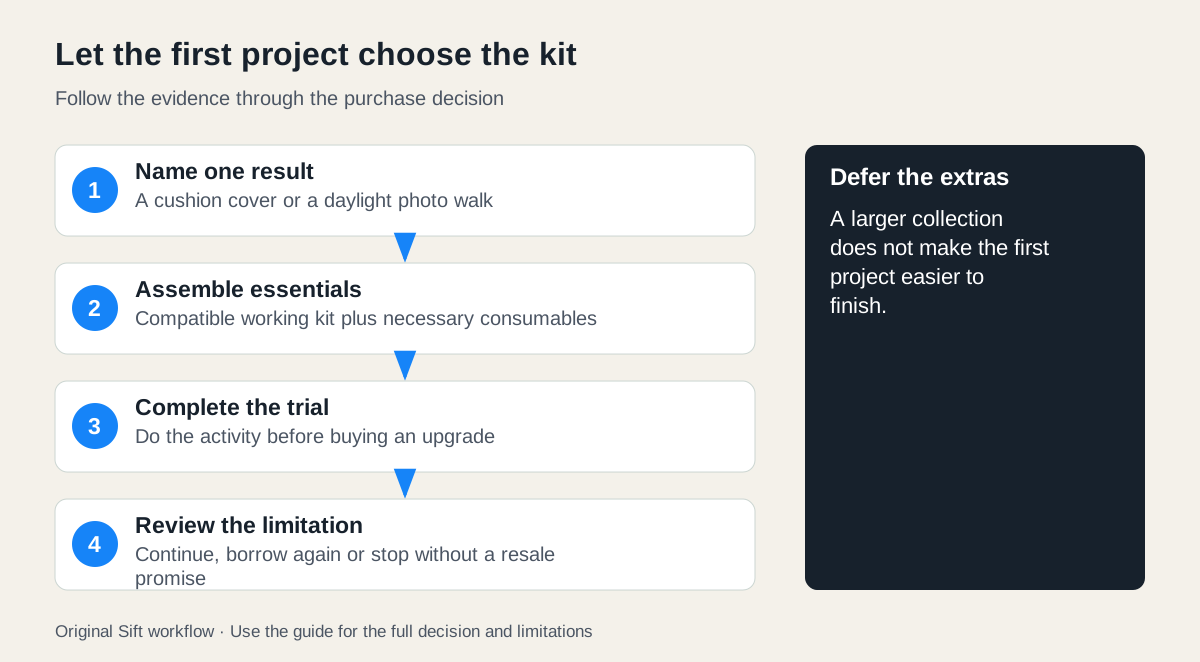
Choose one achievable first activity and list only the equipment needed to complete it. Borrow or hire uncertain components, buy a compatible working starter kit, and set a trial date and spending cap. Defer specialist upgrades until a completed project shows the limitation they would solve.
 Enlarge diagram
Define a project small enough to finish
“Get into photography” or “start sewing” can justify an endless shopping list. Replace the hobby label with a first result: photograph a family walk in daylight, or sew a simple cushion cover from a pattern suited to your skill level.
Then ask what you already own. A phone may be enough to learn framing. A class or borrowed machine may let you try sewing before choosing a machine. For camping, follow the National Park Service’s trip-planning guidance before selecting gear. Borrowing or renting can help you try a suitable activity without owning every associated item.
Set a date to do the activity, not merely a date to finish shopping. If you need instruction or a suitable workspace, arrange that alongside equipment. A complicated bargain that consumes the trial period in repairs does not test whether you enjoy the hobby.
Two bounded starter briefs
These are illustrative plans, not product recommendations or claims about achievable skill.
| Brief | Essential for this attempt | Borrow or already own | Defer |
|---|---|---|---|
| Simple cushion cover | Suitable working machine, exact compatible controller, required basic foot and consumables for the chosen pattern | Workspace, instruction and cutting tools if suitable | Specialist attachments, overlocker and bulk fabric |
| Daylight family walk photos | Compatible camera body and general-purpose lens, battery, charger and supported card if moving beyond a phone | Phone for planning and comparison; existing bag if protective enough | Flash system, long telephoto, studio lights and multiple bodies |
The sewing-machine manual and chosen pattern establish the actual setup; do not assume all bobbins, feet or controllers interchange. For photography, use the starter photography-kit guide to trace the system rather than buying a body and hoping a lens fits.
Build a first-project budget with an exit
Suppose a hypothetical $180 sewing trial consists of a $110 machine, $15 collection, $25 confirmed accessories and $30 materials. That is the complete trial limit. A $70 “needs attention” machine plus an unknown service cost is not necessarily a cheaper version of that plan.
The buyer can compare a loan costing $20 in travel plus the same $30 of materials. If the loan covers the dates and suitable instruction is available, $50 may be an acceptable way to learn before owning. The rent, borrow or buy guide explains the return and damage obligations that still need agreement.
Use zero resale as the exit case. If you dislike the activity, can you afford the full $180 spending and the work of moving the equipment on? Do not assume a beginner kit will resell immediately for what you paid.
Buy a working system, not a promising repair project
A novice often cannot tell whether a poor result comes from technique, unsuitable materials, missing accessories or a fault. For a first attempt, a demonstrably suitable working item can reduce that ambiguity.
Ask the seller for a normal demonstration relevant to your project, using safe, agreed materials. Record what was shown and what remains untested. If a qualified service check is needed, include its cost and timing before buying.
The independent-inspection guide helps commission that check. The for-parts guide describes the different economics of an unknown-fault project. Do not confuse learning the hobby with learning to repair its equipment unless you deliberately want both projects.
Test the attractive bundle against your brief
A camera bundle may contain several lenses, but only one may suit your mount or intended activity. A sewing lot may include a box of accessories without the correct controller. Count the essential compatible kit before giving value to the extras.
For a hypothetical photography comparison, a complete $260 kit needs $15 collection and a $20 supported card: $295. A $170 body needs a $90 lens, $35 charger/battery allowance confirmed for the exact model, $20 card and $15 collection: $330. The lower headline price loses once the same first project is funded.
Those are arithmetic inputs, not market prices. Replace them with actual compatible candidates. Use the listing comparison for price, collection, repairs/missing parts and condition notes. Keep a separate checklist for the system connections the tool does not validate.
Run the trial before expanding the kit
Schedule one session to prepare the equipment and another to complete the project. Follow the exact manual for setup and care. Keep the first attempt simple enough that you can identify one limitation at a time.
Afterwards, write three notes: what you enjoyed, what prevented the intended result and what you could change without buying anything. If the difficulty was understanding settings or allowing enough time, an upgrade may not solve it. If a specific capability was missing, verify that the next item adds that capability to your existing setup.
Do not use the number of listings saved as evidence that you enjoy the activity. A completed project provides better information than another evening comparing accessories.
Decide whether to continue, borrow longer or stop
Continue when the activity itself earns another date in your calendar. Buy an upgrade when you can explain the task it enables, its compatibility and its complete cost. Borrow again when the need remains occasional or the right equipment is still unclear.
If you stop, retain the manual and honest condition record for any future sale or donation. Do not treat the trial as a failure that must be recovered through more purchases. It has answered the original question: whether this activity deserves more of your time and money.
Sources
- 01National Park Service Before the trip