Buy used wedding décor with a complete quantity and setup plan
Quick answer
Build one approved sample arrangement, multiply its usable pieces by the placements, and add deliberate spares. Compare complete costs and rehearse the setup before committing to a large bundle.
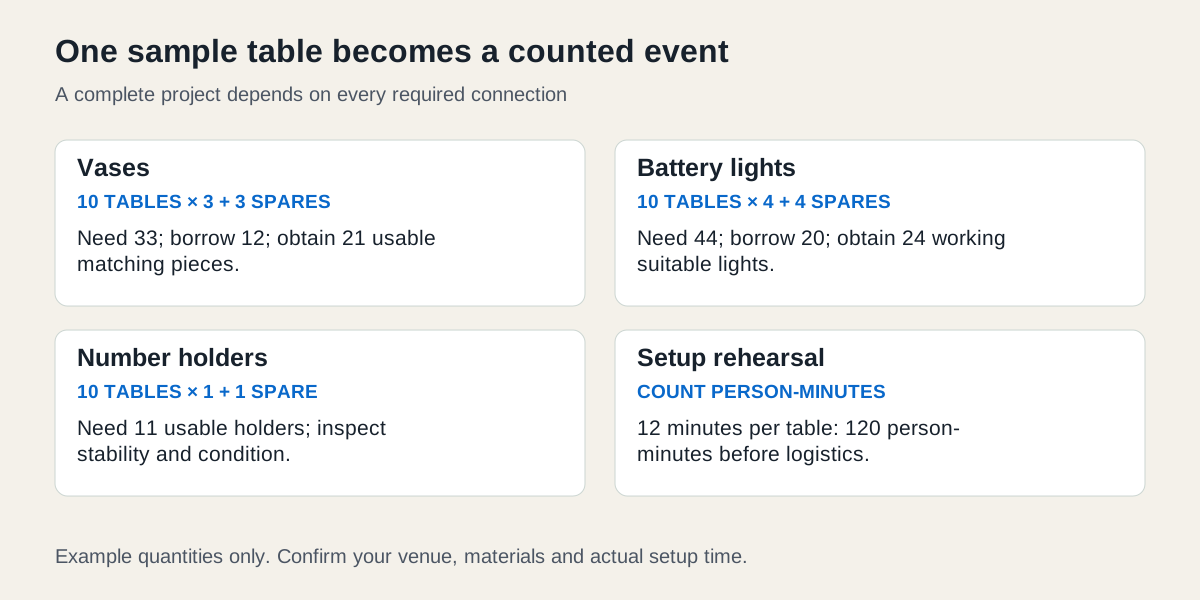 Enlarge diagram
What should be decided before browsing?
Confirm the venue layout, permitted materials, setup and removal windows, storage and who will do the work. Then choose one complete sample arrangement. Décor used at another event is not automatically suitable for this venue.
Ask specifically about flames, electrical items, hanging decorations and anything attached to walls or furniture. NFPA’s candle guidance explains the ignition risk of open flames; it does not grant venue permission. The worked example uses venue-approved battery lighting and does not assume that every flameless product or installation is acceptable.
How do you calculate the quantities?
This fictional event has ten guest tables. Each approved sample arrangement uses three small vases, four battery lights and one table-number holder. Spares are deliberate additions, not an unexplained percentage.
| Piece | Tables × pieces | Deliberate spares | Total needed | Borrowed usable stock | Quantity to obtain |
|---|---|---|---|---|---|
| Vases | 10 × 3 = 30 | 3 | 33 | 12 | 21 |
| Battery lights | 10 × 4 = 40 | 4 | 44 | 20 | 24 |
| Number holders | 10 × 1 = 10 | 1 | 11 | 0 | 11 |
Count usable pieces before calling the list complete. A chipped vase, an unstable holder or a light with a damaged battery compartment is not a spare. Confirm whether lights include suitable working batteries, and plan battery handling and access according to the products and attendees. Keep small parts and batteries managed appropriately around children.
The table covers these decorations only. Flowers, signs, linens and other arrangements need their own quantities and budget if included. Do not silently count the same spare at two different locations.
Compare buying, renting and borrowing
All amounts below are invented to illustrate one equivalent basket of the missing 21 vases, 24 lights and 11 holders. Real rental quantities, cleaning rules and deposits vary.
| Cost | Buy used | Rent | Borrow additional stock |
|---|---|---|---|
| Basket price or rental fee | $180 | $150 | $0 |
| Collection and return travel | $30 | $45 | $50 |
| Cleaning, batteries and packing | $45 | $20 | $35 |
| Storage/removal allowance | $25 | $0 | $0 |
| Planned cash cost | $280 | $215 | $85 |
| Illustrative refundable hold, separate from cost | None | $100 | None |
The rental requires $315 of cash availability while the hold is outstanding, even if its planned net cost is $215. Check the actual return, loss, damage and cleaning terms. Borrowing is cheapest here only if the full matching quantity is available on the dates and the owner accepts the planned use and return condition.
Used purchases have zero assumed resale proceeds. If someone later buys them, that is a benefit outside this conservative plan. The bundle calculator can compare wanted components and missing parts; include transport separately or in the entered bundle cost, and do not count it twice.
What should you inspect in a bundle?
Count the actual colours, sizes and working units. A listing for “30 matching vases” might contain 24 that match your sample, four of another size and two chipped pieces. If that vase bundle costs $90 plus $20 collection, its cost per usable matching vase is $110 ÷ 24, or about $4.58. It is not $110 ÷ 30, or $3.67.
For a requirement of 21 vases, the 24 usable matching pieces cover the gap and three additional backups. If only 18 are acceptable, price the missing three before agreeing. A $18 replacement purchase raises the total to $128, and the mismatched or damaged remainder still needs handling. Reject unsafe pieces instead of hiding them at less visible tables.
Why should you test one full arrangement?
Rehearse unpacking, placing, checking and repacking a complete table setup. In this hypothetical rehearsal, one person takes 12 minutes per table: 120 person-minutes for ten tables. Two people might complete the repetitive placement in about 60 minutes if the work divides cleanly. Add an assumed 25 minutes to unload and distribute boxes plus 20 minutes for final checks: a planned 105-minute window.
If the venue allows only 90 minutes, the plan is short by 15 minutes before any delay. Simplifying the sample reduces placement to eight minutes per table: 80 person-minutes, or 40 minutes with two people under the same assumption. With the other 45 minutes, the plan becomes 85 minutes, leaving only five minutes of slack. Arrange more time or verified help if that margin is inadequate; arithmetic does not guarantee volunteers will work at the rehearsal pace.
What happens after the event?
Label boxes by table and owner, photograph the approved sample and provide a packing list for the removal team. Name the person responsible for returns, cleaning and storage. Record borrowed quantities separately so they do not enter a resale bundle.
A used décor plan is complete when the items can be obtained, prepared, installed and removed within the available money and time. If the quantity or rehearsal fails, simplify the arrangement before buying another large bundle.