Decide whether to buy secondhand before moving
Quick answer
Buy before moving only when need, fit, storage and both transport stages are clear. Compare the incremental moving cost with buying after access, and retain a first-week fallback if the schedule changes.
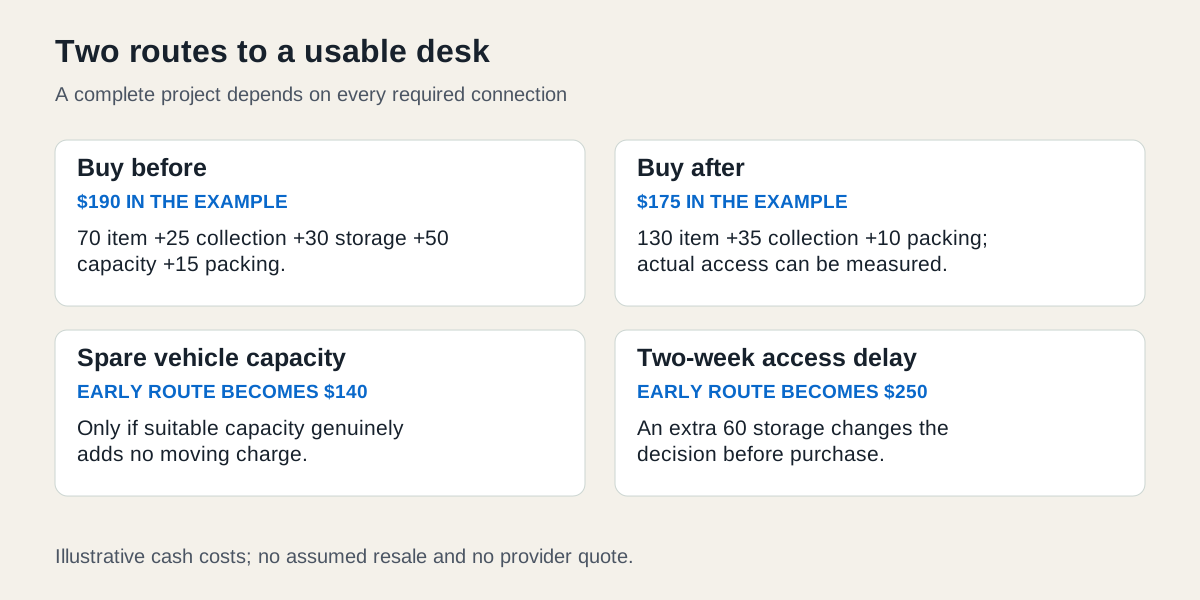 Enlarge diagram
Which purchases are easiest to make before moving?
Buy early when the item’s need, fit, storage and transport are already clear. Small, complete items that travel with belongings you are moving anyway can be straightforward. Bulky furniture, installation-dependent appliances and products needing unavailable storage deserve a full comparison with buying after arrival.
Separate a confirmed requirement from a guess about the new home. A floor-plan measurement may omit a doorway, radiator, stair turn or fixed fitting. If you cannot verify a critical dimension before possession, waiting can be more useful than locking in a low price.
How do you compare buying here with buying there?
This hypothetical comparison concerns a freestanding desk with no installation work. Both candidates must pass the same condition and fit checks. amounts are invented planning inputs, not provider quotes.
| Cost | Buy before moving | Buy after arrival |
|---|---|---|
| Desk | 70 | 130 |
| Collection from seller | 25 | 35 |
| Temporary storage | 30 | 0 |
| Extra moving-vehicle capacity attributable to desk | 50 | 0 |
| Additional packing/handling supplies | 15 | 10 |
| Total | 190 | 175 |
The early desk has two transport stages: collection from its seller and movement to the new home. The $50 line is the incremental vehicle cost caused by carrying it, not the entire household moving bill. If the existing vehicle has suitable spare capacity at no extra cost, change that line to zero; the early route becomes $140 and may make sense.
Do not count a shared expense twice. Conversely, do not call capacity “free” before checking the actual load and route. A desk that forces a larger vehicle or an extra journey has changed the move even when it occupies only one corner.
Enter the acquisition alternatives in listing comparison, including their relevant transport and missing-parts costs. Use the used buying cost calculator for a more detailed cash budget, with storage and incremental move expenses recorded as other purchase costs. Keep the wider household move budget separately.
Tie the purchase to confirmed access
For this fictional move, possession is confirmed for Monday 16 November, and the buyer wants a usable desk by Friday 20 November. Ten days before possession, they confirm the access information, moving capacity and temporary storage. Five days before, they decide whether a fully verified early purchase can be completed. They do not pay merely to preserve an option whose dimensions are unresolved.
If they wait, the first two days after access are for measuring the actual route and testing the room layout. They arrange collection by Thursday if a suitable candidate is available. An already-owned temporary work surface supplies the first-week fallback. These dates are planning assumptions, not a promise that a local listing will appear in time.
A usable deadline plan names the fallback before the final shopping day. Otherwise the deadline can turn an unsuitable purchase into an apparent necessity.
What if the move date changes?
Suppose the early route’s temporary storage extends by two weeks and the actual revised arrangement adds $60. Its total rises from $190 to $250. If the purchase has not been agreed, the buyer defers and searches after arrival. If it has already been bought, the $70 is a sunk payment, but further storage and transport remain decisions to evaluate.
Do not buy another item to justify the storage booking. Confirm the provider’s real extension, access and cancellation terms, then compare retaining, moving or otherwise disposing of the desk through an appropriate route. Assume zero resale unless there is a concrete, credible alternative; a listing is not a completed sale.
If the desk fails the actual doorway measurement before purchase, pass on it. If the problem is discovered after buying, obtain a competent assessment of any manufacturer-permitted disassembly and the full cost of the alternatives. Do not force an oversized item through the route or assume an old glued joint can be safely undone.
How should you handle seller holds?
Agree an actual collection date and ask whether the seller accepts it. A seller’s willingness to wait is separate from your moving company’s booking. Record what has been agreed about payment, cancellation and collection rather than assuming that “hold” has a universal meaning.
The FTC’s marketplace advice supports checking the transaction and payment arrangements. A moving deadline does not improve the protection of an unfamiliar payment request. If the seller cannot accommodate the date you can reliably meet, choose another purchase window.
Protect the plan after buying
Match the item’s instructions for transport, storage and reassembly, and keep its loose components and documents together. Manufacturer assembly resources can help with an identified product; they do not certify an unknown or modified piece.
Use the storage guide for an item already purchased and the apartment furnishing guide for the whole room budget. Buy-before-moving is a timing decision: the early price is attractive only when the additional journey, storage and access uncertainty still leave a workable purchase.