Store secondhand purchases before use: plan the second move
Quick answer
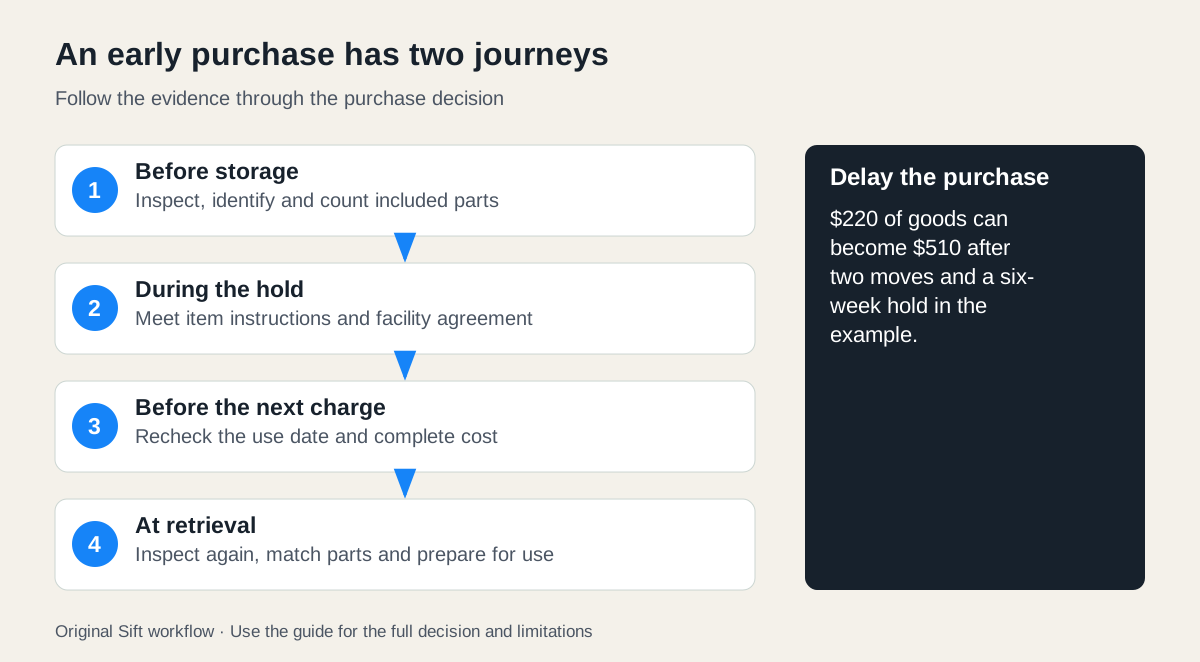
Inspect and identify the item before storage, check its manufacturer’s storage instructions and the provider’s restrictions, then budget both moves and the full holding period. Keep parts labelled and first-use items accessible. If the environment, access or complete cost is unresolved, buying later may be the better plan.
 Enlarge diagram
Storage is another stage of the purchase
A bargain bought six weeks before you can use it has two journeys and a holding period. It may also have a return window that expires before you set it up. Add those facts before deciding the early listing is cheaper than waiting.
First confirm when you expect to use the item and what could delay that date. Storage for an uncertain move needs a longer-cost scenario. A promotional first month is not a complete six-week quote if the agreement bills another full month.
Inspect before the item is packed away
Record identity, included parts, disclosed condition and the ordinary functions that can be safely checked. Do not use storage as a reason to postpone every inspection until any agreed return period has ended. If the item arrives by parcel, complete the arrival record first.
Resolve pest or contamination concerns before putting the item beside other belongings. The pest-risk guide explains why a cover or time in storage is not treatment. Damaged batteries, fuels and other hazardous contents are outside an ordinary household-storage plan.
Check the item and the unit separately
A provider’s “climate-controlled” description is not a manufacturer storage specification. Public Storage’s FAQ, as one US provider example, lists prohibited-item categories and states that it does not guarantee temperature or humidity ranges. Read the actual facility’s agreement and confirm the unit’s features rather than importing a generic standard.
For electronics, find the exact manufacturer limits. Apple’s iPhone/iPad temperature guidance distinguishes operating and storage conditions. That illustrates why a device-specific instruction is needed; it is not a storage specification for every monitor, battery or appliance.
| Item | Before storage | At the facility | Before first use |
|---|---|---|---|
| Disassembled table | Condition checked; approved disassembly; hardware counted | Dry, suitable protection and allowed placement | Match parts and follow assembly instructions |
| Monitor | Model and required input checked; supply labelled | Manufacturer-compatible environment and protection | Inspect for changes; follow normal setup guidance |
| Battery-powered device | No damage concern; exact storage directions obtained | Provider accepts contents and conditions can be met | Recheck condition and manufacturer instructions |
If the unit cannot meet a required condition, choose another location or defer the purchase. Do not substitute an assurance that other customers store electronics there.
A six-week cost example
In a hypothetical case, a table-and-monitor purchase costs $220, the first collection $60, six weeks of storage under the quoted billing arrangement $140, required storage coverage/fees $30 and the second move $60. Complete acquisition and holding cost is $510.
A comparable later purchase budget of $330 plus $60 delivery would be $390. The early deal is $120 more under these assumptions. Even if the storage space is already rented, ask whether these purchases require a larger unit, longer rental or extra trip; count only the incremental cost once, but do count it.
If the move is delayed and another hypothetical $90 becomes payable, the early total rises to $600. That is a reason to reconsider buying now, not assume the delay will be free.
Pack for identification and retrieval
Follow the product’s transport and storage instructions. Label removable parts and their matching item; keep small hardware in a clearly identified container without damaging the finish. Retain manuals and purchase records somewhere accessible rather than burying the only copy at the back of the unit.
Arrange the space around retrieval order. An item needed on the first evening should not require moving every heavy piece to reach it. Leave whatever access the facility requires and avoid an unstable stack. Obtain appropriate moving help; this is a planning guide, not a stacking-load calculation.
A simple inventory can list item, container, intended room, inspection status and next action. Photograph the packed arrangement privately so that you can locate components without repeatedly unpacking.
Confirm access, coverage and the end date
Ask when you can enter, whether a loading area must be booked, what identification or lock is needed, and what notice ends the rental. Read the actual coverage terms with the provider or insurer: limits, exclusions, deductible and proof requirements. A requirement to buy coverage is not proof that every stored object or loss is covered.
Set a reminder before the next charge or notice deadline. If the intended use date changes, recalculate the entire holding plan. Do not let an inexpensive object accumulate storage charges indefinitely because it is out of sight.
Recheck when the item comes out
Compare the item with the pre-storage record, count parts and look for new damage or environmental concerns. Do not energise equipment that appears damaged or unsuitable for use. Follow the manufacturer’s preparation instructions; there is no universal settling or waiting period for every stored product.
Use the first-day guide to route assembly, cleaning and account setup. In the cost calculator, include storage and related fees under other purchase costs and both journeys under collection or delivery. The useful comparison ends when the item is ready in the place you need it.
Sources
- 01Public Storage Storage FAQs
- 02Apple iPhone and iPad temperature guidance