Check secondhand items for pest risk before collection
Quick answer
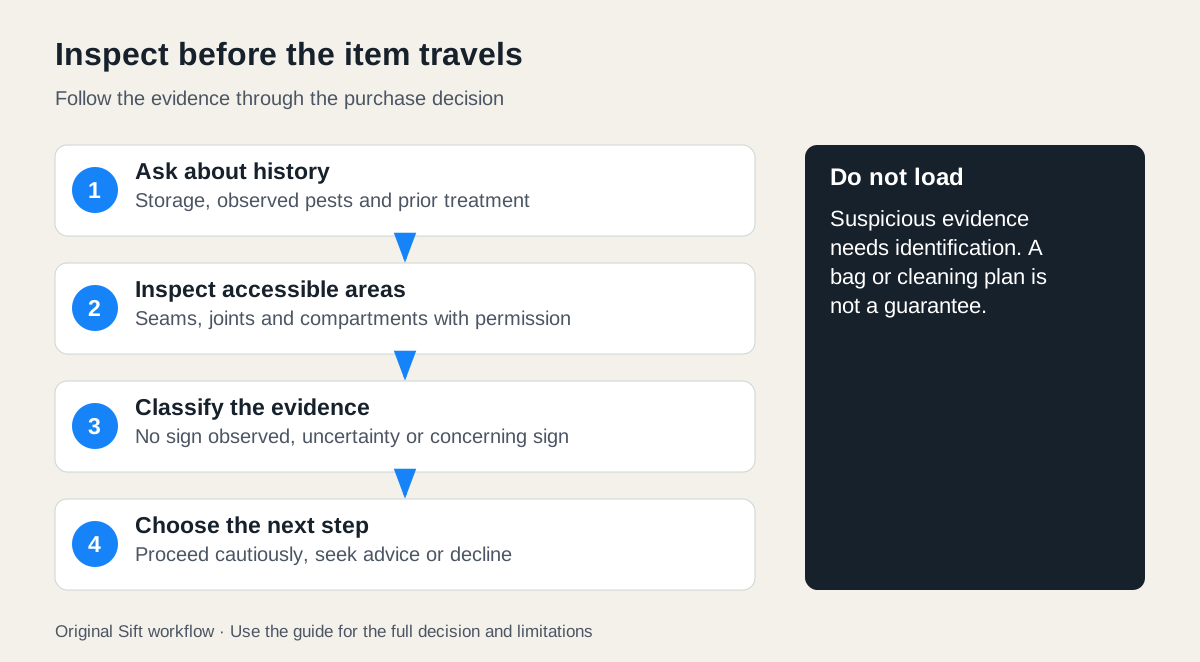
Inspect accessible seams, joints and compartments before bringing a secondhand item home, and ask about storage and pest history. Treat suspicious signs or inaccessible areas as unresolved evidence. A clean appearance or a seller’s reassurance cannot guarantee an item is pest-free. Decline or seek qualified advice rather than planning improvised treatment.
 Enlarge diagram
Make the decision before loading
The best time to decide whether an item has acceptable pest uncertainty is before it enters your vehicle or home. Arrange enough light and access for a reasonable inspection, with the seller’s permission. Ask where it has been stored, whether pests have been noticed and whether any treatment was used. Record the answer without treating it as a certificate.
The US EPA notes that bed bugs can travel on furniture, bedding, luggage, boxes and clothing and recommends checking secondhand furniture before bringing it home. This guide focuses on the buying decision, particularly bed-bug uncertainty; it does not identify every pest or provide an eradication procedure.
A household’s appearance, neighbourhood or the seller’s personal characteristics do not establish whether an item is affected. Base the decision on the item, its relevant history and the limits of the inspection.
Look where you can inspect without damaging the item
For upholstered furniture, ask to view accessible seams, cushion edges, folds and joins. For luggage, look through accessible lining folds, pockets, seams and compartments. For hard furniture, examine accessible joints and recesses. Do not remove stapled fabric, dismantle an electrical product or damage the item to extend the inspection.
The EPA’s identification guidance describes physical signs including insects, dark spots and shed material, while explaining that low-level infestations can be hard to find and other insects can be mistaken for bed bugs. Use that guidance to recognise a reason for further identification, not to diagnose from one ambiguous mark. Skin bites are not a reliable identification method.
If you notice something concerning, stop handling and loading. With permission, a clear photograph may help a qualified pest professional or local extension service advise on identification. Do not carry a suspected sample casually in your belongings.
Compare two items without declaring either safe
These are fictional inspection cases.
| Candidate | What can be examined | What remains unknown | Buyer’s decision |
|---|---|---|---|
| Sofa with removable cushions | Visible seams, cushion undersides and accessible frame areas | Interior cavities; unexplained dark material at a join | Do not load; seek identification or decline |
| Hard-shell suitcase | Open compartments, accessible lining folds, pockets and wheels | Areas behind fixed lining; prior storage history incomplete | Decide whether the remaining uncertainty is acceptable; no pest-free claim |
The suitcase is not automatically pest-free because it is hard-shelled. The sofa is not automatically infested because a mark is dark. The important difference is the evidence available and the buyer’s ability to tolerate what remains unknown.
If the sofa seller will not allow an ordinary accessible inspection, the buyer may decline without making an accusation. If the suitcase’s fixed lining conceals areas the buyer needs assessed, a low price does not remove that limitation.
Decide among proceed, pause and decline
Proceed only when the accessible inspection, history and remaining uncertainty are acceptable to you, and the item separately passes condition and suitability checks. Say “no concerning signs observed in accessible areas,” not “pest-free.”
Pause when a specific sign needs identification or a relevant history question remains unanswered. Keep the item with the seller while the uncertainty is resolved if they agree. Do not bring it home solely to obtain a better look.
Decline when evidence is concerning, inspection is inadequate for your comfort, or any necessary professional assessment and treatment would make the purchase impractical. You do not need to prove an infestation to choose another listing.
Do not make treatment the hidden bargain assumption
A listing may be cheap enough that a buyer thinks they can “just spray it” or leave it in a garage. That is not a complete or verified plan. Ordinary cleaning, pest treatment and contamination remediation are different tasks.
Do not mix chemicals, apply a product contrary to its label, improvise heat treatment or assume a particular time in a bag eliminates risk. The item’s materials and the pest must be identified, and any treatment decision should follow qualified advice and applicable product instructions.
For a hypothetical $60 chair, the relevant alternative is not merely another $60 chair. It is the complete usable item after any professional assessment, permitted treatment, transport and delay. If those amounts and outcomes are unknown, keep them unknown rather than entering a token cleaning cost into a calculator.
Plan transport without overstating containment
Keep a purchased item and its packaging organised and separate from unrelated belongings where practical. Discuss any concern with the transport provider before booking; do not conceal suspected pest evidence from someone handling the item. A cover or bag can assist handling but is not proof of containment or treatment.
Avoid using the arrival of a paid van as a reason to accept an item you would otherwise reject. Agree cancellation and failed-inspection costs in advance through the no-car transport guide. The inspection decision comes before loading, even when the trip has already cost money.
If you discover a concern after arrival
Avoid spreading the item or its packaging through additional rooms. Seek qualified local advice on identification and next steps, including any building-management obligations that apply to your situation. Do not pass the concern to another household by reselling or donating the item without resolving it appropriately.
Keep the listing, seller’s relevant statements and arrival observations. If the issue concerns a specific representation made in the sale, use the not-as-described workflow for the communication and applicable process. That process does not replace pest-management advice.
For ordinary material care after an acceptable purchase, use clean secondhand items before use. For the furniture’s structural condition, use the used-furniture guide. Each answers a different part of the decision.
Sources
- 01US EPA Protecting your home from bed bugs
- 02US EPA How to find bed bugs