Clean secondhand items before use: start with the material
Quick answer
Identify the material and exact product, preserve any purchase-problem evidence, and follow the manufacturer’s permitted cleaning method. Separate ordinary dirt from pest, mould, liquid-damage or other contamination concerns. Do not use one disinfectant or treatment recipe on every item, and do not power equipment that appears damaged.
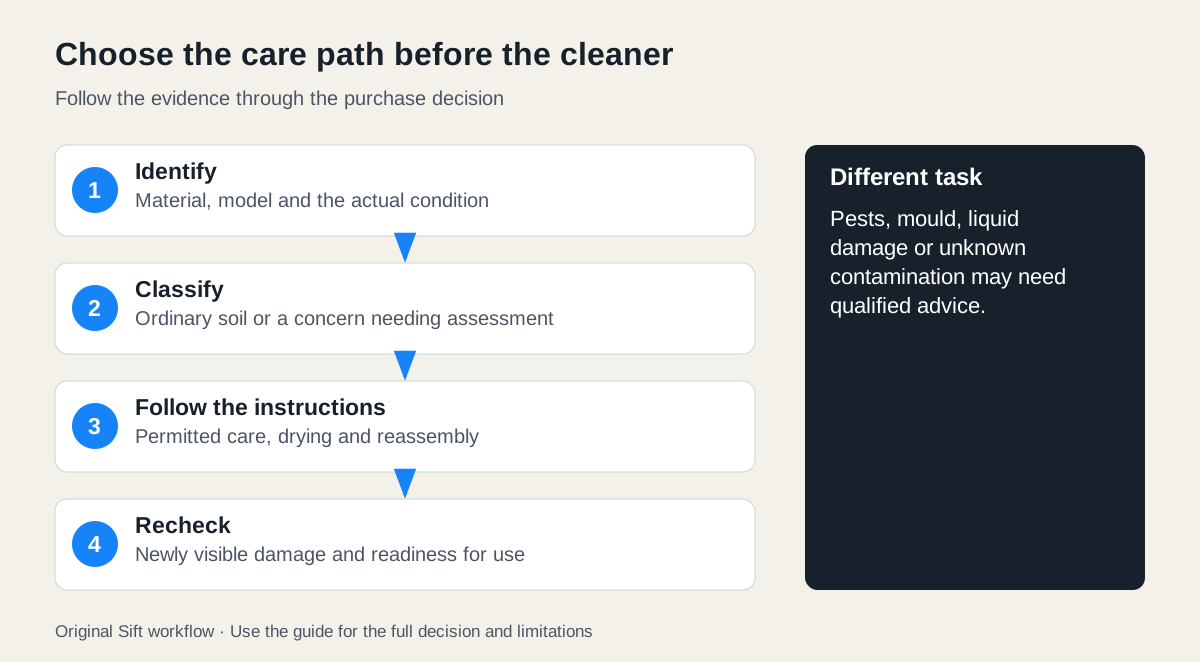 Enlarge diagram
Decide whether ordinary cleaning is the right task
Before reaching for a product, ask what you are trying to remove and whether the item is suitable to use. Dust on a shelf, a washable cover and residue around an electronic port are different situations. Cleaning should not conceal damage that needs inspection or a purchase dispute.
If an item has suspicious pest signs, extensive mould, an unexplained chemical residue, biological contamination or liquid damage, pause ordinary preparation and obtain appropriate advice. The pest-risk guide covers the buying decision; it does not turn cleaning into eradication.
For delivered goods, complete the arrival record before changing the affected condition. Photograph a disputed stain or damaged area and check the applicable return process before attempting to fix it.
Find the material and product instructions
Use the label, exact model and manufacturer’s care guidance. A cabinet may combine coated wood, veneer, metal and fabric; an instruction suitable for one part may damage another. A removable cover is not automatically machine washable, and a product looking waterproof is not proof it can be immersed.
Apple’s cleaning guidance gives different directions and exclusions for different products and surfaces. It is a useful example of why a permitted cleaning product for one device should not be copied onto every screen, coating or connector. Follow the section for the actual item.
If the label is missing and the material is important to the method, ask the manufacturer or a suitable care professional. You can decide against the purchase or leave a mark alone rather than experiment with increasingly strong chemicals.
A three-item triage
These are fictional cases, intended to show the decision sequence rather than prescribe a cleaning solution.
| Item | Evidence available | Ordinary next step | Stop condition |
|---|---|---|---|
| Finished side table | Manufacturer identifies finish and permitted care | Follow that method on intact surfaces | Swollen board, failing finish or unknown residue needs assessment |
| Removable cushion cover | Legible care label and known fibre/finish | Follow washing/drying directions for that cover | Missing label, contamination concern or damaged seams |
| Computer display | Exact model and official cleaning instructions | Power down as directed and use the permitted surface method | Cracked casing, liquid damage or unsafe electrical condition |
A clean-looking surface does not establish that the item is structurally sound or free of pests. Conversely, an ordinary cosmetic mark need not make an otherwise suitable item unusable. Keep those decisions separate.
Plan the preparation time
Include the method’s drying and reassembly requirements in your schedule. An item needed tonight may not be ready after a permitted wash or professional service. Do not accelerate drying with an unapproved heat source or reassemble damp components because the space is needed.
In a hypothetical example, a chair costs $70, collection $20 and a confirmed appropriate cover-cleaning service $35: $125 total. A ready-to-use suitable alternative costs $120 delivered. The first option may still appeal for its fit or design, but it is not cheaper once the necessary preparation is included.
If the service cannot confirm that the material is treatable or the result is acceptable, keep that uncertainty explicit. Paying for cleaning does not guarantee removal of every stain, odour or contaminant.
Keep cleaning, disinfecting and remediation distinct
Ordinary cleaning removes soil under the product’s care directions. A claim about disinfecting requires the correct product, use conditions and compatibility; it should not be improvised from a household recipe. Pest treatment or contamination remediation can require identification and professional methods beyond ordinary cleaning.
Do not mix cleaning chemicals, use products contrary to their labels or apply a strong agent simply because the item is secondhand. Follow both the item manufacturer and cleaning-product instructions. If they conflict or the material is excluded, choose another approved route or seek advice.
For electronics, avoid opening equipment or applying liquids into ports to clean internal contamination. A cosmetic improvement does not repair corrosion or electrical damage. Use the battery-health guide if the condition concern involves a battery.
Recheck before first use
After the permitted preparation is complete, inspect the item again, count removed parts and follow the exact assembly or setup instructions. Stop if cleaning reveals damage that was previously hidden. Do not cover a loosened joint or cracked component with the assumption that it was only dirty.
Keep care instructions with the purchase record, including any professional service and unresolved mark. The first-day guide routes the remaining checks, while maintenance planning covers recurring care.
A useful cleaning plan ends with an item that can be used according to its instructions, not merely one that photographs better. If that endpoint is uncertain before buying, compare another candidate before committing to the work.
Sources
- 01Apple How to clean Apple products
- 02US EPA Protecting your home from bed bugs