Plan maintenance before buying a used item
Quick answer
Read the exact model’s maintenance instructions before buying. Separate owner care, consumables and qualified service; verify required parts and supplies are obtainable. Price the first catch-up work and a normal-use planning scenario without inventing universal intervals or remaining lifespan.
 Enlarge diagram
Find the maintenance workload before agreeing the price
Two similar items can require different consumables, cleaning access or service arrangements. Read the exact manual and note what depends on usage, water conditions, environment or an indicator. A generic “service annually” rule can be wrong for the product you are buying.
Ask the seller what care they performed and whether relevant records exist. An invoice can support a particular service date and item identity; it does not prove every task is current. A missing record is uncertainty to assess, not permission to invent a complete overdue-service bill.
Contrast a vacuum and an espresso machine
Dyson’s V8 support page provides a model-family care and parts route, including filter care and several possible causes of short runtime. Match the exact variant before selecting replacements. Breville’s BES870 manual distinguishes cleaning and descaling indications and describes water-filter care. Those are named examples, not instructions for every vacuum or coffee machine.
| Item | Source-directed task to identify | Cost to verify | Boundary |
|---|---|---|---|
| Exact V8 variant | Filter care and required drying; condition-related troubleshooting | Correct filter or battery/service if actually needed | Short runtime is not automatically a battery diagnosis |
| Exact BES870 regional model | Routine care, cleaning indication, descaling and water-filter schedule | Compatible approved consumables and any qualified service | Cleaning and descaling are not interchangeable procedures |
| Either product | Initial normal-use assessment and relevant history | Confirmed catch-up work | Do not open or repair beyond supported owner actions |
The point of this table is to identify tasks in the manual. Follow the matching document for the actual procedure rather than using a summary as operating instructions. Regional or revised manuals can differ.
Separate three kinds of spending
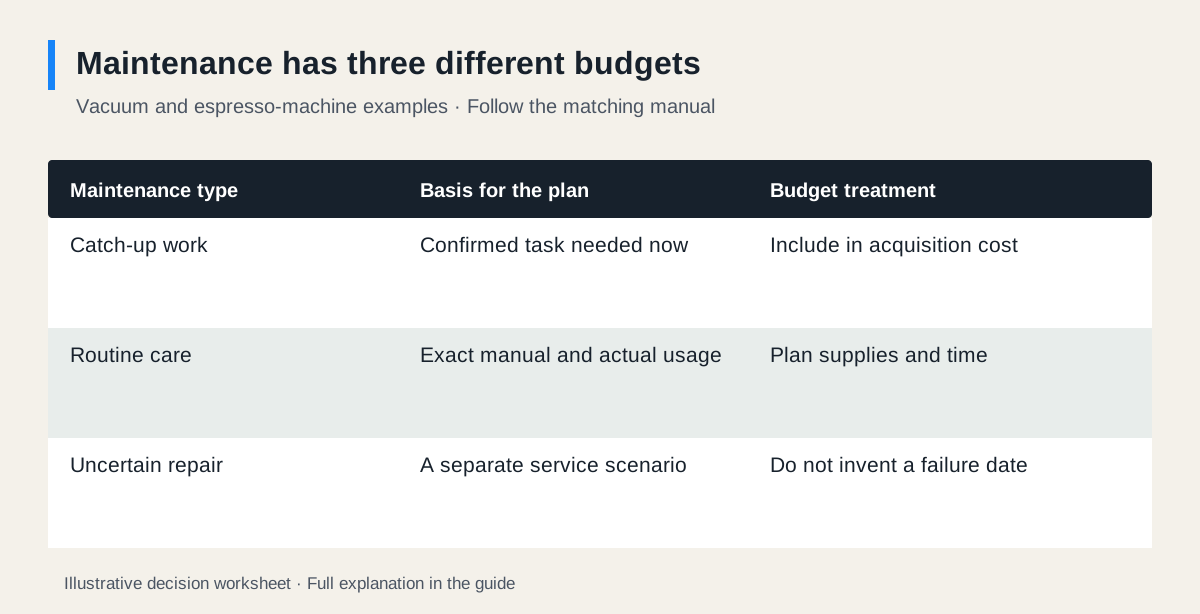
Initial catch-up work is what must be done before the item meets your requirements. Obtain evidence and a quote where necessary. Routine consumables are the supplies used under the model’s normal care plan. Uncertain repair is a scenario, not a scheduled expense with a known date.
A hypothetical vacuum plan includes $140 purchase, $15 collection and $25 for a confirmed compatible filter needed now: $180 acquisition. An illustrative $100 supported battery service is a separate sensitivity case only if the buyer has obtained a real model-specific route and quote. Do not automatically add it as a proven repair or exclude it as impossible.
A hypothetical espresso-machine plan includes $250 purchase, $20 collection and $50 initial assessment/care: $320 acquisition. The buyer’s usage-based consumable estimate is $60–100 over a year. That range is a planning assumption built from their verified supplies and anticipated use, not a manufacturer service interval or a market-price claim.
If another suitable option costs $390 and requires less immediate work, compare the complete acquisition and the same planned use. Do not compare one item’s purchase price with another’s annual cost.
Verify availability as well as compatibility
Find the exact consumable or part through the manufacturer or authorised supply route. Record the part number, region, required quantity, availability and date checked. A search result saying “fits many models” is not the same as manufacturer compatibility evidence.
If the part is unavailable, ask whether an official replacement or supersession exists. Use the discontinued-parts guide rather than substituting a lookalike. A cheaper item with no practical maintenance path may not meet a long-term need.
Consumables can also create storage and waste requirements. Buy quantities suited to actual use, and check shelf-life or storage instructions where the manufacturer specifies them. A large bundle of old supplies should not automatically count as savings.
Decide which tasks you will actually do
List owner-permitted care separately from work needing a qualified professional. Consider access, time, ability and willingness. If you will not perform a required recurring task, price an appropriate service or choose a different product. Do not assume future motivation will solve an inconvenient maintenance design.
Ask a service provider what the quoted visit includes, which parts are extra and what happens if a fault is found. Keep servicing separate from certification or a guarantee of remaining life. The independent-inspection guide helps define the scope.
Put reminders around triggers, not invented dates
For a task specified by time, record the manufacturer’s interval. For an indicator or usage condition, record what to watch for and where the instructions are. Note the starting state after the first appropriate care or service so that the next owner does not inherit an unexplained reminder.
Use the used-versus-new calculator for ownership scenarios with purchase/setup costs, assumed years, annual running costs and optional resale. It does not generate maintenance schedules. Keep the model-specific record alongside the purchase record.
Buy when the initial condition and ongoing work fit your budget and routine. Renegotiate a known consumable expense, investigate an unexplained symptom, and pass if necessary maintenance cannot be supported. A cheap purchase with upkeep you cannot complete is an unfinished project.
Sources
- 01Dyson V8 support and care
- 02Breville BES870 US/Canada instruction manual