Furnish an apartment secondhand without overspending
Quick answer
Start with sleeping, eating and working functions, including belongings you already own. Measure the rooms and delivery route, then give each purchase a complete budget for collection and setup. Buy in phases tied to confirmed access. Keep a reserve and leave optional furniture unbought until daily use shows what is missing.
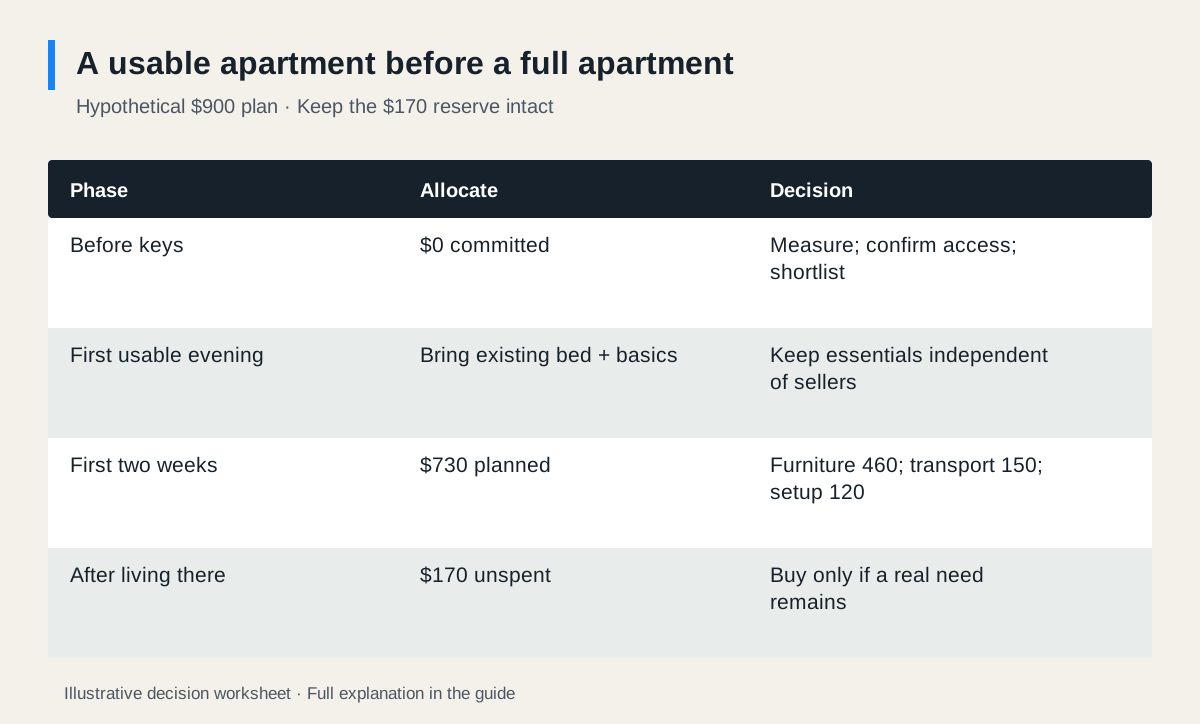 Enlarge diagram
What should your first shopping list contain?
List functions before furniture. A place to eat might be a compact table or a counter you already have. Storage might mean one cabinet after you unpack. Work may initially happen at the dining table if that arrangement is comfortable for your actual use.
Divide the list into needed on arrival, useful in the first month and optional later. Put your existing belongings into the plan first. A secondhand furnishing budget should not spend money replacing something that already solves the problem.
For every wanted piece, write a maximum footprint, a complete spending limit and the earliest date it can enter the apartment. “Small desk” is hard to verify. “No more than 40 inches wide and 22 inches deep (about 102 × 56 cm); chair must pull out without blocking the entrance” gives you a useful search and a reason to reject a listing.
A complete small-apartment plan
The following is a hypothetical planning example, not a real project, local price survey or delivery quote. One person has a bed and mattress they will bring, a laptop, basic kitchenware and temporary storage boxes. They have $900 for additional furnishings and their associated costs. The apartment already has the required fixed appliances and lighting.
The plan reserves a sleeping zone, a two-seat eating area and a work corner. The example dimensions are this fictional buyer’s limits, not recommended universal room clearances. Anyone using mobility equipment or needing a different access arrangement should design the layout around those requirements from the beginning.
| Function | Purchase limit and fit requirement | Item allowance | When to buy |
|---|---|---|---|
| Eating | One table, maximum 32 × 32 inches (about 81 × 81 cm), plus two suitable chairs | $140 | After measuring with keys |
| Working | Desk maximum 40 × 22 inches (about 102 × 56 cm); suitable chair | $180 | First two weeks |
| Storage | One low cabinet, maximum 32 × 14 inches (about 81 × 36 cm); approved setup possible | $80 | After unpacking |
| Local task lighting | Two suitable lamps with required parts | $60 | After checking useful positions |
| Furniture and lamps | Four functions, not a complete matching room | $460 | Phased |
| Collection or delivery | Two planned collections | $150 | Only after quotes |
| Setup and known missing parts | Assembly help, required fixings or confirmed accessories | $120 | Item-specific |
| Unspent reserve | Not an invitation to increase every offer | $170 | Retain |
| Total available | All amounts use the same currency | $900 |
The $120 setup allowance is a budget envelope. Before committing to an item, replace it with identified work and real costs. If anchoring or assembly cannot be completed properly within the allowance, change the item or the plan.
A sofa, coffee table, matching side tables and decorative shelves are deliberately absent. The buyer will discover which are useful after living in the room. The existing bed keeps sleeping independent of whether a seller replies on moving day. Someone without a suitable sleeping arrangement needs a separate confirmed solution before treating this as a usable first-evening plan; the used-mattress guide explains why that choice deserves its own scrutiny.
What should you measure?
Measure both the space in use and the route to it. A desk fitting between two walls says nothing about the chair behind it. A cabinet fitting through an entrance says nothing about the turn immediately after that entrance.
- Draw the room and fixed obstacles. Include doors in their open position, radiators, outlets, built-in cupboards and the items you are bringing.
- Place the activity. Mark where a person sits, moves, opens drawers or reaches storage. Check the arrangement against your own use, not just a furniture rectangle.
- Trace the delivery route. Record entrances, hallways, stair turns, lift dimensions and any building restrictions. Confirm whether protective coverings or a booking are required.
- Record the largest transportable section. Ask whether legs or other parts can be removed according to the product instructions and who will do it.
- Resolve the uncertain point. A seller’s estimate or a photograph without scale is not a measurement. Ask for a measured dimension or a qualified delivery assessment.
Use the furniture fit checker to organise the dimensions it supports. It is not a simulation of rotating a sofa around a stair turn. Keep unresolved corners, lifting constraints and access restrictions visible in the decision.
For the example work corner, the buyer has set a 40 × 22-inch (about 102 × 56 cm) desk limit after accounting for the chair and door. A listing says “compact desk” but the measured top is 48 × 24 inches (about 122 × 61 cm). That desk is rejected even at $40. It would consume the planned circulation space; a lower price cannot recover the missing room.
How does a rejected item change the budget?
Suppose the buyer had shortlisted that oversized desk at $40 and a chair at $70, leaving $70 within the $180 work allowance. Once the desk fails the fit check, they keep the chair only if its condition and dimensions work independently. They search for a desk up to $110 within the original size limit.
They do not pay a collection provider to take the unsuitable desk because the booking already exists. Before booking, they agree what the provider charges if the inspection fails or an item is not collected. If the trip is already chargeable, that amount belongs in the transport budget; it does not make the wrong furniture useful.
A second option is to use the dining table temporarily and postpone the desk. That preserves cash and avoids buying under pressure. Recheck whether the temporary setup is practical for the time spent working; the home-office plan treats the workstation as a connected fit decision.
Should you buy a matching room bundle?
Compare the bundle with the functions you actually need. In this example a hypothetical $260 bundle contains a table, four chairs and a sideboard. Delivery is $90, so acquisition costs $350 before any setup. The table is within the size limit, but only two chairs are needed and the sideboard blocks the planned work area.
A separate table-and-two-chair option costs $140 plus $50 collection: $190. If the buyer also buys the planned $80 cabinet, the comparable spending is $270 before any additional cabinet collection or setup. The bundle is not automatically cheaper because it includes more objects.
There are three sensible branches:
- The seller agrees to separate the wanted pieces. Get a new price and transport quote, then compare again.
- Every piece can serve an actual planned function. Compare the full delivered cost and inspect all important pieces.
- Some pieces are unwanted or will not fit. Include their handling and disposal work, with zero resale as the base case. Pass if the bundle no longer works.
Do not subtract hopeful resale proceeds for the extra chairs and sideboard to manufacture a bargain. They occupy space and need another buyer. The bundle guide gives a fuller method for counting usable pieces and rejecting a mixed-condition lot.
What should you ask before arranging collection?
Ask questions that resolve the current uncertainty. For a cabinet, that might be the exact dimensions, a photograph of the model label, whether shelves and fixings are included, and whether any joints or panels are damaged. For upholstered furniture, use the furniture inspection guide and the pest-risk decision before committing transport.
A useful message for the example desk is:
I have a space limited to 40 inches wide and 22 inches deep (about 102 × 56 cm). Could you confirm the measured top size, whether all assembly hardware is included, and any damage or looseness? If it fits, I would like to inspect it before confirming purchase. My building access is available Saturday afternoon.
Keep safety and completeness separate from cosmetic tolerance. A scratched top may be acceptable; a missing structural component is a different decision. Check identified furniture in CPSC recalls in the US, and obtain the exact assembly and anchoring instructions. A clean appearance does not settle those checks.
For furniture requiring anchoring, establish the correct model instructions, complete hardware, suitable wall arrangement and permission to carry out the work. CPSC’s Anchor It guidance addresses furniture tip-over prevention. Follow the exact product and anchoring instructions, and get appropriate installation help when the wall or required method is uncertain. A rental restriction is a reason to resolve the setup or choose another suitable product, not omit a required safety step.
How do you schedule collections around possession?
Before keys, shortlist and ask factual questions. Avoid arranging a delivery into a building you cannot yet access. Confirm the possession time, lift or loading arrangements, and who can receive the item. A listing described as available today need not become your responsibility today.
| Stage | Complete this | Purchase decision |
|---|---|---|
| Before possession | Confirm access; draw provisional zones; inventory belongings | No bulky purchase dependent on unverified access |
| First evening | Bring existing sleeping and kitchen basics; inspect actual space | Use the apartment without waiting for optional furniture |
| First weekend | Measure; inspect eating furniture; obtain carrying quote | Buy if fit, condition and complete cost pass |
| Following week | Observe daily routes and work needs | Confirm desk and chair combination |
| After unpacking | Check what still lacks a home | Buy one cabinet only if needed |
| End of first month | Review reserve and real gaps | Consider optional pieces individually |
Combine collections only when windows, load space and inspection time genuinely fit. The multiple-pickup guide shows how one rejected item changes a route. If you have no car, choose a transport method using the no-car furniture guide before committing to a seller’s timing.
Keep the plan open after you move in
Write down the thing you cannot comfortably do before buying another piece. “We need somewhere to put two bags near the entrance” is a better next search than “the hallway looks empty.” Measure the new solution against the room you now understand.
For each actual candidate, use the used buying cost calculator to separate item price, collection, repairs, missing parts and other purchase costs. Shared delivery costs should be allocated once across the project, not charged in full against every item and then added again.
Keep the $170 reserve available until the essential plan is working. It may cover a revised delivery quote or remain unspent. A furnished apartment is successful when the required activities fit, the furniture can be used properly and the budget still makes sense after everything arrives.