Kijiji price history and Price Drop badges explained
Quick answer
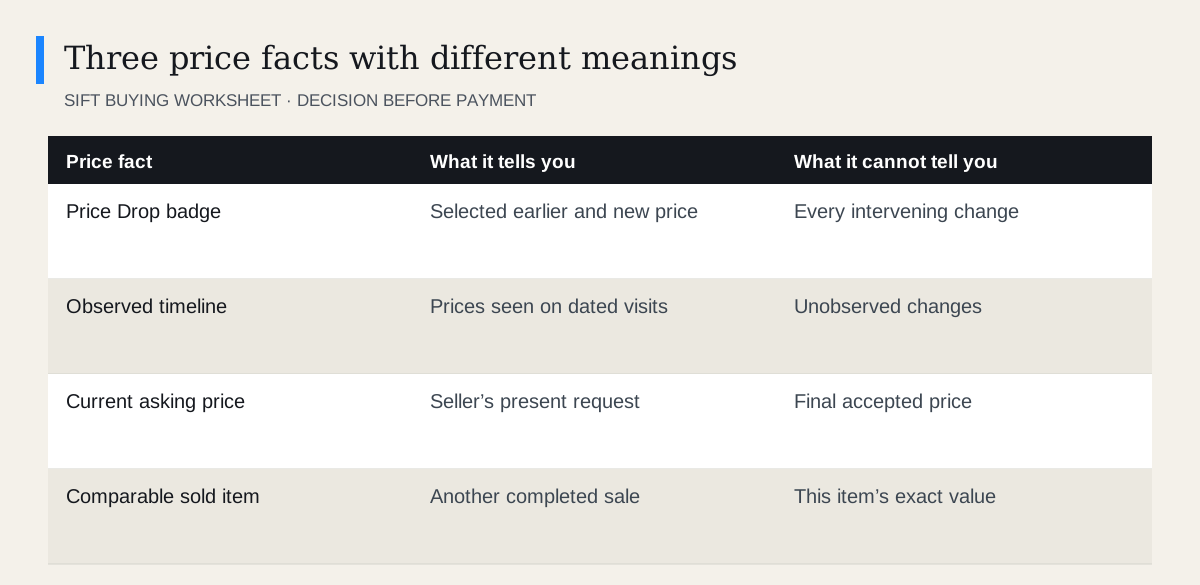
Kijiji’s native Price Drop promotion can show a reduced price beside an earlier price, but it is not a complete public timeline of every change. Keep dated observations if you are tracking an ad. On a computer, Sift shows the prices it has observed and highlights drops; it cannot reveal prices from before observation or prove what the item eventually sold for.
 Enlarge diagram
What does Kijiji’s Price Drop badge mean?
Kijiji documents Price Drop as a paid promotion that shows a reduced asking price alongside an earlier price. It draws attention to a reduction; it is not a comprehensive archive.
That distinction matters when a listing advertises a large percentage saving. The earlier amount may have been an ambitious asking price. A reduction from an unrealistic starting point can still leave the item expensive compared with suitable alternatives.
Do not conclude that an ad without the badge has never changed price. The presence or absence of a paid promotional feature does not answer that question.
How can you keep a useful price record?
- Save the specific ad. Use Kijiji Favourites so you can return to it.
- Record the observed price and date. Include the model and important included parts.
- Check for changes in the package. A lower price might exclude an accessory previously included.
- Compare the same listing identity. A new ad may represent a relist or a different item.
- Keep the current alternatives visible. Price history alone cannot establish value.
A simple record can be useful even when you only revisit a few times. Do not fill the gaps between observations with invented daily prices.
How does Sift’s history differ?
On a computer, Sift shows observed prices and highlights drops during Marketplace and Kijiji browsing. That can make a change easier to notice than relying on memory.
The observation boundary matters: history starts with available observations. A listing’s first observed price is not necessarily its original asking price. An unobserved change may be absent. The final negotiated amount may never appear publicly.
Use the timeline as context for a buying decision, not a claim to know the seller’s complete pricing strategy.
What should you do when a price drops?
Reopen the listing and compare the current description with your notes. Check whether condition, included accessories, quantity or pickup terms changed. Then compare the new complete cost with current alternatives.
| Observation | Decision question |
|---|---|
| Asking price falls from $300 to $240 | Is $240 competitive for this model and condition? |
| Stand is no longer included | What does a compatible stand cost? |
| Pickup location changes | Does transport erase the reduction? |
| Similar complete item is $230 nearby | Why choose this one? |
These figures are examples. A visible percentage reduction is not the same as money saved against your best alternative.
Can you use history to negotiate?
Yes, politely. Use the current offer and relevant evidence rather than accusing the seller of inflating a price. “I can offer $220 based on the missing stand and comparable complete examples” is more constructive than arguing about an old asking amount.
The seller can decline regardless of previous reductions. A long listing history does not create an obligation to accept your preferred price.
Use the Kijiji offer guide for the app feature and ordinary chat offers. Keep your maximum based on value and complete cost rather than trying to guess the lowest amount the seller might accept.
What if the ad disappears or is relisted?
Keep your own notes, but do not assume a new ad is the same physical item. Compare the model, photographs, seller and description, then ask if necessary.
An unavailable ad does not reveal its sale price. It might have sold, expired or been withdrawn. Avoid entering the last asking price into a comparison as though it were a verified completed sale.
If you still want the item type, carry the model and condition criteria into a fresh search. History is useful when it helps you recognise a better opportunity, not when it keeps you attached to an item that is no longer available.
Questions people ask
Does Kijiji show price drops?
Yes. Its paid Price Drop feature can display a reduced price and the earlier price used for the promotion. That is different from a complete history.
Can Sift show every past price?
No. It can show observed prices, not changes that happened before or outside its observations.
Does a price drop mean the item is a good deal?
No. Compare the current price with equivalent items and include condition, missing parts and collection costs.
Sources
- 01Kijiji Promoting listings through Price Drop
- 02Kijiji Favourite Kijiji listings