Used camera tripods: legs, head and plate fit
Quick answer
Identify the legs, head and camera plate separately. Match their connections and manufacturer load guidance to your camera and lens, inspect locks and joints, and test normal movement with the equipment safely supported. A missing plate or creeping head can make a sturdy-looking tripod unusable. Price the exact replacement parts and the height you will actually work at.
Treat the tripod as three purchases
A complete support is legs, a head and a compatible camera attachment. The legs may be one brand, the head another and the plate missing entirely. Record each exact model and the plate or clamp system, then check the manufacturer’s mounting and load guidance for the intended camera and lens.
Include the lens, cage and other accessories in the supported setup. A long lens can place its weight differently from a compact camera of similar total mass. Do not assume a headline load rating guarantees comfortable use at every angle, height or extension. Match the actual arrangement to the manuals and test the movement you need.
Manfrotto’s MT055XPRO3 product resources provide model-specific instructions and spare-part documents. That is the useful research pattern: identify the exact version and verify replacement hardware, rather than treating every clamp or plate as universal.
Choose the working position, not just maximum height
Decide whether you need eye-level still photography, low-angle work, controlled video pans or a compact travel support. Measure the working height with the head and camera included. Note the folded size and weight you must carry. A tall tripod that is impractical to transport may be the wrong purchase even if its joints work.
Ask whether the centre column, feet or head has been changed. Check whether all original parts needed for your intended configuration are included. A conversion or missing column may be acceptable for one use and unsuitable for another.
 Enlarge diagram
Inspect every leg and lock
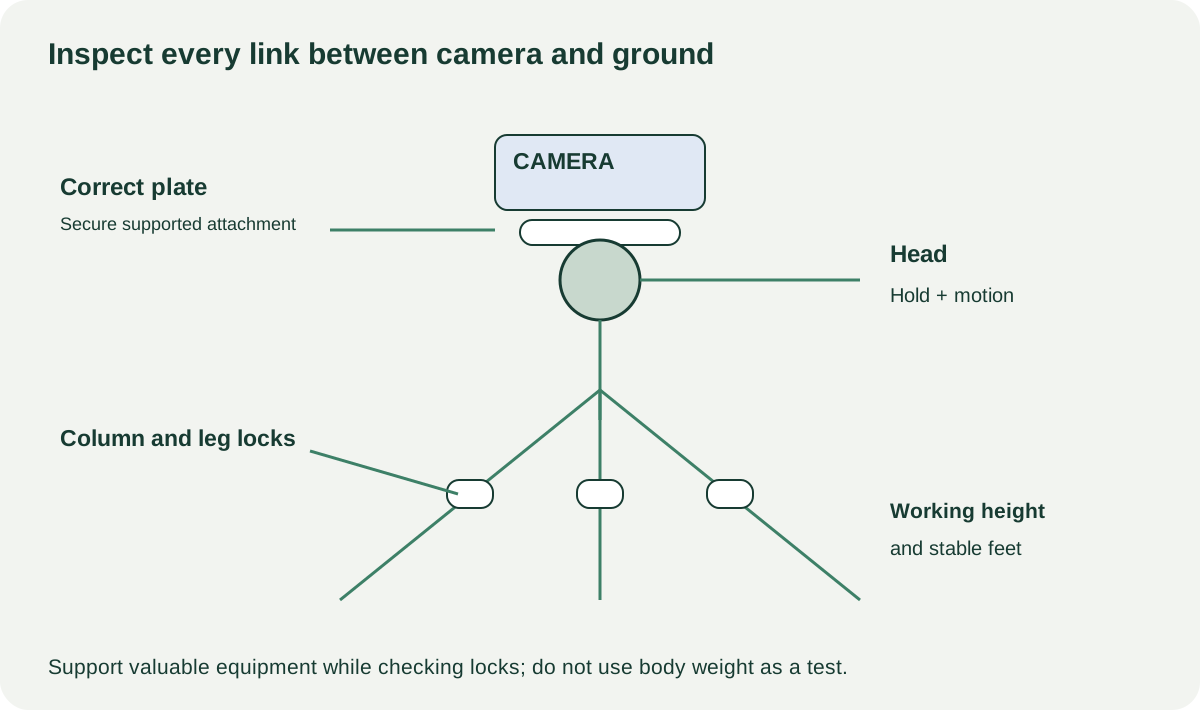
Start without a valuable camera attached. Extend each leg section normally, set its lock and look for slipping, binding, cracked clamps or distorted tubing. Try the supported leg-angle stops and inspect the apex where the legs join. Do not stand on the tripod, hang your body weight from it or tighten a lock beyond its instructions to prove strength.
Inspect feet for damage and confirm any removable tips are correctly attached. Check the centre-column mechanism and its locks through the ordinary range. A missing foot or knob may have an available exact replacement; a cracked structural joint is a different issue.
Look at accessible carbon or metal sections for damage without bending them to test a suspected crack. Ask about drops, salt-water exposure, sand contamination and repairs. A sticky twist lock could need maintenance or could have damaged parts; establish the cause before calling it a cheap clean.
Test the head with controlled support
Confirm the head is attached correctly and cannot loosen unexpectedly during ordinary movement. Identify which control locks each axis, sets friction or adjusts a documented video function. Have the seller demonstrate the intended operation before you release an unfamiliar control.
Fit the correct plate to the intended camera according to its instructions, or use an agreed suitable test load. Keep a hand supporting the equipment while checking seating and lock engagement. Never discover a missing safety catch by releasing an unsupported camera. A plate that almost fits is not an acceptable mounting solution.
At your working height, frame an ordinary subject and lock the head. Observe whether it creeps under the supported arrangement. Try normal pan and tilt movements if required, checking for sticking or sudden jumps. A locked static shot does not demonstrate smooth video movement, and smooth movement with no load does not establish behaviour with your camera.
| Component | Demonstrate | Cost question |
|---|---|---|
| Legs | Each section and required angle holds | Exact lock, foot or section available? |
| Column | Required position holds normally | Correct assembly and parts? |
| Head | Supported load holds; needed movement works | Serviceable model or replacement needed? |
| Plate/clamp | Correct fit and normal secure attachment | Exact compatible plate and screw? |
Compare complete support costs
A hypothetical leg set is $70, a suitable head $65 and correct plate $25, with $15 collection: $175. A complete $150 tripod may be a better buy if it meets the same height and movement needs. Those are example inputs, not current valuations.
Known replaceable feet or plates can support negotiation after verification. A slipping leg lock, creeping head or questionable structural repair should be resolved or assessed before trusting expensive equipment to it. Do not turn a cheap tripod into a costly camera-drop experiment.
Record the exact head and plate you tested and confirm they are included. Fold and pack it according to the manual, protect protruding controls and secure loose parts. A useful bargain is a support that holds your real equipment at your real working position, not a large load number printed in a listing.
Sources
- 01Manfrotto MT055XPRO3 product manuals and spare parts