How to test a used espresso machine from cold to steam
Quick answer
Ask to see the machine start cold, reach its normal ready state, brew and produce steam using the manufacturer’s procedure. Check the tank, group area, wand and underside for leaks. Identify the exact portafilter, baskets and maintenance requirements. A warm machine making one drink leaves questions about startup, scale and intermittent faults; include a suitable grinder and service allowance where needed.
Decide which coffee workflow you are buying
A manual espresso machine, a machine with a built-in grinder and a fully automatic machine require different accessories and maintenance. Identify the exact model and check how it prepares coffee before comparing prices. A low machine price can hide the need for a suitable grinder, portafilter, milk container or removable brew unit.
Ask for the model label, all included baskets and tools, service history and known faults. Check the voltage and regional version, especially for imported machines. Find the manufacturer’s current manual and parts availability; superficially similar portafilters and baskets are not always interchangeable.
Measure counter depth and clearance under cupboards, including access to the water tank and bean hopper. A machine that fits on the counter may still be awkward to refill or clean in that position.
Describe an ordinary morning in order: grind, dose, brew the number of drinks you need, steam milk if wanted, then clean the parts. Note which steps use separate equipment and whether you can accept the model’s normal wait or transition between them. A single successful espresso does not demonstrate a fully automatic machine’s milk cleaning or a built-in grinder’s adjustment.
For example, a machine sold without a grinder may still suit a buyer using the manufacturer’s supported basket and preparation method. A buyer wanting a different espresso workflow may need a suitable adjustable grinder as a separate purchase. Check the basket and intended preparation before treating “grinder included” as either essential or a bonus. The grinder guide covers the separate burr, adjustment and retention checks.
 Enlarge diagram
Ask about water and maintenance specifically
Ask which water was used, how the machine signalled maintenance and what cleaning products or service work were performed. A general claim of “regularly cleaned” may refer only to wiping the outside.
The Breville Bambino manual distinguishes care for the steam wand, baskets, group area and descaling. That gives useful questions for a seller, but its procedures are specific to that model. For another machine, follow its own instructions and material restrictions.
Do not run an aggressive descale during an inspection to see what happens. Breville’s troubleshooting guidance directs users to model-specific procedures and distinguishes failure to enter a cycle from poor flow or an incomplete cycle. A seller should resolve a claimed maintenance-only issue before you price the machine as working.
Inspect it before heat and pressure build
With the machine cool and disconnected, inspect the plug, cable, tank and accessible seals. Look under and around it for mineral deposits, rust and evidence of persistent leakage. Check the drip tray, reservoir lid and user-removable parts are present and seat properly.
Inspect the portafilter lugs, basket and group area without scraping or dismantling anything. Look at the steam wand tip for dried residue and damaged threads. Check any grinder hopper and burr access only as the manual permits, with power disconnected. A machine’s internal boiler and wiring are not part of a casual purchase inspection.
For a fully automatic model, ask the seller to demonstrate the specified user cleaning access, milk system and waste container. Do not assume the brew unit is removable on every machine.
Watch a complete normal cycle
Ask the seller to operate the machine while you observe. Keep clear of steam and hot water, and use the specified containers and normal operating sequence. Never remove a pressurised portafilter or open a boiler cap to investigate a fault.
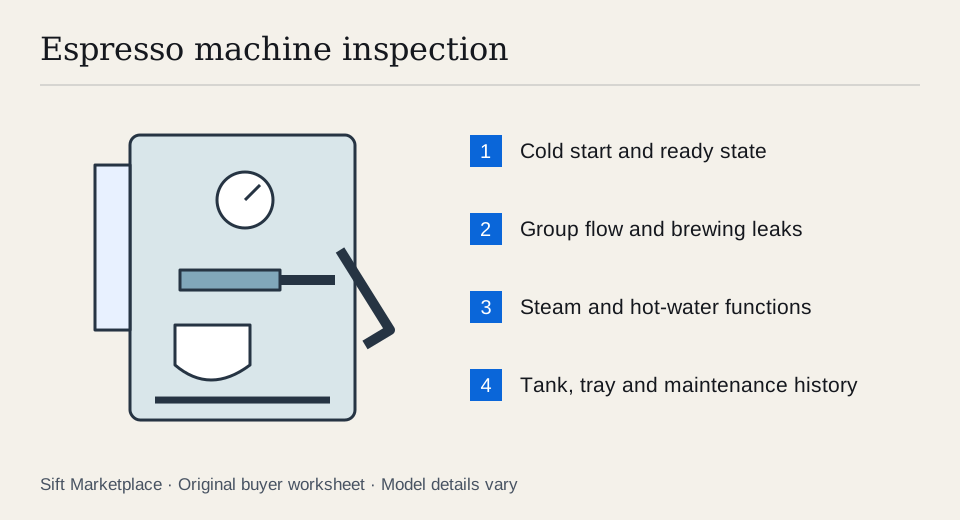
- Start from cold. Observe warm-up, ready indications and any errors. Compare with the model’s normal process rather than a universal warm-up time.
- Run the appropriate water-flow check. With the tank correctly seated, have the seller demonstrate the manual’s normal flush or dispensing function.
- Prepare a familiar shot. Use a suitable basket and coffee preparation. Watch for leaks around the group and under the machine, not only liquid entering the cup.
- Repeat an ordinary brew. Check that the machine remains usable and does not display an unexplained fault after its first successful shot.
- Demonstrate steam. Observe whether the wand produces useful steam and whether controls start and stop it normally. Expect the model’s normal transition between brewing and steaming.
- Check hot-water or milk functions you need. Test them separately where fitted. A good espresso shot does not prove a blocked milk system works.
- Inspect after operation. Look for fresh leaks, unusual smells and errors, then let the machine cool using its normal shutdown procedure.
Shot taste alone is not a reliable machine diagnosis because beans, grind, dose and preparation all contribute. Conversely, a pressure gauge moving does not establish the health of every water path. Keep the test focused on repeatable operation and visible faults.
Record each stage rather than one overall tick: cold startup, ordinary water flow, coffee brewing, repeat brewing, steam, required milk/hot-water function and leaks after use. Suppose brewing works twice but the wand produces no useful steam. The coffee path has shown evidence; the steam requirement remains failed. A listing that calls this “only a cleaning job” should demonstrate the corrected result or be compared as an unresolved machine.
If taste is the only concern, repeat with a sensible documented preparation before assigning a repair diagnosis. If water appears underneath during each cycle, stop and establish the source without opening the hot machine. Water deliberately discharged to a fitted drip tray and a leak from an unexplained location are different observations. Buy on complete normal operation, negotiate exact missing accessories and seek an assessment for recurring leaks, errors or restricted flow.
Know which missing pieces change the deal
| Item | What to verify |
|---|---|
| Portafilter and baskets | Exact fit and appropriate basket type |
| Grinder | Suitable adjustment for your intended workflow |
| Tank and filter holder | Correct, intact and available |
| Milk components | Complete, cleanable and demonstrated |
| Cleaning tools and products | Model-approved supplies |
| Service | Local support and actual quote for known faults |
An illustrative $180 machine needing a $55 portafilter and a $100 service assessment reaches $335 before a grinder. A $300 complete working candidate may be the more sensible buy. These are example budget inputs, not typical prices or a repair promise. Add your own figures in the cost calculator.
Do not assume a weak pump, blocked valve or leak is a cheap seal. If the fault is unresolved and you want a ready-to-use appliance, choose another listing. If you want a repair project, set a budget around a qualified assessment and the possibility of additional faults.
Plan collection and a clean first use
Let the machine cool, remove loose accessories and follow its transport or draining instructions. Keep water away from electrical areas and protect the steam wand from impacts. Clean food-contact parts according to the manual before making your own drinks; do not assume every piece is dishwasher-safe.
Sift, a free Facebook Marketplace filter and scam checker that also works on Kijiji, helps focus local searches on Chrome on a computer. Use model-word filters and recorded prices to find candidates worth seeing through a complete cold-to-steam demonstration.
Questions people ask
Does a pressure gauge prove an espresso machine is healthy?
No. The reading depends on the machine, basket, coffee and preparation. Check normal water flow, brewing, steam and leaks, and compare behaviour with the exact manual rather than applying one universal gauge target.
Is cleaning the same as descaling?
No. Removing coffee oils and residues is different from treating mineral scale. Follow the model’s specified procedures and products. Some machines have distinct cycles; do not assume a button sequence or chemical is universal.
Should I buy a machine that just needs descaling?
Have the seller complete the appropriate procedure and demonstrate normal operation first. Restricted flow can have several causes, and a promised future descale does not establish the cost or outcome of repair.
Sources
- 01Breville Bambino BES450 instruction manual
- 02Breville Model-specific descaling troubleshooting