Used film cameras: dry checks, film evidence and service cost
Quick answer
Identify the camera, film format, lens compatibility and power requirements. Inspect accessible seals and controls without touching shutter curtains, then observe normal operation using the matching manual. A shutter sound or working meter cannot prove accurate exposure, film transport or freedom from light leaks. Seek recent developed-film evidence or price the remaining uncertainty and qualified service.
Identify the photographic system before the collectible
Record the exact camera model, film format, lens or mount, required battery and any special back, magazine or accessories. Ask what was last used, when it was serviced and whether the seller has recent results from this exact camera. An old roll in the case is not evidence of successful recent photography.
Decide whether you want to shoot immediately, restore a project or collect a particular version. A camera can be attractive on a shelf yet expensive to make reliable. A valuable edition or originality claim may require specialist provenance assessment beyond checking that the shutter fires.
Find the original operation manual before the visit. Nikon’s manual resources emphasise model-specific instructions; the F6 manual is one example of how loading, power, lens support and controls belong to a particular camera. Do not apply one camera’s winding or opening sequence to an unfamiliar design.
Establish whether there is film inside
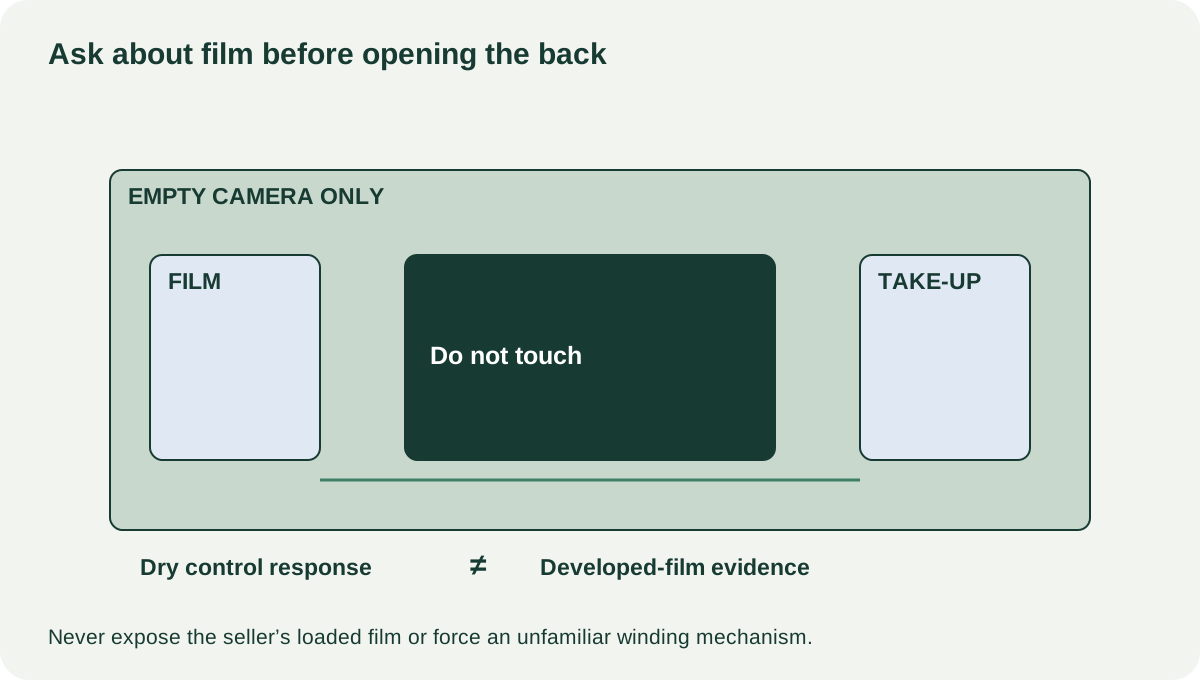
Ask before opening the back. The seller may have personal photographs on a loaded roll. Do not expose it to inspect the shutter or pressure plate. Agree whether inspection can wait until the owner finishes or safely removes the film using the correct procedure.
With the camera empty and handled according to its manual, inspect accessible door seals, hinge areas, battery compartment and film path visually. Look for deteriorated foam, corrosion, damaged latches or obvious impact marks. Do not touch shutter curtains, mirrors or internal optical surfaces, and do not scrape seals during pickup.
Check the lens separately for supported fit and ordinary focus/aperture operation. A physically attached lens does not establish every metering or automatic function. For interchangeable backs or magazines, include their exact identity and operation in the inventory; one working back does not clear another.
 Enlarge diagram
Use dry operation for the questions it can answer
Have the seller demonstrate normal winding, release, rewind controls and relevant settings using the matching manual. Do not force an advance lever or repeatedly fire a mechanism that binds. Some functions depend on film, battery, lens or another condition; check those prerequisites before calling the camera broken.
Listen for grossly inconsistent behaviour and observe whether controls respond, but do not claim to measure shutter-speed accuracy by ear. A meter changing with light shows some response; it does not establish accurate calibration across the range. A clean viewfinder does not prove the image plane or shutter is sound.
Try supported electronic functions with the correct power source. Do not substitute a battery solely because it fits physically, particularly where the model’s metering depends on a specified supply. If the correct modern replacement route is unclear, obtain qualified advice before assigning a simple battery cost.
| Evidence level | What it contributes | What remains uncertain |
|---|---|---|
| Exterior and accessible inspection | Visible condition, seals, controls and corrosion | Hidden mechanical and optical faults |
| Normal dry cycle | Some control and mechanism response | Accurate timing and film travel under load |
| Meter observation | Response under those conditions | Exposure calibration |
| Recent developed test roll | Results for that camera, film and conditions | Every mode, future reliability and untested settings |
| Qualified service assessment | Measured findings and repair scope | Only what that assessment actually covers |
Ask for film evidence that can be connected to the camera
Recent negatives or scans from a documented test roll can add useful evidence. Ask which camera, lens, film and approximate conditions produced them, and whether any repair occurred afterward. A beautiful image alone can conceal defects elsewhere in the roll or extensive editing.
Look for consistency across frames, spacing problems, repeated marks, unexplained bands or light leaks. These observations still need interpretation: film handling, processing, lens and camera can all contribute. A competent film-camera technician can assess the cause more reliably than a casual buyer guessing from a compressed image.
If a test roll is essential, arrange a suitable inspection or trial period and agree film, processing and return terms before purchase. It usually cannot be completed during a short meetup. Do not describe an untested camera as film-tested because the seller says it worked years ago.
Compare the first reliable photographs, not just the body price
A hypothetical body is $90, with a compatible $55 lens, $20 power/accessory requirement and an assessed $120 service: $285 before film, processing and collection. A $250 serviced package with credible recent results may be better. These numbers are illustrative; service feasibility and parts availability must come from the relevant specialist.
Separate a known seal replacement from an undiagnosed shutter or transport fault. Do not apply a generic small service allowance to every old camera. If the model has no practical repair route, decide whether you are knowingly buying a project or display object rather than a ready-to-shoot tool.
Buy when the evidence level matches your intended use and price. Negotiate confirmed accessory or maintenance needs with actual quotes. Pause for forced mechanisms, unresolved corrosion or an expensive attribution claim without specialist support. Remove or protect film as the owner and manual require, pack the camera carefully, and keep the test and service record with it.