Used trumpets: valves, slides and playable condition
Quick answer
Confirm the exact trumpet and the player’s requirements, inspect accessible dents, joints and valve action, and have an experienced player demonstrate ordinary response with a suitable clean mouthpiece. Do not force a stuck slide or mouthpiece. Separate cosmetic wear from technician-assessed mechanical or structural issues before comparing complete playable costs.
Confirm the instrument before the finish
Ask a teacher or experienced player which type and model characteristics suit the intended use. A beginner’s first instrument, a specialised trumpet and a collectible vintage horn are different purchases. Record the exact model and any disclosed replacement leadpipe, bell, valves or other parts.
Request photos of the whole instrument, valve area, slides, bell and case. Ask about service history, sticking valves, stuck slides, drops and repairs. A shiny finish is not a functional test, and worn lacquer does not automatically mean poor playability. A premium for rare provenance or originality needs specialist evidence beyond a model stamp or serial.
Inspect without turning a small problem into damage
Have the seller or an experienced player handle the instrument. Look for obvious dents, distorted tubing, loose braces, cracked solder joints and corrosion. Pay attention to areas affecting assembly and normal movement, while avoiding the assumption that every visible dent has the same consequence.
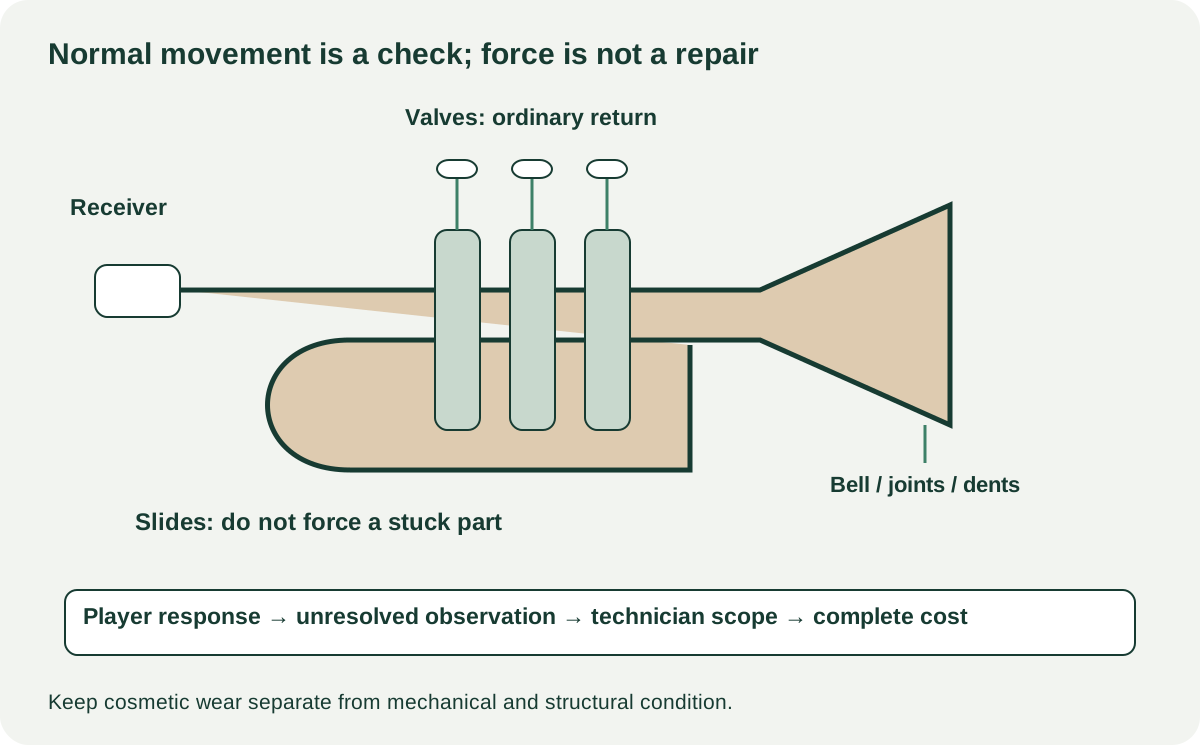
Try normal valve movement only as the seller and manual allow. Note whether a valve returns consistently or sticks. Let the experienced person demonstrate ordinary slide movement, but do not force a stuck slide or mouthpiece. Do not use pliers, twisting pressure or improvised leverage during pickup. A technician can assess removal and the underlying cause without sacrificing the instrument to the inspection.
Yamaha’s trumpet manual distinguishes valve and slide care, including different materials and procedures for different parts. That supports using the correct instructions rather than treating all moving parts alike. Yamaha’s service information also places relevant repair work with instrument specialists.
 Enlarge diagram
Arrange a clean mouthpiece and a useful player test
Agree a suitable clean mouthpiece setup with the experienced player. The mouthpiece in the case may not suit the buyer and should not be shared without appropriate cleaning. Check the case, valve caps, buttons and other included accessories against the actual model.
Ask the player to demonstrate ordinary notes, transitions and dynamics appropriate to the intended use, rather than only a loud or impressive passage. Note response, persistent sticking, unusual rattles and any concern about tuning or mechanical action. The player’s technique and mouthpiece matter, so their report should distinguish a suitability concern from a suspected instrument fault.
A beginner may struggle on a sound instrument and an experienced player may compensate for a difficult one. For a first purchase, the teacher’s judgment of whether the student can use it comfortably is more useful than the seller’s performance alone. A short test does not establish valve compression, hidden corrosion or full service condition.
| Observation | Next question | Purchasing consequence |
|---|---|---|
| Valve returns inconsistently | Routine maintenance, alignment, wear or damage? | Technician assessment if unresolved |
| Slide or mouthpiece stuck | What removal and repair are needed? | Do not force; get a quote |
| Visible dent or loose joint | Does it affect function or structural integrity? | Price assessed work, not appearance alone |
| Response difficulty | Player/setup issue or instrument condition? | Experienced-player test plus technician where needed |
| Finish wear only, ordinary function acceptable | Does appearance matter to this buyer? | Potential cosmetic negotiation |
Obtain a repair scope that matches the concern
Ask the technician what they found, what work is necessary for the intended use, what remains uncertain and whether parts are available. A generic cleaning price is not a quote for valve damage or extensive dent work. If the seller claims a repair is trivial, ask for the appropriate work to be completed and the instrument demonstrated again.
For an expensive or collectible trumpet, ask about originality and previous repairs separately from playability. A good playing instrument can contain replacement parts, while an original instrument can need significant service. Do not collapse those two valuations into one condition adjective.
Compare complete outfits and a realistic start date
A hypothetical trumpet costs $160, with an assessed $130 service, a suitable $55 mouthpiece and $35 case: $380 before collection. A $350 outfit that the teacher approves and a technician finds ready to use may be better value. These are illustrative inputs; get actual local quotes and do not assume every repair fits a standard allowance.
Also consider timing. If the student needs an instrument next week and a specialist part is on back order, a repair candidate may not meet the purpose even at a lower eventual cost. Confirm the service schedule before promising the instrument for a lesson or performance.
Buy when the instrument suits the player, ordinary response is demonstrated and any necessary service is understood. Negotiate known cosmetic or accessory gaps. Pass or wait when mechanical and structural concerns remain unresolved. Pack it in a suitable case without loading pressure onto the valves or bell, and retain the technician’s findings rather than relying on the listing’s “excellent condition” description.
Sources
- 01Yamaha trumpet owner manual
- 02Yamaha brass and woodwind service