Used saxophones: response, keywork and a technician’s quote
Quick answer
Choose the saxophone type and model for the player’s needs, inspect the body, neck and keywork without bending or adjusting anything, and arrange an experienced-player demonstration with a suitable clean mouthpiece setup. Visible pads and a few easy notes do not prove the instrument seals or responds throughout its range. Price technician-assessed service and the complete playing outfit.
Start with the player’s actual requirement
Confirm the saxophone type and suitability with a teacher or experienced player before comparing finishes and brand names. A student may need a different instrument from an experienced player seeking a particular vintage model. Record the full model, serial privately where relevant, included neck and any disclosed replacement parts.
Ask for photographs of the whole body, bell, neck, keywork, case and accessories. Request repair history, the date and scope of the last service and any known difficult notes or sticking keys. A seller describing a saxophone as “recently serviced” should be able to say what work occurred. New-looking pads in a few places do not establish the adjustment of the whole instrument.
If a premium depends on originality, a rare finish or provenance, obtain specialist evidence. Serial information can help identify an instrument but does not by itself authenticate every component or prove ownership. Judge a student purchase primarily by fit, serviceable condition and the complete playing cost.
Inspect the neck and body as a connected system
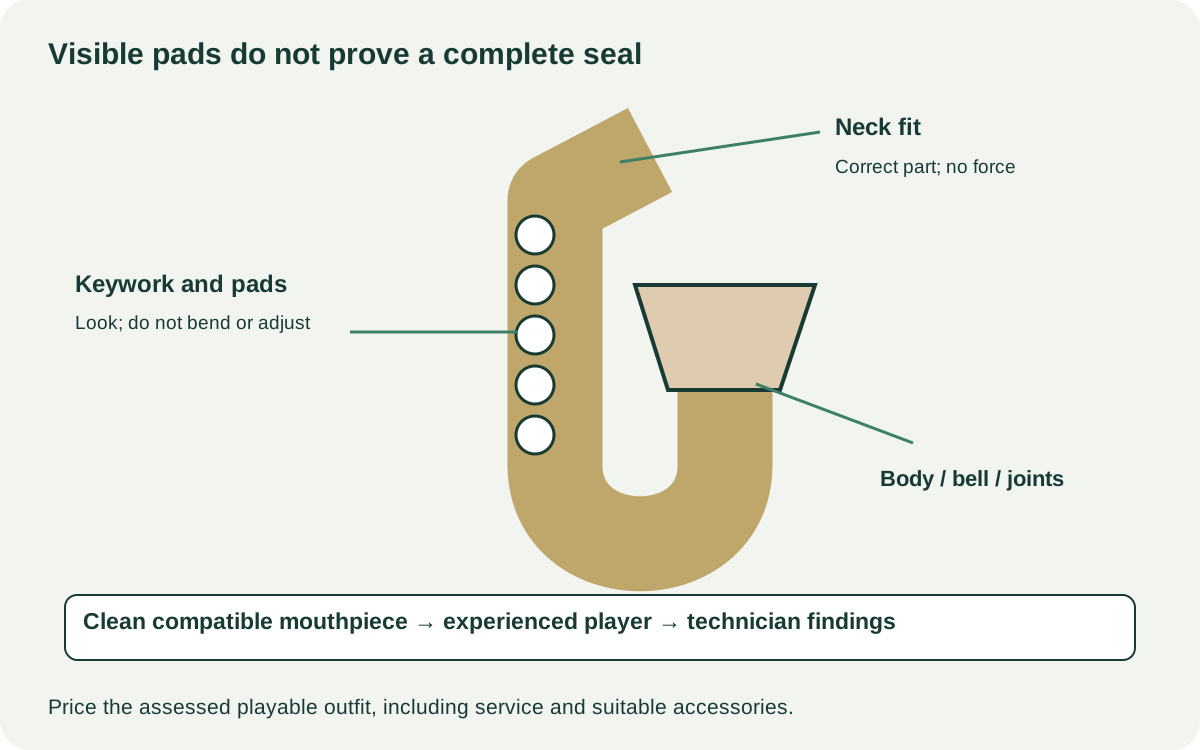
Have the seller or experienced player assemble the instrument normally. Check that the neck is the correct intended part and fits as documented without force. Look for obvious dents, distortion, cracked soldered joints, corrosion and signs of impact around the body and key guards.
Inspect accessible pads and key movement visually, but do not bend rods, turn adjustment screws or insert improvised leak-testing objects. A pad can look intact yet fail to seal correctly. Conversely, tarnish or worn lacquer does not by itself establish poor playing function.
Yamaha’s saxophone manual distinguishes ordinary assembly and care from the delicate key and pad areas. Its brass and woodwind service information identifies specialist maintenance and repair work. Use the relevant maker’s instructions for the actual instrument and a qualified technician for sealing, alignment or structural questions.
 Enlarge diagram
Arrange a clean, compatible playing setup
Agree who will play and what mouthpiece, ligature and reed will be used. An experienced player bringing a familiar, clean and compatible setup can reduce one source of uncertainty. Follow the maker’s hygiene and care guidance; do not share an unclean mouthpiece or reed simply because it came in the case.
Check the neck strap or harness, case and other accessories for suitability. The presence of a mouthpiece is not proof it suits the player or the instrument. A beginner should not be expected to diagnose a saxophone by trying unfamiliar equipment without help.
| Outfit component | Record |
|---|---|
| Body and neck | Exact model and disclosed substitutions |
| Mouthpiece setup | Compatible mouthpiece, ligature, cap and suitable reed |
| Support | Appropriate strap or harness |
| Case | Secure fit and working closures |
| Service | Technician findings, work required and quote |
Ask the player to demonstrate response, not just a tune
Use an ordinary range of notes and dynamics appropriate to the instrument and player. Ask the experienced player to note persistent resistance, uneven response, sticking keys or difficult transitions. A short attractive melody using easy notes leaves other areas untested.
Listen without pretending that a phone recording or one player can isolate every cause. Mouthpiece, reed, technique and adjustment all affect the result. The player can identify a concern and judge suitability; a technician can assess leaks, key alignment and repair needs with the right tools.
If the seller says a difficult note is “just the reed,” try an appropriate known setup where practical. If the issue remains, keep it unresolved. Do not price an unknown leak as one cheap pad, or assume a dent is harmless because the instrument makes some sound.
A costly instrument or one with obvious service uncertainty deserves an agreed technician inspection before payment or suitable written trial terms. If the seller cannot accommodate either and you need a reliable student instrument, choose a candidate with stronger service evidence.
Compare playable cost and repair scope
Suppose a hypothetical saxophone is $300, with a technician-assessed $220 service, $80 for the player’s suitable mouthpiece setup and $20 collection: $620. A $580 serviced alternative may be better if its exact condition and outfit are suitable. Those numbers are examples, not market values or a promise that a service will cost a certain amount.
Ask whether a quote covers only adjustment or includes identified pads, corks, dent work or other parts. A general service price cannot be assumed to cover every hidden structural problem. Confirm availability when a repair depends on a model-specific neck, key or other component.
Buy when the player finds the instrument suitable, required response is demonstrated and any necessary work is assessed at a total you accept. Negotiate bounded consumables or missing accessories. Pause for unassessed structural damage, extensive uncertain keywork or a valuable originality claim without evidence. Transport it in a properly fitting case without pressure on the keys, and keep the service findings with the purchase record.
Sources
- 01Yamaha saxophone owner manual
- 02Yamaha brass and woodwind service