How to buy used vinyl records by pressing and condition
Quick answer
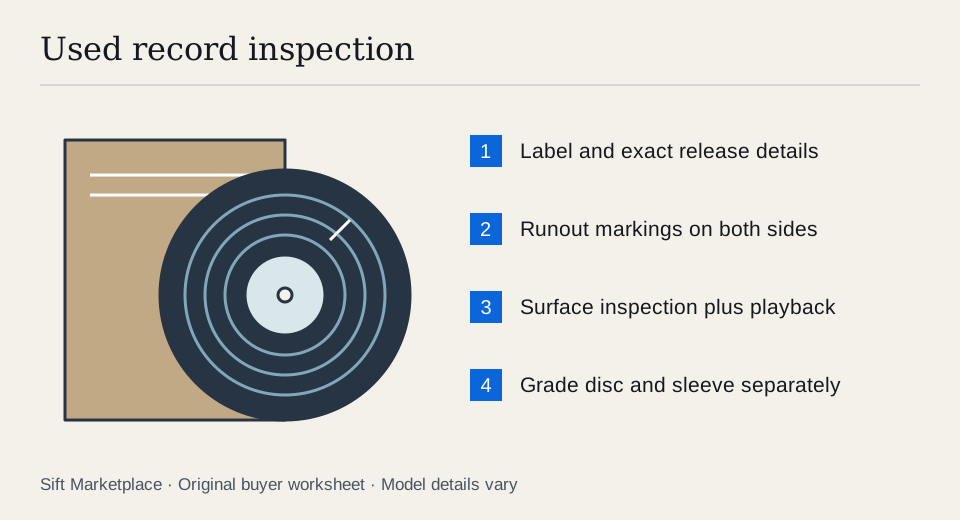
Match the record’s label, catalogue number and runout markings to the release you are pricing. Inspect both sides under angled light and play important or suspicious passages where possible. Grade the disc and sleeve separately. For a collection, value the records you want and can verify rather than multiplying the total count by the price of its best album.
Identify the record, not just the album cover
The same album can exist in many countries, editions, speeds, colours and reissues. Start with the artist, title, label and catalogue number, then compare the disc itself with the sleeve. A correct sleeve can contain the wrong record, and a multi-record set can be incomplete.
Check the writing or stamping in the smooth runout area near the label. Discogs’ identifier guidance describes matrix/runout information as markings commonly found there. Use those details with the rest of the release information; a partial match is not proof of a valuable edition.
Ask for clear photographs of both labels and relevant identifiers before travelling for an expensive record. Do not assume a barcode alone settles the pressing, or that an early copyright date means an early physical copy. If identification remains uncertain, compare it as an uncertain copy rather than paying the premium associated with a claimed rarity.
 Enlarge diagram
For a multiple-disc edition, make one line per disc and side. Confirm that the catalogue information, labels and runouts belong together, then count required discs and inserts. A first disc in excellent condition cannot establish that a second disc is present or belongs to the same issue. Photograph identifiers only with permission and avoid posting the seller’s personal details alongside them.
Suppose the sleeve and first record appear to match the advertised edition, while the second record carries a different catalogue number. Pause the premium comparison until the mismatch is explained. You may still want a playable mixed set at a price that suits you, but it is a different purchase from a complete identified edition.
Handle it in a way that preserves the evidence
Wash and dry your hands, then hold the record by the outer edge and label area. The Library of Congress care guidance recommends keeping fingers off the playing surface, storing discs upright and avoiding damaging environmental conditions. Those basics apply during inspection as well as after purchase.
Ask permission before taking a disc from its sleeve. Keep the opening clear so you do not drag the surface across grit or a torn edge. Use bright angled light and slowly rotate the record. Inspect both faces, the edge and the centre hole without rubbing a scratch with a fingernail.
Look for cracks, obvious warping, scratches crossing grooves, dull worn areas and contamination. Surface appearance helps select what to test, but it does not precisely predict playback. A glossy record can have groove wear, while some light marks may be less audible than they look.
Separate visual grading from a listening test
Discogs uses the Goldmine grading standard, with distinct meanings for grades such as Near Mint, Very Good Plus, Very Good and Good. Its guidance treats audible wear and surface noise as relevant. A seller using “mint” casually may mean something different, so ask how the grade was assigned.
Keep the media grade and sleeve grade separate. A lovely cover does not repair a noisy disc; a worn cover may be acceptable when you mainly want a clean playing copy. Record missing inserts, writing, seam splits and water damage explicitly rather than compressing everything into one flattering adjective.
For a useful play test:
- Use a properly set up player. An unknown worn stylus or incorrect tracking setup makes the result hard to interpret. See the turntable checklist.
- Listen to the lead-in and a quiet passage. Note surface noise and repeated clicks without expecting silence from every used record.
- Play across visible marks. Check whether they produce a click, distortion, skip or repeating groove. Do not force the stylus through a damaged section.
- Check nearer the end of each side. A first-song sample does not establish the condition of the entire side.
- Watch for warp-related movement. Observe from the side without touching the spinning record or arm.
- State the test’s limits. A few sampled passages are sampled passages, not a full-side play grade.
Do not buy a dirty or noisy disc on a guarantee that cleaning will restore it. If the seller wants the price of a cleaned, play-graded record, ask them to complete that work and demonstrate the result first.
Price the exact copy, with realistic condition
Compare the same release and similar media and sleeve condition. Separate sold evidence from ambitious asking prices, and include shipping or buyer charges when comparing online options with local pickup. The fair-price guide explains how to keep those comparisons consistent.
For an expensive pressing, request enough time to identify and inspect it properly. If you cannot verify authenticity or the specific variant, an experienced record shop’s assessment may be worth more than a quick private-sale discount. Do not let a seller’s claim that another buyer is waiting replace identification.
| Field | Your note |
|---|---|
| Release | Label, catalogue number, country and format |
| Identifiers | Runout details from both sides |
| Disc condition | Visible marks, warp and listening observations |
| Sleeve condition | Seams, writing, water damage and inserts |
| Test scope | Full sides or named sample passages |
| Comparison | Similar-condition sold examples, not just title matches |
Evaluate collections from the bottom as well as the top
Ask for a list or photographs that cover the whole collection. Inspect records from different parts of each box, not only the attractive titles placed at the front. Count duplicates, empty sleeves and records you do not want. A collection’s large total does not establish its useful value to you.
An illustrative 40-record lot at $120 is $3 per record only if all 40 are useful. If you want ten and the rest have no value to you, your effective cost is $12 per wanted record before cleaning or replacement sleeves. That arithmetic is a decision aid, not a resale estimate.
For a larger lot, agree on an inspection sample that you select from several boxes, including records below the top layer. Record how many sleeves you opened, which titles you listened to and which defects recur. Sampling can reveal a storage or grading concern; it cannot certify every uninspected disc. If the price depends on a handful of valuable titles, identify and assess those individually rather than extrapolating from a convenient ordinary copy.
Count the work as well as the records: clean replacement sleeves, suitable storage space, carrying weight and time to sort duplicates. If you would pass on an ordinary copy with a skip, placing it inside a cheap lot does not make it useful. Decide the maximum lot price from the copies you actually want and the uncertainty you accept, without relying on unverified resale proceeds from the rest.
Transport records upright with support so they do not bend or slide, and keep them out of a hot parked vehicle. Sift, a free Facebook Marketplace filter and scam checker that also works on Kijiji, helps focus artist and title searches on Chrome on a computer. Use listing-word filters and recorded prices to find collections worth listening through.
Questions people ask
Does an old copyright date prove an original pressing?
No. Reissues can carry earlier copyright dates. Compare the label, catalogue number, country, format and runout information with the exact release. Do not pay an original-pressing premium on the date alone.
Does Good mean a used record is in good condition?
In formal record grading, Good is a specific worn condition rather than everyday praise. Discogs’ grading guidance allows substantial surface noise at that grade. Ask which grading standard was used and whether the record was play-tested.
Can cleaning fix every noisy used record?
No. Cleaning may remove contamination, but it does not reverse groove wear, cracks or every scratch. Price a record on its observed and heard condition, not a guaranteed improvement after cleaning.
Sources
- 01Library of Congress Care, handling and storage of audiovisual materials
- 02Discogs How to grade items
- 03Discogs Database identifiers and matrix/runout information