How to buy a used turntable without guessing at the stylus
Quick answer
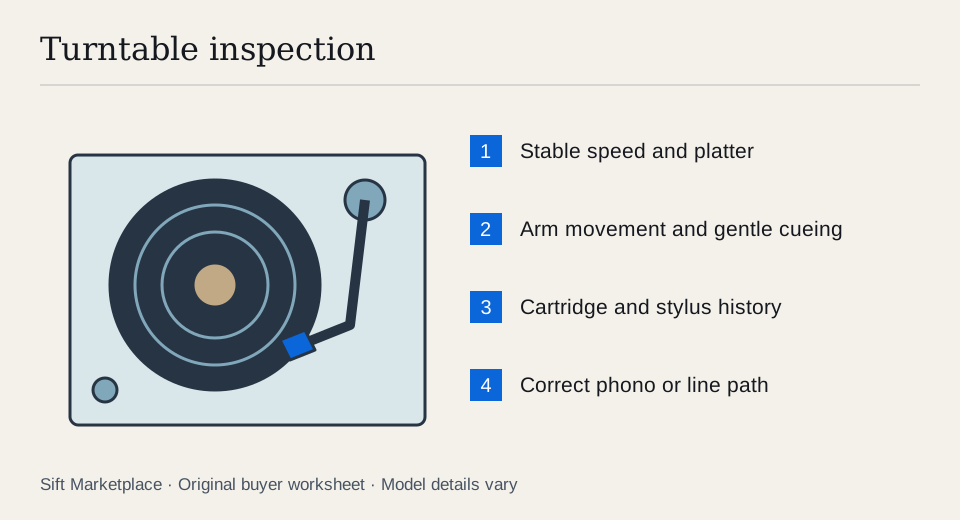
Check the exact turntable and cartridge, test stable playback at every speed you need and inspect the tonearm, cueing and automatic functions. Match its phono or line output to your amplifier or powered speakers. If stylus history is uncertain, budget for a compatible replacement. A spinning platter alone does not prove the turntable can play records correctly.
Map the audio path before shopping
A record player needs more than a rotating platter. Identify whether the turntable has a built-in phono preamp, whether your amplifier has a suitable phono input and whether the speakers are powered or passive. Each part must fit the next.
The Audio-Technica AT-LP5 manual distinguishes phono and line settings and includes troubleshooting for mismatched inputs and tracking force. Use that as a model-specific example, then check the manual for your actual candidate. Very quiet or distorted playback can be a connection problem, but the correct setup must be demonstrated before the purchase.
Ask for the turntable model, cartridge model, included stylus, power supply and accessories. If a cartridge was changed, its setup and replacement stylus may differ from the original specification. Do not order parts based only on the turntable name.
Write one complete route for the system you already own: cartridge → appropriate phono stage → line-level input/amplification → speakers. Identify where the phono stage sits and whether a turntable’s switch enables or bypasses it. If your speakers require an amplifier, an RCA cable alone does not fill that role. The speaker guide helps distinguish passive, powered and connected products.
For example, a turntable with a suitable built-in phono stage can feed a compatible powered speaker’s line input. A model without that stage needs an appropriate external stage or an amplifier’s suitable phono input. Price that exact arrangement before comparing the two listings. Avoid buying a second preamp merely because another seller includes one.
 Enlarge diagram
Inspect the delicate parts without handling the tip
Look at the tonearm from several angles. Check for a bent tube, loose headshell connection or missing counterweight. Inspect the cartridge body and cantilever without touching the stylus. A clearly bent or missing tip is a fault; an apparently straight one does not prove it is unworn.
Ask when the stylus was fitted and whether there is a receipt or part number. “Barely used” is not a measurable wear history. If history is uncertain, include a compatible new stylus in your budget before playing valuable records at home.
Check the dust-cover hinges, feet, switches and cables. A cracked cover is generally a different decision from a damaged arm bearing. A missing proprietary power supply or counterweight can make a low asking price misleading, so establish replacement availability before travelling.
Use a familiar record and a stable surface
Bring an ordinary clean record you know well and are comfortable using for a test. Avoid valuable pressings while the stylus and setup are uncertain. Have the seller place the turntable on a level stable surface, with the appropriate amplifier or speakers connected.
- Start each required speed. Observe startup and watch the platter edge for obvious wobble. Use a suitable strobe method where the model provides one; do not treat an uncalibrated phone reading as definitive.
- Operate the cueing lever. Check that the arm lifts clear and lowers under control. It should not simply drop onto the record.
- Play the outer section of a side. Listen for stable pitch, both channels and excessive hum. Keep volume moderate so acoustic feedback does not confuse the test.
- Listen nearer the inner section. Check for obvious distortion and skipping with correct setup. Repeated problems need investigation rather than extra weight on the arm.
- Try automatic functions. If the model offers start, return or repeat, demonstrate them with the correct record size and settings.
- Check the output path. Confirm the actual phono or line setting and appropriate input. Test USB recording or Bluetooth only if those features matter and are supported.
- Restart and recheck. A belt that slips, intermittent motor or sticky control may be easier to notice during an ordinary second start than continuous playback.
Ask the seller to follow the cartridge’s tracking-force and anti-skate instructions rather than using a guessed universal setting. If you are unfamiliar with adjustment, a knowledgeable shop’s inspection may be worth more than a discount on an uncertain setup.
Separate setup faults from repair projects
| Symptom | Sensible next check |
|---|---|
| Very quiet playback | Phono preamp and input matching |
| Loud distorted output | Output switch and input stage matching |
| One channel missing | Cable, cartridge connections and another input |
| Hum | Grounding arrangement and cable condition per manual |
| Skipping | Record condition and proper cartridge setup |
| Pitch wandering | Stable speed test and drive-system assessment |
| Arm sticks or drifts abruptly | Setup and possible bearing or mechanism fault |
Do not promise a cheap belt or stylus will solve a fault you have not isolated. A turntable that cannot complete a normal record side without trouble should be priced as unresolved, even if the plinth is beautiful.
Keep the record and test setup in the notes. If both candidates are compared using different records, cartridges, amplifiers and volume levels, a difference in sound cannot be assigned to their drive mechanisms alone. For condition checks, the useful observations are repeatable pitch behaviour, tracking with correct setup, working channels, controlled cueing and the functions you need.
Suppose the first passage plays cleanly but the arm repeatedly sticks near the same position on two suitable test records. That is unresolved despite the clean opening. If the same skip occurs at one damaged groove on only one record, the disc is a separate suspect. Ask the seller to resolve the cause through normal documented setup; do not let extra tracking weight stand in for a repair demonstration. Agree on enough time to test a meaningful portion of playback before travelling.
Compare the complete cost and plan the move
Include a suitable stylus, phono preamp if needed, correct cables and a missing power supply. A cartridge upgrade only has value to you if it is compatible, healthy and set up properly. Compare the exact model and condition using the fair-price guide.
An illustrative $120 turntable plus a $60 replacement stylus and $45 preamp totals $225 before collection. A $200 complete alternative may cost less to start using, though its own stylus history still needs checking. These numbers illustrate a budget, not current prices. Record your actual components in the cost calculator.
Follow the manufacturer’s transport instructions. Secure the arm in its rest, protect the stylus and remove or secure the platter and counterweight where instructed. Do not carry the turntable with loose heavy components bouncing against the arm. Keep the dust cover from bearing the load of other items.
Sift, a free Facebook Marketplace filter and scam checker that also works on Kijiji, helps narrow searches on Chrome on a computer. Use model and exclusion words and follow recorded prices while you arrange a listening test. Pair the purchase with the used-record checklist so both the player and what you put on it are worth keeping.
Questions people ask
Can a used turntable connect directly to powered speakers?
It depends on the available phono preamp and speaker input. A turntable’s line output can feed a suitable line input; a phono-level output needs appropriate phono amplification first. Check the exact equipment and switch settings.
Can I judge stylus wear by looking at it?
A normal visual check can reveal a missing tip or bent cantilever, but it does not reliably establish remaining stylus life. Ask for replacement history and budget for a compatible replacement if it is uncertain.
Should I put a coin on a tonearm that skips?
No. Use the cartridge’s specified tracking force and the turntable’s setup instructions. A coin hides an unresolved setup or hardware problem and can apply inappropriate force to the record.
Sources
- 01Audio-Technica AT-LP5 user manual