Build a secondhand stereo system that works together
Quick answer
Choose a complete source, amplifier and speaker path before buying individual bargains. Verify exact inputs, outputs and model requirements, then include missing cables, setup and collection in the comparison.
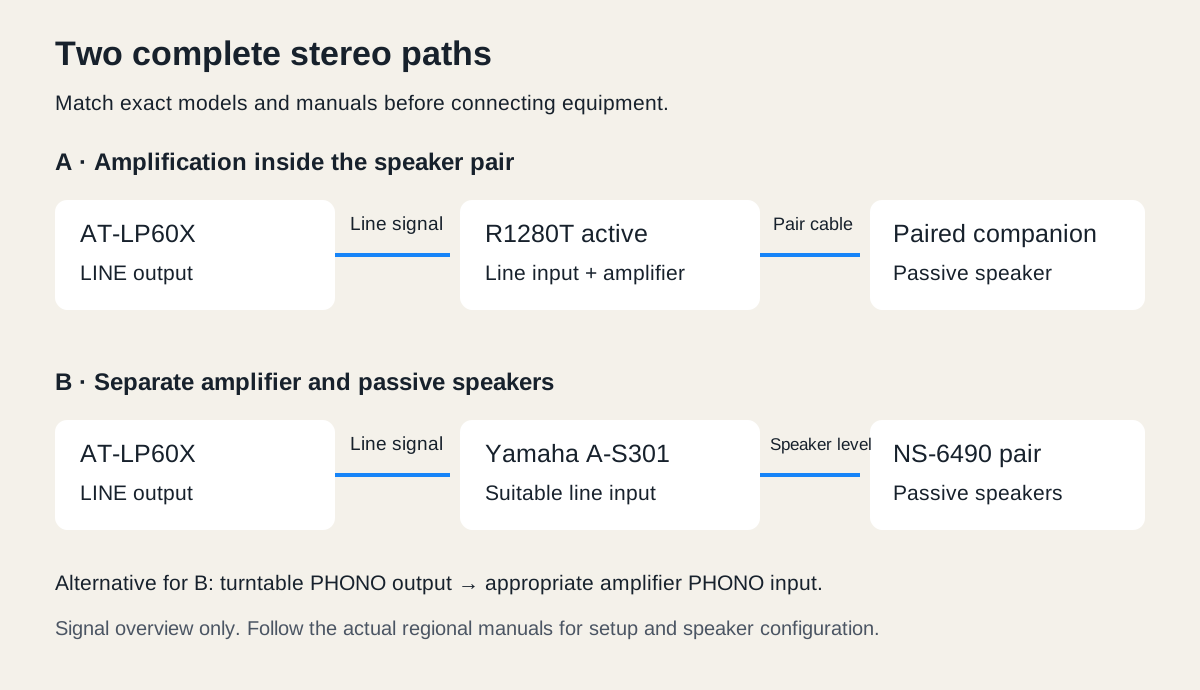 Enlarge diagram
Choose the listening job and the room
A secondhand stereo needs a source, amplification and speakers. Those functions may be combined in fewer boxes. Start with what you will play, where you will listen and the space available for the equipment. A small system for records at a desk is a different project from a living-room system that must also accept television sound.
List the source’s actual output and the next component’s actual input. “Audio out,” “Bluetooth” and “RCA” are not interchangeable descriptions of a complete connection. A socket shape alone does not establish the signal type. Photograph model labels and rear panels with permission, then check the exact manuals before buying the missing pieces.
The examples below are ordinary two-channel consumer systems. They are not instructions for internal repair, mains wiring or modifying equipment. Damaged power cables, unexplained overheating or unidentified imported electrical equipment require resolution before a listening test.
Compare two complete architectures
Option A: turntable plus an active speaker pair. An Audio-Technica AT-LP60X can provide a line-level output to the line input of an Edifier R1280T pair. The Edifier set contains one active speaker and its passive companion; the matching pair and its connecting cable are part of the purchase. It is not two independent powered speakers. A separate power amplifier is unnecessary for this arrangement.
The AT-LP60X manual distinguishes its LINE output for a line/AUX input from its PHONO setting for an appropriate phono input. The R1280T manual identifies the paired speakers and normal source connections. Match the exact versions; a similar-looking model name does not establish Bluetooth or other features.
Option B: source plus amplifier plus passive speakers. A Yamaha A-S301 and one suitable pair of passive speakers separate amplification from the speaker cabinets. As a named example, the US NS-6490 specification lists an eight-ohm nominal impedance. Check the labels and regional manuals for the actual units, and follow the amplifier’s requirements for the selected speaker configuration. The relevant sources are the A-S301 manual and US NS-6490 specifications.
For the same AT-LP60X source, choose one documented route: LINE to a suitable amplifier line input, or PHONO to the appropriate phono input. Do not combine the two stages by guesswork. The amplifier then supplies the passive speakers through its speaker outputs. An amplifier’s speaker output is not a line input for powered speakers.
Count the whole basket
These figures are hypothetical planning inputs. They are not observed prices or a claim that either system will sound better.
| Purchase | Active-speaker example | Amplifier/passive-speaker example |
|---|---|---|
| AT-LP60X with required power supply | 100 | 100 |
| Complete R1280T pair | 85 | 0 |
| A-S301 amplifier | 0 | 200 |
| Complete NS-6490 pair | 0 | 80 |
| Required cables missing from offers | 15 | 25 |
| Collection | 20 | 35 |
| Known setup/service allowance | 40 | 40 |
| Total | 260 | 480 |
The $40 line is a budget allowance, not a diagnosis or guarantee that all repairs cost that amount. Get an actual assessment for an uncertain turntable or amplifier; if the quote is $90, replace the allowance with $90. Do not count an unidentified fault as a cheap stylus replacement.
Option B costs $220 more in this example and needs space for another box. The buyer chooses it only if its inputs, controls or future component flexibility serve a real need. Option A remains the simpler fit for the stated two-component brief. If the buyer already has a usable source, remove the turntable and its costs from both baskets rather than buying records equipment merely because it is included in a bundle.
Use listing comparison for the complete candidates, with missing cables and known work included in the cost fields. Use its notes for the signal route and unresolved questions. A low total does not establish compatibility.
Ask for the demonstration you will actually use
Send a short inventory and test request: “Does this include both matching speakers, their interconnecting cable and the listed source cable? Can we hear both channels using this input at an ordinary listening level? Please confirm the exact model on the rear label.” For the separate-amplifier option, ask which speakers and source will be used in the demonstration.
A seller may demonstrate an amplifier through a different input from the one you need. That proves less than a test of your intended chain. Agree the relevant input and controls in advance, and bring only appropriate known equipment if the seller agrees. Follow the manuals for connection and power sequencing. Do not improvise adapters or open cabinets to chase a fault during collection.
For condition detail, use the speaker guide, turntable guide and, where relevant, receiver guide. Keep the system comparison focused on whether the pieces work together and fit your room.
Resolve failures before adding components
If only one speaker of the Edifier pair is present, it is not the complete $85 system in the table. Confirm a correct replacement and its cost, or reject the offer. If a turntable plays very quietly, do not assume that buying another amplifier will solve it; first establish whether the documented source/input route is correct, then have unresolved condition questions assessed.
If the passive speakers have unreadable labels, the named compatibility check cannot be completed. If the amplifier overheats or shows damage, stop the demonstration and get qualified advice. No price adjustment turns an unresolved safety issue into a normal setup task.
At home, plan stable positions, the manufacturer’s ventilation clearance and cable routes before assembly. Test the agreed source, both channels and ordinary controls before adding further devices. Keep the model list and manuals with the purchase record. The next upgrade should solve a limitation you have heard or encountered in this system, rather than create another unverified connection.