Buy secondhand items for a community project
Quick answer
Agree the venue requirements, approval authority and acceptance evidence before shopping. Apply the same checks to donations, and keep received items out of service until their required checks and setup are complete.
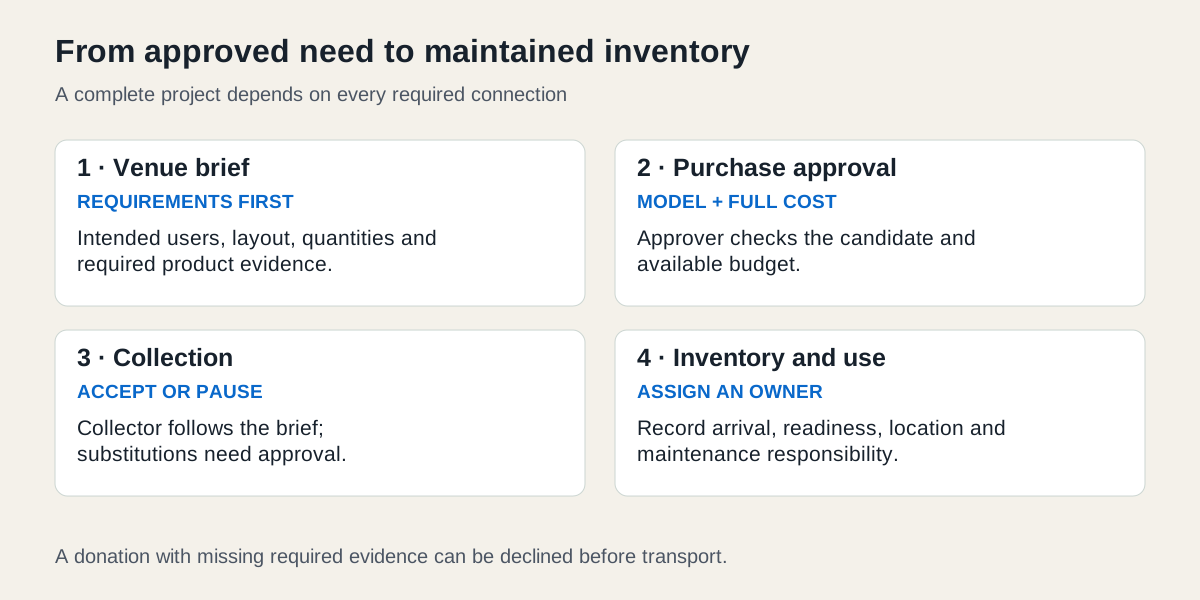 Enlarge diagram
Turn the project into an approved shopping brief
A donated desk can be expensive if it blocks an agreed route, needs work nobody can approve or leaves the group responsible for disposal. Before volunteers search, ask the venue and project lead to define the intended use, people served, layout, evidence required and who can accept each item.
The example here is a fictional community reading room in an existing venue. It needs a small set of movable furniture and storage, with no construction work included in the purchasing plan. Its approval conditions are invented planning assumptions, not a statement of legal standards or evidence that residential furniture is suitable for public use.
Local requirements can depend on the building, organisation and work being done. For example, Ontario’s public-spaces guidance distinguishes requirements by organisation and the creation or redevelopment of particular spaces. Ask the responsible venue contact or qualified adviser which rules apply to your project. Do not infer that a used chair, a clear-looking aisle or a completed shopping checklist establishes compliance.
A filled reading-room brief
The fictional group agrees to buy only items on a venue-approved list. The venue supplies the permitted layout and required product evidence; volunteers do not choose substitute accessibility dimensions themselves. People who will use the room are consulted about the proposed furniture before the buyer commits.
| Need | Quantity and acceptance condition in this example | Approval owner |
|---|---|---|
| Reading chairs | Six; stable, cleanable, appropriate to the approved use and documented requirements | Venue facilities contact approves model; two users review a sample |
| Shared table | One; fits the agreed layout and supports the required accessible use | Venue contact approves dimensions and product evidence |
| Book storage | Two units; capacity, placement and any required installation resolved | Facilities contact and named installer, if needed |
| Portable accessories | Two document holders and a small supply box | Project lead within the approved allowance |
| Cleaning and maintenance | Materials and schedule suitable for accepted items | Named volunteer coordinator with venue guidance |
A listing marked “office furniture” does not satisfy this brief by itself. Obtain model information, condition evidence and the documents the venue actually requires. If a shelf needs anchoring, that requirement belongs in the installation plan and approval, not in an informal promise that a volunteer can do it later.
Identify the product, obtain its instructions and check CPSC recalls in the US or the relevant local authority elsewhere. A free donation deserves the same acceptance review as a purchase. When an item cannot be identified, the group may be unable to complete those checks or establish the required suitability.
Allocate money before authorising collection
The group has a hypothetical $1,200 project allocation. These are example allowances, not supplier prices.
| Allocation | Amount |
|---|---|
| Six approved chairs | $240 |
| One approved table | $180 |
| Two approved storage units | $180 |
| Collection and delivery | $180 |
| Necessary installation/assessment allowance | $140 |
| Cleaning and small supplies | $80 |
| Uncommitted reserve | $200 |
| Total | $1,200 |
The project lead can approve spending within the agreed lines only after the venue clears the product. Moving money between lines requires the group’s stated approval process. If actual installation quotes exceed $140, revise the plan before collection; the allowance does not guarantee a contractor will accept the job.
A donor offers two upholstered chairs at no charge. The venue’s fictional brief requires material and suitability evidence that the donor cannot supply. The group declines before arranging transport. “Free” would otherwise mean using part of the $180 delivery allocation and possibly paying to remove items the venue will not accept.
A second seller offers six approved-model chairs for $210, but inspection finds only five acceptable. Buying a matching replacement at an illustrative $55 makes the chair total $265, above the $240 line. The collector cannot silently use the reserve. They send the evidence to the project lead, who can approve a revised budget, choose a different set or postpone.
Give collectors authority they can use
One person communicates with each seller, one person approves the purchase, and one person records payment. These may be the same person in a small group, but the responsibilities should be explicit. Send the collector the item identity, approved quantity, maximum total, required checks, seller agreement and conditions that require stopping.
A usable instruction reads: “Accept six chairs of the approved model only if all six meet the attached condition checklist. Maximum item payment $240. Do not accept substitutes or incomplete quantities without approval. If the approver cannot be reached, leave the transaction pending.” It does not require sharing someone else’s bank login or personal documents.
Arrange access with the venue before booking collection. Confirm the delivery window, unloading help, storage location and who will inspect arrival. The pickup planner can organise the handover information; it does not book a mover or approve an installation. Compare candidate totals in listing comparison, retaining the evidence-based acceptance notes outside the price ranking.
Accept into an inventory, then into service
Assign a simple inventory identifier, such as RR-CHAIR-01 through RR-CHAIR-06. Record description, model, quantity, source, amount paid or donation status, observed condition, approval, location and maintenance owner. Store relevant manuals and purchase records where the group can access them without exposing volunteers’ private account information.
Arrival and readiness are separate statuses. “Received, awaiting installation approval” is more useful than marking a shelf complete because it is inside the building. Hold items out of use until the required cleaning, checks and installation are complete. Record who accepted them into service and what remains unresolved.
Finally, agree who handles faults, recalls, storage changes and eventual disposal. The group should know whom to tell if a chair becomes unstable or a shelf is moved. A manageable project finishes with usable approved items and clear responsibility, not merely a collection of successful pickups.