Buy used equipment that needs installation: quote the whole job
Quick answer
Identify the exact model and obtain the matching installation instructions before purchase. Have the appropriate qualified provider confirm site suitability, required parts, removal, installation and completion checks. Budget the whole job and assign each responsibility. A delivered item is not necessarily an installable or ready-to-use item.
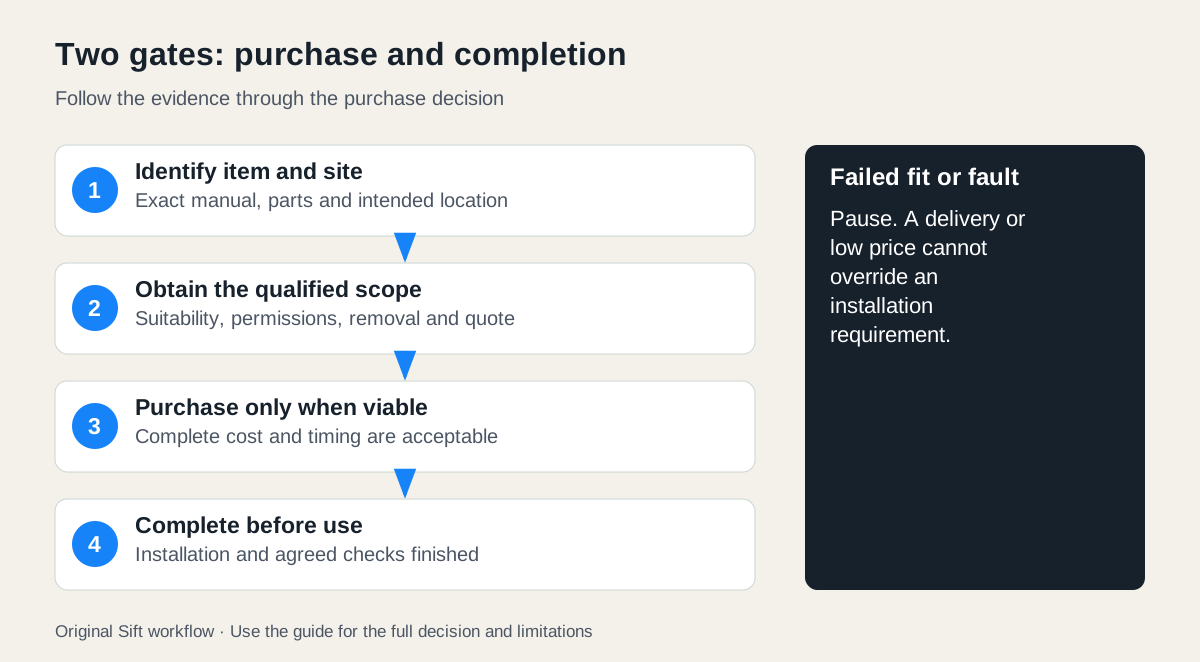 Enlarge diagram
Buy the installed result, not just the object
A used dishwasher, wall-mounted display or other fixed equipment must suit both its own instructions and the destination. The seller can describe the object; they may not know whether your services, structure, access or permissions are suitable.
Obtain the exact model, regional version and relevant installation manual. Ask whether any mounting brackets, supports, templates, proprietary connections or other required parts are included. A photograph of the front is not enough to price the installation.
Manufacturer instructions can explicitly require qualified work. For example, this Bosch dishwasher installation manual is addressed to qualified installers and requires applicable electrical and plumbing codes to be met. Match the manual to the actual model; do not copy its dimensions or connection details onto another dishwasher.
Give the installer a usable brief before purchase
Provide the item identity, accessible photographs, intended location, existing equipment details and your required completion date. Ask what they can assess remotely and what requires a site visit. Do not remove covers, disconnect services or expose wiring to obtain evidence yourself.
| Stage | Question |
|---|---|
| Suitability | Does this exact model suit the site and intended use? |
| Permissions | What owner/building approvals and local permits or licences apply? |
| Seller removal | Who safely disconnects and releases the used item? |
| Transport | Who handles the item and follows its transport requirements? |
| Destination work | What parts, labour and site changes are included? |
| Completion | What ordinary commissioning checks and documentation are provided? |
| Failure branch | What is charged if the item cannot be installed or has a fault? |
Licensing and permit requirements depend on the work and locality. Confirm them through the relevant authority and qualified provider. This guide does not supply gas, plumbing, electrical or structural installation procedures.
Appliance example: the cheap unit changes the site cost
In a fictional dishwasher case, the item is $180. Seller-side professional removal is $70, transport $80, installation $160 and identified required parts $60: $550 before any additional site work or applicable charges not already included.
The installer then finds that a necessary site change is outside the quote and would add an illustrative $220. The revised total is $770. A different compatible option priced at $650 installed may now be worth considering, provided its scope and condition are comparable.
The buyer does not remove the old appliance first to force a decision. They resolve the new unit’s suitability, timing and quote before making the home dependent on it. If the seller cannot allow the relevant condition assessment before disconnection, that uncertainty belongs in the purchase decision.
Wall-mounted example: include the support system
A used display may be fully functional but arrive without the correct stand or mount parts. Record the display model, weight and mounting requirements, then have the appropriate installer assess the wall and proposed support system. The mount’s model, completeness and suitability matter independently of the display.
Do not infer that bolts included in the seller’s bag are correct for your display or wall. Do not reuse unknown fixings or improvise a structural attachment because the listing was inexpensive. If the approved complete mounting arrangement cannot be established, use a suitable confirmed alternative or pass.
In a hypothetical quote, a $150 display plus $90 complete compatible mount and $140 assessed installation totals $380. A $220 display with an appropriate included stand might better suit a buyer who does not need wall mounting. Compare the result you actually want, including permission and room layout.
Distinguish inspection, transport and installation
A delivery driver may not be the installer. An installer may not diagnose every internal fault in a used appliance. A product inspection may not assess the destination services. Assign each question explicitly rather than assuming one provider covers the whole chain.
Use the independent-inspection workflow when condition needs specialist assessment. Use seller delivery or the no-car transport guide for the agreed handover. Keep the item and site records together.
Set a purchase gate and a completion gate
The purchase gate is satisfied when the item is sufficiently identified and assessed, the site is suitable, required parts and services are obtainable, and the complete cost and schedule work. A promise to “sort the fittings later” leaves that gate open.
The completion gate occurs after the item has arrived, the qualified work is complete and the agreed checks have been performed. Do not use equipment that requires installation before that stage. Retain invoices, model-specific instructions and any required completion record.
If the installer discovers a fault or failed fit, pause the job and use the agreed scope for next steps. Do not pressure them to bypass a requirement to avoid another visit. Preserve relevant condition evidence before repairs if there is a purchase dispute.
In the used buying cost calculator, enter purchase, transport, known service work, missing parts and other installation-related costs once. Keep uncertain site work visible as an unresolved decision or separate scenario. The bargain is meaningful only when the installed result is achievable.